AD
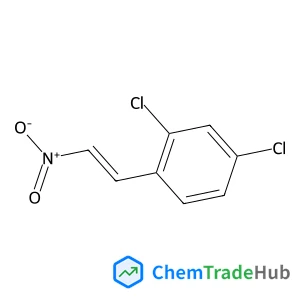
2,4-Dichloro-1-(2-nitrovinyl)benzene(CAS: 18984-21-9)
CAS Number
Related Products

(2R)-1,2-Dimethylpiperazine
CAS Number: 623586-02-7
![(2S)-4-Hydroxy-7-(hydroxymethyl)-2-(2-hydroxy-2-propanyl)-2,3-dihydro-5H-furo[3,2-g]chromen-5-one](https://static.chemtradehub.com/structs/496/49624-66-0-7116.webp)

O~15~-Heptanoylretinol
CAS Number: 88641-44-5
![1-Methoxy-2-[1-(4-methoxyphenyl)propyl]benzene](https://static.chemtradehub.com/structs/334/33451-22-8-2ef2.webp)
CAS Number: 1350524-27-4

Other Suppliers for 2,4-Dichloro-1-(2-nitrovinyl)benzene



Basic Information
Molecular Formula
C8H5Cl2NO2
Molecular Weight
218.03 g/mol
Physical Properties
Melting Point
115-119 °C (lit.)
Chemical Identifiers
SMILES
C1=CC(=C(C=C1Cl)Cl)C=C[N+](=O)[O-]
InChIKey
LIWIJBBAMBDXME-ONEGZZNKSA-N
Database References
MDL Number
MFCD00053063
FAQ
2,4-Dichloro-1-(2-nitrovinyl)benzene (CAS: 18984-21-9) is a crystalline compound with a molecular weight of approximately 287.03 g/mol. It is slightly soluble in water but soluble in common organic solvents like ethanol and acetone. The compound is known for its reactivity towards nucleophiles and electrophiles, making it useful in various synthetic applications. It is stable under normal laboratory conditions but should be handled with care due to its chemical reactivity.
2,4-Dichloro-1-(2-nitrovinyl)benzene (CAS: 18984-21-9) is typically synthesized through a multi-step process involving the nitration of 2,4-dichlorobenzene followed by the vinyl chloride addition. The process often requires the use of a catalyst and involves careful control of reaction conditions to achieve high selectivity and yield. Detailed procedures are typically found in organic chemistry literature and can be adapted for laboratory-scale production.
2,4-Dichloro-1-(2-nitrovinyl)benzene (CAS: 18984-21-9) is used in various industries, including pharmaceuticals, where it serves as a precursor for drug intermediates. It is also utilized in the synthesis of polymers and sensors due to its chemical reactivity. Additionally, it has applications in the semiconductor industry, where it can be used in the development of specific materials for electronic devices.
When handling 2,4-Dichloro-1-(2-nitrovinyl)benzene (CAS: 18984-21-9), it is crucial to follow standard laboratory safety protocols. Use appropriate personal protective equipment (PPE) such as gloves, safety goggles, and a lab coat. Work in a well-ventilated area or a fume hood to minimize exposure to vapors. Spills should be cleaned up immediately using appropriate absorbent materials, and the area should be flushed with water. Always refer to the Material Safety Data Sheet (MSDS) for detailed safety information and emergency procedures.
Safety Notice
Please verify product specifications and safety data before use. Contact the supplier for detailed safety information.
Always follow proper handling procedures