



AD
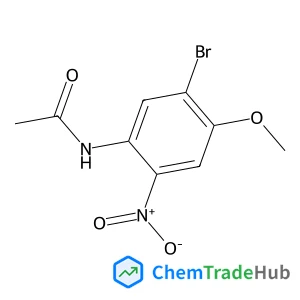
4-Acetamido-2-bromo-5-nitroanisole(CAS: 7357-66-6)
CAS Number
Related Products
methyl}benzamide](https://static.chemtradehub.com/structs/224/2247491-97-8-c197.webp)
![4-Amino-2-({[(2-methyl-2-propanyl)oxy]carbonyl}amino)butanoic acid](https://static.chemtradehub.com/structs/289/2899-79-8-863a.webp)
![2-Methyl-2-propanyl 7-(4,4,5,5-tetramethyl-1,3,2-dioxaborolan-2-yl)-2-azaspiro[4.4]nonane-2-carboxylate](https://static.chemtradehub.com/structs/230/2304631-27-2-21b7.webp)
![Methyl 3-(4-{3-[3-(trifluoromethyl)phenyl]-1H-pyrazol-5-yl}-1-piperidinyl)propanoate](https://static.chemtradehub.com/structs/103/1030386-15-2-7851.webp)
Other Suppliers for 4-Acetamido-2-bromo-5-nitroanisole





Basic Information
Molecular Formula
C9H9BrN2O4
Molecular Weight
289.08 g/mol
Physical Properties
Melting Point
171-173 ºC
Density
1.656
Chemical Identifiers
SMILES
CC(=O)NC1=CC(=C(C=C1[N+](=O)[O-])OC)Br
InChIKey
WFVRYIASUVEKMY-UHFFFAOYSA-N
Database References
MDL Number
MFCD16618927
FAQ
4-Acetamido-2-bromo-5-nitroanisole (CAS: 7357-66-6) is a crystalline compound with a molecular weight of 298.01 g/mol. It has a low solubility in water but is more soluble in organic solvents like ethanol and dichloromethane. This compound is known for its reactivity in nucleophilic aromatic substitution reactions due to the presence of a bromine atom and nitro group. It also exhibits good stability under neutral and slightly acidic conditions, but can be sensitive to strong bases and reducing agents.
4-Acetamido-2-bromo-5-nitroanisole (CAS: 7357-66-6) can be synthesized through a multi-step process that involves the bromination of anisole followed by nitration and acetylation. The bromination step typically uses N-bromosuccinimide (NBS) in the presence of a peroxide initiator. Nitration is performed using fuming nitric acid and sulfuric acid. The acetylation is achieved using acetic anhydride or acetyl chloride in the presence of a catalyst. These reactions require precise control of conditions to achieve high yield and selectivity.
4-Acetamido-2-bromo-5-nitroanisole (CAS: 7357-66-6) is primarily used in the pharmaceutical industry as an intermediate for the synthesis of various drug candidates. It also finds applications in the polymer industry for the development of novel materials with specific chemical functionalities. Additionally, this compound can be utilized in sensor technology for detecting certain chemical species and in semiconductor manufacturing as a dopant material.
When handling 4-Acetamido-2-bromo-5-nitroanisole (CAS: 7357-66-6), it is essential to wear appropriate personal protective equipment (PPE) such as gloves, goggles, and a lab coat. This compound should be used in a well-ventilated fume hood to prevent inhalation of fumes. In case of a spill, it should be cleaned up immediately with appropriate absorbent materials. Handling should be done with care to avoid skin contact and ingestion. Always refer to the Safety Data Sheet (SDS) for detailed information on safe handling and disposal procedures.
Safety Notice
Please verify product specifications and safety data before use. Contact the supplier for detailed safety information.
Always follow proper handling procedures
Contact Information
Contact Person
Manager Gu
sales@gh-reagent.com
Mobile
18939883912
Telephone
021-34536277
Visit Website
https://www.gh-reagent.com/Address
No. 91, Building 2, Block 537, Sanada Road, Minhang District, Pujiang Town, Shanghai