



AD
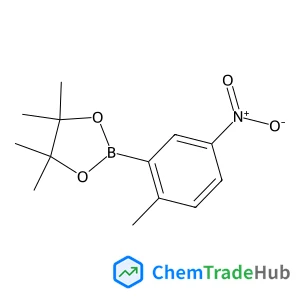
4,4,5,5-Tetramethyl-2-(2-methyl-5-nitrophenyl)-1,3,2-dioxaborolane(CAS: 957062-84-9)
CAS Number
Related Products
amino}butanoic acid](https://static.chemtradehub.com/structs/221/221124-57-8-c784.webp)
![1-Cyclopropyl-8-methyl-7-[5-methyl-6-(methylamino)-3-pyridinyl]-4-oxo-1,4-dihydro-3-quinolinecarboxylic acid](https://static.chemtradehub.com/structs/245/245765-41-7-85ad.webp)
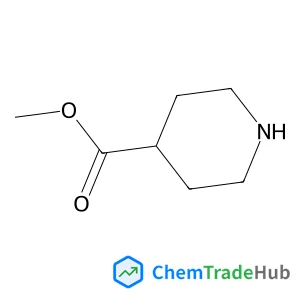
Methyl 4-piperidinecarboxylate
CAS Number: 2971-79-1

4,5-Pyridazinedicarboxylic acid
CAS Number: 59648-14-5
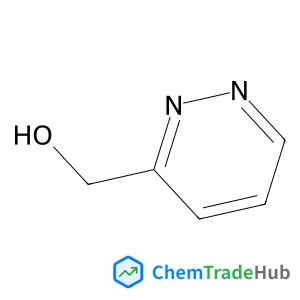
pyridazin-3-ylmethanol
CAS Number: 37444-46-5
![N-[4-(Trifluoromethoxy)phenyl]acetamide](https://static.chemtradehub.com/structs/173/1737-06-0-69aa.webp)
N-[4-(Trifluoromethoxy)phenyl]acetamide
CAS Number: 1737-06-0
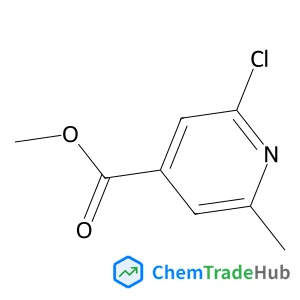
Methyl 2-chloro-6-methylisonicotinate
CAS Number: 3998-90-1

2-Fluoro-5-iodophenol
CAS Number: 186589-89-9
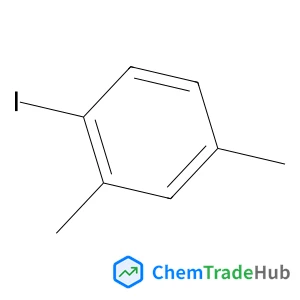
1-Iodo-2,4-dimethylbenzene
CAS Number: 4214-28-2
Other Suppliers for 4,4,5,5-Tetramethyl-2-(2-methyl-5-nitrophenyl)-1,3,2-dioxaborolane






Basic Information
Molecular Formula
C13H18BNO4
Molecular Weight
263.1 g/mol
Physical Properties
Boiling Point
378.9℃ at 760 mmHg
Flash Point
182.9℃
Chemical Identifiers
SMILES
B1(OC(C(O1)(C)C)(C)C)C2=C(C=CC(=C2)[N+](=O)[O-])C
InChIKey
LYFUUPOOXAXEEP-UHFFFAOYSA-N
Database References
MDL Number
MFCD09027081
FAQ
4,4,5,5-Tetramethyl-2-(2-methyl-5-nitrophenyl)-1,3,2-dioxaborolane is a solid with a crystalline form. It has a molecular weight of approximately 330.06 g/mol. This compound is slightly soluble in common organic solvents like dichloromethane and toluene. It is moderately reactive, particularly towards electron-rich substrates in Suzuki coupling reactions.
4,4,5,5-Tetramethyl-2-(2-methyl-5-nitrophenyl)-1,3,2-dioxaborolane is synthesized through a multistep process that begins with the nitration of a phenylboronic acid derivative, followed by a coupling reaction under microwave-assisted conditions. This method ensures high yield and selectivity, often employing palladium catalysts and base additives.
4,4,5,5-Tetramethyl-2-(2-methyl-5-nitrophenyl)-1,3,2-dioxaborolane is primarily used in the pharmaceutical and polymer industries. It plays a crucial role in the synthesis of drug intermediates and as a monomer in the development of new polymers with unique properties. Additionally, it finds applications in the electronics industry for the production of semiconductors and sensors.
When handling 4,4,5,5-Tetramethyl-2-(2-methyl-5-nitrophenyl)-1,3,2-dioxaborolane, it is essential to use appropriate personal protective equipment (PPE), including gloves, goggles, and a laboratory coat. Work should be conducted in a fume hood to minimize inhalation risks. Spills should be cleaned up immediately using appropriate absorbents, and the area should be well-ventilated. Refer to the Safety Data Sheet (SDS) for detailed handling and storage guidelines.
Safety Notice
Please verify product specifications and safety data before use. Contact the supplier for detailed safety information.
Always follow proper handling procedures

Contact Information
3007522982@qq.com
Mobile
18117592386
Telephone
021-57481218
Fax
无
Visit Website
https://www.acmec-e.com