



AD
(2-Acetamidophenyl)boronic acid(CAS: 169760-16-1)
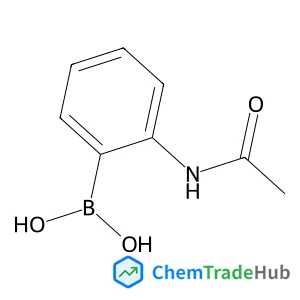
CAS Number
Related Products
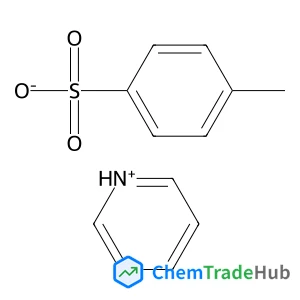
Pyridinium 4-methylbenzenesulfonate
CAS Number: 24057-28-1
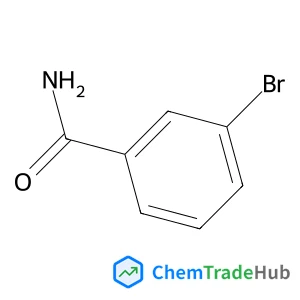
3-Bromobenzamide
CAS Number: 22726-00-7
![2-[(2Z)-4-{[4-(1-Piperidinylmethyl)-2-pyridinyl]oxy}-2-buten-1-yl]-1H-isoindole-1,3(2H)-dione (2Z)-2-butenedioate (1:1)](https://static.chemtradehub.com/structs/146/146447-26-9-a8ab.webp)
![(4S)-4-({3-[2-(Dimethylamino)ethyl]-1H-indol-5-yl}methyl)-1,3-oxazolidin-2-one](https://static.chemtradehub.com/structs/139/139264-17-8-3758.webp)
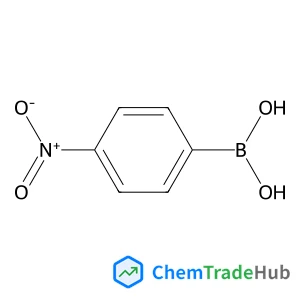
(4-Nitrophenyl)boronic acid
CAS Number: 24067-17-2
![(3-{[(2-Methyl-2-propanyl)oxy]carbonyl}phenyl)boronic acid](https://static.chemtradehub.com/structs/220/220210-56-0-5baa.webp)
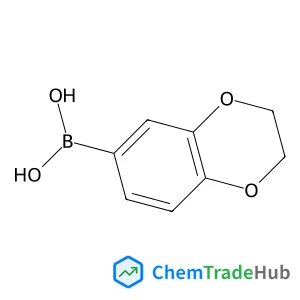
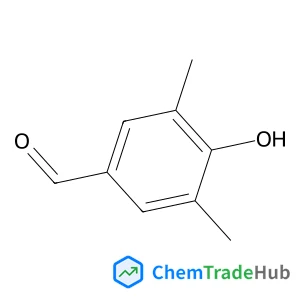
4-Hydroxy-3,5-dimethylbenzaldehyde
CAS Number: 2233-18-3
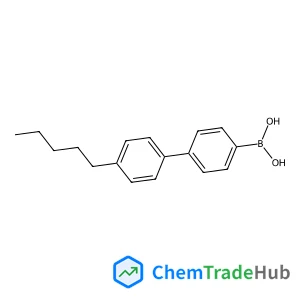
(4'-Pentyl-4-biphenylyl)boronic acid
CAS Number: 121554-18-5
Other Suppliers for (2-Acetamidophenyl)boronic acid





Basic Information
Molecular Formula
C8H10BNO3
Molecular Weight
178.98 g/mol
Physical Properties
Melting Point
>300 °C
Boiling Point
°Cat760mmHg
Density
1.23
Flash Point
°C
Chemical Identifiers
SMILES
B(C1=CC=CC=C1NC(=O)C)(O)O
InChIKey
UMOPBIVXPOETPG-UHFFFAOYSA-N
Database References
MDL Number
MFCD02179474
FAQ
What are the physical and chemical properties of (2-Acetamidophenyl)boronic acid (CAS: 169760-16-1)?
(2-Acetamidophenyl)boronic acid is a white crystalline solid with a molecular weight of approximately 235.21 g/mol. It has a low solubility in water but is more soluble in organic solvents like ethanol. This compound is relatively unreactive but can undergo condensation reactions under certain conditions. Its pKa is around 6.9, indicating a weak basic character.
(2-Acetamidophenyl)boronic acid can be synthesized through the reaction of 2-acetamidophenol with boron tribromide followed by hydrolysis. Alternatively, it can be prepared via the Suzuki coupling reaction of 2-acetamidophenylboronic ester with a suitable coupling partner. The yield is typically high, and the method is known for its good selectivity.
(2-Acetamidophenyl)boronic acid is primarily used in pharmaceuticals for the synthesis of various compounds, including drugs. It also finds applications in the production of polymers and as a reagent in organic synthesis. Additionally, it is utilized in sensors and semiconductors due to its unique chemical properties.
When handling (2-Acetamidophenyl)boronic acid, it is important to wear appropriate personal protective equipment (PPE), such as gloves, goggles, and a lab coat. Work should be conducted in a well-ventilated area or fume hood to minimize inhalation risks. Spills should be cleaned up immediately with appropriate absorbent materials, and proper disposal methods should be followed. Always refer to the safety data sheet (SDS) for detailed handling and storage information.
Safety Notice
Please verify product specifications and safety data before use. Contact the supplier for detailed safety information.
Always follow proper handling procedures
Contact Information
pingan@candiapharm.com