



AD
2-Chloro-6-fluorobenzaldehyde(CAS: 387-45-1)
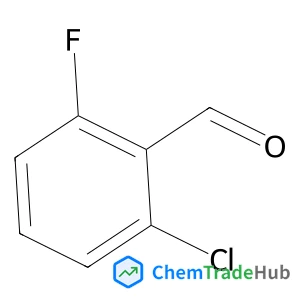
CAS Number
Related Products
![[3-(2-Hydroxyethyl)phenyl]boronic acid](https://static.chemtradehub.com/structs/647/647853-32-5-c363.webp)
![N-(Butylsulfonyl)-O-[4-(4-piperidinyl)butyl]-L-tyrosine hydrochloride hydrate](https://static.chemtradehub.com/structs/150/150915-40-5-1679.webp)
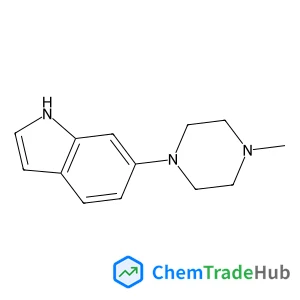
6-(4-methylpiperazin-1-yl)-1H-indole
CAS Number: 321745-04-4
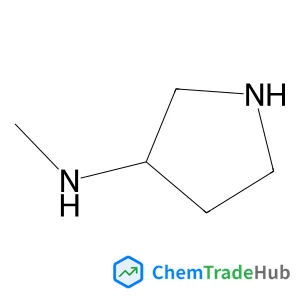
N-Methyl-3-pyrrolidinamine
CAS Number: 83030-08-4
![2-Chloro-N-[4-chloro-3-(2-pyridinyl)phenyl]-4-(methylsulfonyl)benzamide](https://static.chemtradehub.com/structs/879/879085-55-9-5abe.webp)
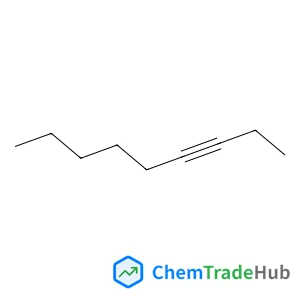
3-Nonyne
CAS Number: 20184-89-8
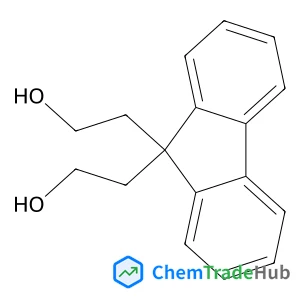
2,2'-(9H-fluorene-9,9-diyl)diethanol
CAS Number: 203070-78-4
![1,4-Dioxaspiro[4.5]dec-8-ylacetic acid](https://static.chemtradehub.com/structs/134/134136-04-2-8def.webp)
Other Suppliers for 2-Chloro-6-fluorobenzaldehyde




Basic Information
Molecular Formula
C7H4ClFO
Molecular Weight
158.56 g/mol
Physical Properties
Melting Point
35.0 to 39.0 deg-C
Boiling Point
92 ºC (10 mmHg)
Chemical Identifiers
SMILES
C1=CC(=C(C(=C1)Cl)C=O)F
InChIKey
OACPOWYLLGHGCR-UHFFFAOYSA-N
Database References
MDL Number
MFCD00003306
Beilstein Registry Number
2245530
FAQ
2-Chloro-6-fluorobenzaldehyde (CAS: 387-45-1) is a crystalline solid with a molecular weight of approximately 199.01 g/mol. It has a low solubility in water (less than 1 g/L at 20°C) but is more soluble in common organic solvents like ethanol and acetone. The compound is moderately reactive, typically undergoing nucleophilic substitution reactions. It is insoluble in nonpolar solvents such as hexane or toluene.
2-Chloro-6-fluorobenzaldehyde (CAS: 387-45-1) can be synthesized by electrophilic chlorination of 6-fluorobenzenecarbaldehyde. Commonly, this involves treating 6-fluorobenzenecarbaldehyde with thionyl chloride in the presence of a suitable catalyst, such as aluminum chloride, to achieve high selectivity and yield. The reaction is typically performed under reflux conditions in anhydrous conditions to minimize side reactions.
2-Chloro-6-fluorobenzaldehyde (CAS: 387-45-1) is primarily used in the pharmaceutical industry for the synthesis of various organic compounds and intermediates. It also finds applications in the production of resin and polymer compounds, and in the development of sensors and semiconductors due to its unique chemical reactivity and functional groups.
When handling 2-Chloro-6-fluorobenzaldehyde (CAS: 387-45-1), it is essential to use appropriate personal protective equipment (PPE), including gloves, goggles, and a lab coat. The compound should be handled in a well-ventilated area or within a fume hood to minimize exposure to vapors. Spills should be cleaned up immediately using appropriate absorbents, and the area should be well-ventilated before resuming work. Always refer to the Safety Data Sheet (SDS) for detailed handling and disposal instructions.
Safety Notice
Please verify product specifications and safety data before use. Contact the supplier for detailed safety information.
Always follow proper handling procedures

Contact Information
Contact Person
Miss Xu
1986399151@qq.com
Mobile
15221998634
Telephone
021-59178156
Visit Website
https://www.yingxinbio.com/Address
Yugang Town Yiling Road 258 Lane C Zone