



AD
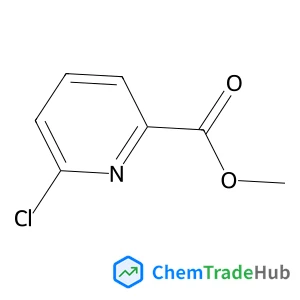
Methyl 6-chloro-2-pyridinecarboxylate(CAS: 6636-55-1)
CAS Number
Related Products
methyl}benzamide](https://static.chemtradehub.com/structs/224/2247491-97-8-c197.webp)
![4-Amino-2-({[(2-methyl-2-propanyl)oxy]carbonyl}amino)butanoic acid](https://static.chemtradehub.com/structs/289/2899-79-8-863a.webp)
![2-Methyl-2-propanyl 7-(4,4,5,5-tetramethyl-1,3,2-dioxaborolan-2-yl)-2-azaspiro[4.4]nonane-2-carboxylate](https://static.chemtradehub.com/structs/230/2304631-27-2-21b7.webp)
![Methyl 3-(4-{3-[3-(trifluoromethyl)phenyl]-1H-pyrazol-5-yl}-1-piperidinyl)propanoate](https://static.chemtradehub.com/structs/103/1030386-15-2-7851.webp)
Other Suppliers for Methyl 6-chloro-2-pyridinecarboxylate





Basic Information
Molecular Formula
C7H6ClNO2
Molecular Weight
171.58 g/mol
Physical State
White to Yellow Solid
Physical Properties
Melting Point
93.0 to 97.0 deg-C
Boiling Point
275.832°C at 760 mmHg
Density
1.295
Flash Point
120.619℃
Water Solubility
Slightly soluble in water.
Chemical Identifiers
SMILES
COC(=O)C1=NC(=CC=C1)Cl
InChIKey
TWUXBVMXSBEKHA-UHFFFAOYSA-N
Database References
MDL Number
MFCD00155391
Beilstein Registry Number
128580
FAQ
Methyl 6-chloro-2-pyridinecarboxylate (CAS: 6636-55-1) is a white crystalline solid. It has a molecular weight of approximately 161.02 g/mol. The compound is slightly soluble in water and more soluble in organic solvents such as ethanol and acetone. It is relatively stable under normal conditions but can react with strong bases to form pyridine derivatives. Its reactivity is typical of carboxylic acid derivatives.
Methyl 6-chloro-2-pyridinecarboxylate (CAS: 6636-55-1) is typically synthesized via a Grignard reaction or a Friedel-Crafts acylation. In a Grignard reaction, 2-chloropyridine is reacted with methyl magnesium bromide to form the Grignard reagent, which is then reacted with acetyl chloride to give the desired product. In a Friedel-Crafts acylation, 2-chloropyridine is acylated using acetyl chloride in the presence of a Lewis acid like aluminum chloride.
Methyl 6-chloro-2-pyridinecarboxylate (CAS: 6636-55-1) is used in various industries, including pharmaceuticals and fine chemicals. It serves as a valuable intermediate in the synthesis of other compounds, particularly in the development of new drugs and agrochemicals. Its use in polymer synthesis and as a precursor in the production of functional materials is also noted.
Methyl 6-chloro-2-pyridinecarboxylate (CAS: 6636-55-1) should be handled with caution due to its potential for skin and eye irritation. Use appropriate personal protective equipment (PPE), such as gloves, goggles, and a lab coat. Work in a well-ventilated area or a fume hood to minimize exposure. Store in a cool, dry place away from sources of heat and ignition. In case of spill, neutralize with an appropriate agent and dispose of according to local regulations. Always refer to the Safety Data Sheet (SDS) for specific handling and disposal instructions.
Safety Notice
Please verify product specifications and safety data before use. Contact the supplier for detailed safety information.
Always follow proper handling procedures
Contact Information
Contact Person
Manager Gu
sales@gh-reagent.com
Mobile
18939883912
Telephone
021-34536277
Visit Website
https://www.gh-reagent.com/Address
No. 91, Building 2, Block 537, Sanada Road, Minhang District, Pujiang Town, Shanghai