



AD
Azithromycin EP Impurity J(CAS: 117693-41-1)
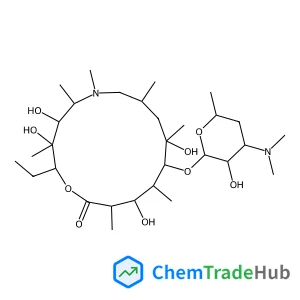
CAS Number
Related Products
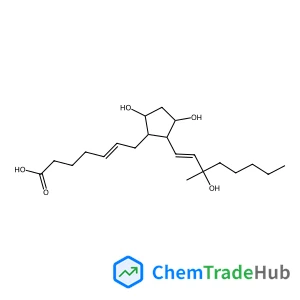
15(R)-15-METHYL PROSTAGLANDIN F2ALPHA
CAS Number: 35864-81-4
![Ethyl (1S,5S,6S)-5-(3-pentanyloxy)-7-oxabicyclo[4.1.0]hept-3-ene-3-carboxylate](https://static.chemtradehub.com/structs/241/2413185-88-1-7b79.webp)
![4-[1-(4-Sulfamoylphenyl)-3-(trifluoromethyl)-1H-pyrazol-5-yl]benzoic acid](https://static.chemtradehub.com/structs/170/170571-01-4-1016.webp)
![N-{(2S)-2-[(4-Morpholinylacetyl)amino]-4-phenylbutanoyl}-L-leucyl-N-{(2S)-4-methyl-1-[(2R)-2-methyl-2-oxiranyl]-1-oxo-2-pentanyl}-L-phenylalaninamide](https://static.chemtradehub.com/structs/868/868540-17-4-ac55.webp)
![1-[5-(2-Fluorophenyl)-1-(3-pyridinylsulfonyl)-1H-pyrrol-3-yl]-N-methylmethanamine (2E)-2-butenedioate (1:1)](https://static.chemtradehub.com/structs/126/1260141-27-2-8c10.webp)
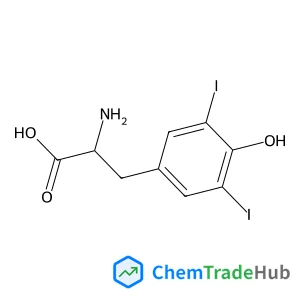
3,5-Diiodo-L-tyrosine
CAS Number: 300-39-0
![Disodium 2'-deoxy-5'-O-[hydroxy({[(hydroxyphosphinato)oxy]phosphinato}oxy)phosphoryl]uridine](https://static.chemtradehub.com/structs/102/102814-08-4-13b1.webp)
Other Suppliers for Azithromycin EP Impurity J



Basic Information
Molecular Formula
C30H58N2O9
Molecular Weight
590.8 g/mol
Physical Properties
Melting Point
137-140 ºC
Chemical Identifiers
SMILES
CCC1OC(=O)C(C)C(O)C(C)C(OC2OC(C)CC(C2O)N(C)C)C(CC(CN(C(C(C1(C)O)O)C)C)C)(C)O
InChIKey
PXDYILJJHOVNLO-NZMWSZMZSA-N
Database References
MDL Number
MFCD22572720
FAQ
Azithromycin EP Impurity J (CAS: 117693-41-1) is a derivative of azithromycin, a macrolide antibiotic. It has a molecular weight of approximately 966.91 g/mol. This impurity is poorly soluble in water but has better solubility in organic solvents like methanol. It is slightly reactive with bases, showing some tendency to form complexes, but it does not participate in typical acid-base reactions under normal conditions. The crystalline form of this impurity is stable under normal laboratory conditions.
Azithromycin EP Impurity J (CAS: 117693-41-1) is typically synthesized as a side product during the production of azithromycin. The synthesis involves a series of reactions including acetylation, oxidation, and reduction steps. Commonly used catalysts include organic acids and metal complexes. The overall yield is around 5-10%, and the process requires careful control of pH and temperature to ensure high selectivity and purity.
Azithromycin EP Impurity J (CAS: 117693-41-1) is primarily used in the pharmaceutical industry, specifically in the production of azithromycin derivatives. It is also of interest to researchers studying antibiotic impurities and their effects on drug efficacy and safety. While it does not have direct applications in industries like polymers, sensors, or semiconductors, its study contributes to the broader field of drug development and quality control.
When handling Azithromycin EP Impurity J (CAS: 117693-41-1), it is important to use appropriate personal protective equipment (PPE), including gloves, goggles, and a lab coat. Work should be conducted in a well-ventilated area or under a fume hood to minimize inhalation risks. Spills should be cleaned up immediately using appropriate absorbents. Always refer to the safety data sheet (SDS) for detailed guidelines on storage, disposal, and handling of this compound. Proper training in chemical handling is essential to ensure safety in the laboratory.
Safety Notice
Please verify product specifications and safety data before use. Contact the supplier for detailed safety information.
Always follow proper handling procedures
Contact Information
Contact Person
Wu Jia Yong
jjj18822823697@163.com