














Intersections between materials science and marine plastics to address environmental degradation drivers: a machine learning approach
Literature Information
Publication Date
2023-10-27
DOI
10.1039/D3VA00106G
Impact Factor
0
Authors
Henrique de Medeiros Back, Daphiny Pottmaier, Camilla Kneubl Andreusi, Orestes Estevam Alarcon
View Original
Abstract
Plastics are an integral part of the material structure in modern societies. However, their widespread contamination in the environment raises concerns regarding the sustainable use of these materials. Plastic pollution research has accelerated rapidly in the past 20 years and developed as a broad and multidisciplinary field, due to its complex nature. Research on the fate of plastics in the environment, specifically their dispersal and degradation, is one of the pillars in the field. In this study, we used machine learning and text mining tools to bridge the marine plastics community to the existing knowledge from polymer science regarding degradation drivers. Topic modelling enabled visualising hot topic trends in marine plastics research and filtering for relevant publications with minimal expert intervention. The recurrence of drivers was verified in the literature, indicating particular areas of focus on the marine degradation of plastics. The results show weathering conditions to be more recurrent than polymer properties and the latter to be rarely discussed in depth. Also, biodegradation is found to be a hot topic in the field, while degradation caused by abiotic factors is less addressed. This may be necessary as polymer engineering is traditionally less concerned about the end-of-life of plastic products. Finally, we argue that not only a deep understanding of plastics from polymer science should aid fundamental degradation studies by the marine plastics community, but also that the latter has the opportunity to largely contribute to the former by filling the gaps it has left.
Related Literature
Surface reaction and transport in mixed conductors with electrochemically-active surfaces: a 2-D numerical study of ceria
Francesco Ciucci, William C. Chueh, David G. Goodwin, Sossina M. Haile
2010-11-30
Paper
DOI: 10.1039/C0CP01219J
Low temperature rate coefficients for reactions of the butadiynyl radical, C4H, with various hydrocarbons. Part II: reactions with alkenes (ethylene, propene, 1-butene), dienes (allene, 1,3-butadiene) and alkynes (acetylene, propyne and 1-butyne)
Coralie Berteloite, Sébastien D. Le Picard, Nadia Balucani, André Canosa, Ian R. Sims
2010-03-19
Paper
DOI: 10.1039/B923867K
Laser spectroscopic study on (dibenzo-24-crown-8-ether)–water and –methanol complexes in supersonic jets
Satoshi Kokubu, Ryoji Kusaka, Yoshiya Inokuchi, Takeharu Haino, Takayuki Ebata
2010-02-25
Paper
DOI: 10.1039/B924822F
Redox-induced Ru(bpy)32+-methylviologen radical formation and its dimerization in cucurbit[8]uril
Shiguo Sun, Wenyan Gao, Fengyu Liu, Fusheng Li, Jiangli Fan, Xiaojun Peng
2010-11-01
Paper
DOI: 10.1039/C0CP00712A
A detailed TPD study of H2O and pre-adsorbed O on the stepped Pt(553) surface
Maria J. T. C. van der Niet, Angela den Dunnen, Ludo B. F. Juurlink, Marc T. M. Koper
2010-12-01
Paper
DOI: 10.1039/C0CP01162B
Hydrogen-bond strengths by magnetically induced currents
Heike Fliegl, Olli Lehtonen, Dage Sundholm
2010-11-12
Communication
DOI: 10.1039/C0CP00622J
Characterization and mechanism study of micrometer-sized secondary assembly of β-cyclodextrin
Yifeng He, Xinghai Shen, Qingde Chen, Hongcheng Gao
2010-10-29
Paper
DOI: 10.1039/C0CP00899K
Regenerable Fe–Mn–ZnO/SiO2 sorbents for room temperature removal of H2S from fuel reformates: performance, active sites, Operando studies
Priyanka Dhage, Divya Repala, Evert C. Duin, Bruce J. Tatarchuk
2010-12-06
Paper
DOI: 10.1039/C0CP01355B
You might also like
Compound Q&A
How should waste containing (6-Bromo-2-naphthyl)oxy](dimethyl)(2-methyl-2-propanyl)silane be handled?
Waste containing (6-Bromo-2-naphthyl)oxy](dimethyl)(2-methyl-2-propanyl)silane (...
100751-65-3[(6-Bromo-2-naphthyl...
Compound Q&A
How is 7-Fluoro-4-isoquinolinecarboxylic acid (CAS: 1841081-40-0) typically synthesized?
7-Fluoro-4-isoquinolinecarboxylic acid can be synthesized via a multi-step proce...
1841081-40-07-Fluoro-4-isoquinol...
Compound Q&A
What are the physical and chemical properties of 2,3,5,6-Tetrabromothieno[3,2-b]thiophene (CAS: 124638-53-5)?
2,3,5,6-Tetrabromothieno[3,2-b]thiophene is a crystalline compound with a high m...
124638-53-52,3,5,6-Tetrabromoth...
Compound Q&A
Is 1-[4-(Benzylamino)-7,8-dihydro-5H-pyrano[4,3-d]pyrimidin-2-yl]-2-methyl-1H-indole-4-carboxamide (CAS: 1542705-92-9) safe?
1-[4-(Benzylamino)-7,8-dihydro-5H-pyrano[4,3-d]pyrimidin-2-yl]-2-methyl-1H-indol...
1542705-92-91-[4-(Benzylamino)-7...
Compound Q&A
What is the market or research trend for imidazo[5,1-d]-1,2,3,5-tetrazine-8-carboxylic acid, 3,4-dihydro-3-methyl-4-oxo- (CAS: 113942-30-6)?
The market for imidazo[5,1-d]-1,2,3,5-tetrazine-8-carboxylic acid, 3,4-dihydro-3...
113942-30-6Imidazo[5,1-d]-1,2,3...
Compound Q&A
What is 3-(Triisopropylsilyl)propiolaldehyde (CAS: 163271-80-5)?
3-(Triisopropylsilyl)propiolaldehyde is a synthetic organic compound with the CA...
163271-80-53-(Triisopropylsilyl...
Compound Q&A
What regulatory guidelines apply to 6-Nitro-2H-1,4-benzoxazin-3(4H)-one (CAS: 81721-87-1)?
6-Nitro-2H-1,4-benzoxazin-3(4H)-one (CAS: 81721-87-1) is subject to various regu...
81721-87-16-Nitro-2H-1,4-benzo...
Compound Q&A
How should waste containing (3-Fluorophenyl)(4-{[(2-methyl-2-propanyl)oxy]carbonyl}-1-piperazinyl)acetic acid (CAS: 885272-91-3) be handled?
Waste containing (3-Fluorophenyl)(4-{[(2-methyl-2-propanyl)oxy]carbonyl}-1-piper...
885272-91-3(3-Fluorophenyl)(4-{...
Compound Q&A
What are the physical and chemical properties of N,N'-4,4'-Biphenyldiyldiisonicotinamide (CAS: 55119-40-9)?
N,N'-4,4'-Biphenyldiyldiisonicotinamide is a white crystalline solid with a mole...
55119-40-9N,N'-4,4'-Biphenyldi...
Compound Q&A
What industries use 6-Bromo-8-fluoro-2-quinazolinol (CAS: 1036756-15-6)?
6-Bromo-8-fluoro-2-quinazolinol is primarily used in the pharmaceutical industry...
1036756-15-66-Bromo-8-fluoro-2-q...
Source Journal
Recommended Compounds


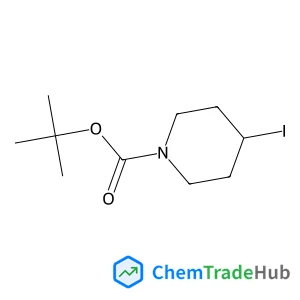
2-Methyl-2-propanyl 4-iodo-1-piperidinecarboxylate
CAS Number:
301673-14-3
Molecular Formula:
C10H18INO2

Recommended Suppliers





Disclaimer
This page provides academic journal information for reference and research purposes only. We are not affiliated with any journal publishers and do not handle publication submissions. For publication-related inquiries, please contact the respective journal publishers directly.
If you notice any inaccuracies in the information displayed, please contact us at support@chemtradehub.com. We will promptly review and address your concerns.