


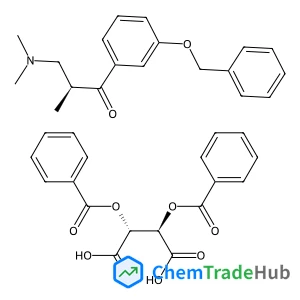
(S)-1-(3-(Benzyloxy)phenyl)-3-(dimethylamino)-2-methylpropan-1-one (2r,3r)-2,3-bis(benzoyloxy)succinate
CAS Number:
1004315-81-4
Molecular Formula:
C37H37NO10
A graphical abstract is available for this content

Journal of Asian Natural Products Research

Atomization and Sprays

Bioorganic & Medicinal Chemistry Letters

Journal of Chemical Sciences

Chinese Journal of Chemistry

Acta Metallurgica Sinica-English Letters

NDT & E International

Biocatalysis and Biotransformation

Bioorganic & Medicinal Chemistry

Topics in Catalysis
Wenliang Wang, Chen Zhang, Zhongjie Du, Jianguo Mi
DOI: 10.1039/C5CP03915K
Wojciech Plazinski, Anita Plazinska, Mateusz Drach
DOI: 10.1039/C5CP03357H
Sebastián Miranda-Rojas
DOI: 10.1039/C5CP04503G
Lauren Takahashi, Keisuke Takahashi
DOI: 10.1039/C5CP03382A
Kosuke Sugawa, Tsuyoshi Akiyama, Yoshimasa Tanoue, Takashi Harumoto, Sayaka Yanagida, Atsuo Yasumori, Shohei Tomita, Joe Otsuki
DOI: 10.1039/C4CP05058D
Darya Radziuk, Helmuth Moehwald
DOI: 10.1039/C4CP04946B
Sergio Romero-Romero, Miguel Costas, Adela Rodríguez-Romero, D. Alejandro Fernández-Velasco
DOI: 10.1039/C5CP01599E
Michael H. Abraham, Raymond J. Abraham, Abil E. Aliev, Claudio F. Tormena
DOI: 10.1039/C5CP90167G
Cristina M. Muntean, Ioan Bratu, Nicolae Leopold, Cristian Morari, Luiza Buimaga-Iarinca, Monica A. P. Purcaru
DOI: 10.1039/C4CP05425C
6-(3-Fluorophenyl)picolinic acid is generally considered safe for laboratory use...
(3R)-3-Pyrrolidinol is used in the pharmaceutical industry as a precursor for dr...
When handling (4R,5R)-4,5-Diethoxycarbonyl-2,2-dimethyldioxolane (CAS: 59779-75-...
1-(6-Chloroimidazo[1,2-b]pyridazin-3-yl)ethanone is often synthesized via a mult...
The market for N-Ethyl-3,4-dimethylbenzylamine (CAS: 39180-83-1) remains steady,...
Tert-butyl 3-(pyrrolidin-1-yl)azetidine-1-carboxylate is a chemical compound wit...
1-Bromo-3-chloro-2,4-dimethoxybenzene (CAS: 1228956-93-1) falls under the classi...
The safety of 8-Bromo-2-methyl-3,4-dihydroisoquinolin-1(2H)-one (CAS: 1368622-07...
Benzyl [(3S)-2,6-dioxo-3-piperidinyl]carbamate is generally safe when handled wi...
1-{[4-(4,4,5,5-Tetramethyl-1,3,2-dioxaborolan-2-yl)phenyl]sulfonyl}pyrrolidine s...
Journal of Materials Chemistry A, B & C cover high quality studies across all fields of materials chemistry. The journals focus on those theoretical or experimental studies that report new understanding, applications, properties and synthesis of materials. The journals have a strong history of publishing quality reports of interest to interdisciplinary communities and providing an efficient and rigorous service through peer review and publication. The journals are led by an international team of Editors-in-Chief and Associate Editors who are all active researchers in their fields. Journal of Materials Chemistry A, B & C are separated by the intended application of the material studied. Broadly, applications in energy and sustainability are of interest to Journal of Materials Chemistry A, applications in biology and medicine are of interest to Journal of Materials Chemistry B, and applications in optical, magnetic and electronic devices are of interest to Journal of Materials Chemistry C. More than one Journal of Materials Chemistry journal may be suitable for certain fields and researchers are encouraged to submit their paper to the journal that they feel best fits for their particular article. Example topic areas within the scope of Journal of Materials Chemistry B are listed below. This list is neither exhaustive nor exclusive. Antifouling coatings Biocompatible materials Bioelectronics Bioimaging Biomimetics Biomineralisation Bionics Biosensors Diagnostics Drug delivery Gene delivery Immunobiology Nanomedicine Regenerative medicine & Tissue engineering Scaffolds Soft robotics Stem cells Therapeutic devices image block All articles published in Journal of Materials Chemistry B from 2019 onwards will be indexed in MEDLINE®. Articles that primarily focus on providing insight into the underlying science and performance of biomaterials within a biological environment are more suited to our companion journal, Biomaterials Science.

![1-Benzyl-1,7-diazaspiro[4.4]nonane dihydrochloride structure](https://static.chemtradehub.com/structs/115/1159822-71-5-0320.webp "1-Benzyl-1,7-diazaspiro[4.4]nonane dihydrochloride structure")



