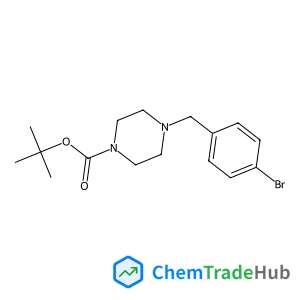
2-Methyl-2-propanyl 4-(4-bromobenzyl)-1-piperazinecarboxylate
CAS Number:
844891-10-7
Molecular Formula:
C16H23BrN2O2
Yu-Xin Lin, Chenghao Jiang, Yu-Bo Wang, Jia-Xin Wang, Bin Li, Guodong Qian
Hydrogen-bonded organic frameworks (HOFs) have great potential as sensing platforms for specific molecular recognition due to their designable structures, high solution processability, and easy regeneration. However, the exploration of fluorescent HOFs for chemical sensing in water remains a challenge due to the need to combine excellent photoluminescence performance, high water stability, and specific recognition sites simultaneously. Herein, we report an aggregation-induced emission (AIE) active HOF (termed HOF-TPE-CN) built from a cyano-decorated tetraphenylethylene linker for highly fluorescent sensing of mono-nitrophenol isomers. Owing to the effective AIE effect, HOF-TPE-CN shows a notable enhancement in fluorescence emission, wherein the quantum yield of HOF-TPE-CN was notably increased to 21% compared with that of the TPE-CN ligand in DMF solution (2.89%). Most importantly, this HOF exhibits highly efficient fluorescence quenching toward mono-nitrophenol isomers in water, with a remarkably low detection limit of 0.65 μM. Furthermore, HOF-TPE-CN is more responsive and selective toward mono-nitrophenols compared with a series of homologues. Theoretical calculations combined with X-ray photoelectron spectroscopy revealed that there exist multiple van der Waals and hydrogen-bonding interactions between the trapped nitrophenol molecules and the HOF framework, which form ground-state complexation, resulting in fluorescence quenching by efficient photo-induced electron transfer.

Journal of Physics and Chemistry of Solids

Pure and Applied Chemistry

Fibre Chemistry

Helvetica Chimica Acta

European Journal of Wood and Wood Products

Journal of Catalysis

Proceedings of the National Academy of Sciences of the United States of America

Israel Journal of Chemistry

Journal of Heterocyclic Chemistry

Journal of Medicinal Chemistry
Keisuke Niimi, Tetsuya Taketsugu, Akira Nakayama
DOI: 10.1039/C5CP00568J
İbrahim Mutlay, Albeiro Restrepo
DOI: 10.1039/C4CP04736B
S. Chevreux, R. Paulino Neto, C. Allain, K. Nakatani, P. Jacques, I. Ciofini, G. Lemercier
DOI: 10.1039/C4CP05661B
DOI: 10.1039/C5CP00460H
Anu George, Harish K. Choudhary, Biswarup Satpati, Sukhendu Mandal
DOI: 10.1039/C4CP05743K
Rafael B. Araujo, Sudip Chakraborty
DOI: 10.1039/C4CP05042H
J. R. Soto, B. Molina, J. J. Castro
DOI: 10.1039/C4CP05912C
Daniel Braun, Othmar Steinhauser
DOI: 10.1039/C4CP04779F
DOI: 10.1039/C4CP02381A
Waste containing 2-Ethyl-4-Methyl-1H-Imidazole-5-Carbaldehyde (CAS: 88634-80-4) ...
Triethoxy(octyl)silane (CAS: 1385031-14-0) is widely used in the pharmaceuticals...
Several alternatives to 3-iodo-7-nitro-1H-indazole (CAS: 864724-64-1) exist in t...
Yes, there are alternatives to Benzene, bis[(trimethoxysilyl)ethyl] (CAS: 266317...
Isothiazole-3-carbonitrile (CAS: 1452-17-1) is generally considered safe when us...
(3-Chlorophenyl)methanol (CAS: 873-63-2) is considered low to moderately toxic. ...
(2S,3S)-2-Hydroxy-3-({[(2-methyl-2-propanyl)oxy]carbonyl}amino)-3-(2-naphthyl)pr...
Proper handling of methyl 2-(bromomethyl)-5-methoxybenzoate requires the use of ...
6,8-Dibromoimidazo[1,2-a]pyridine-2-carboxylic acid (CAS: 904805-36-3) is an aro...
3-Amino-5-bromo-2-pyridinecarbonitrile is considered safe when handled under pro...

Journal of Materials Chemistry A, B & C cover high quality studies across all fields of materials chemistry. The journals focus on those theoretical or experimental studies that report new understanding, applications, properties and synthesis of materials. The journals have a strong history of publishing quality reports of interest to interdisciplinary communities and providing an efficient and rigorous service through peer review and publication. The journals are led by an international team of Editors-in-Chief and Associate Editors who are all active researchers in their fields. Journal of Materials Chemistry A, B & C are separated by the intended application of the material studied. Broadly, applications in energy and sustainability are of interest to Journal of Materials Chemistry A, applications in biology and medicine are of interest to Journal of Materials Chemistry B, and applications in optical, magnetic and electronic devices are of interest to Journal of Materials Chemistry C. More than one Journal of Materials Chemistry journal may be suitable for certain fields and researchers are encouraged to submit their paper to the journal that they feel best fits for their particular article. Example topic areas within the scope of Journal of Materials Chemistry A are listed below. This list is neither exhaustive nor exclusive. Artificial photosynthesis Batteries Carbon dioxide conversion Catalysis Fuel cells Gas capture/separation/storage Green/sustainable materials Hydrogen generation Hydrogen storage Photocatalysis Photovoltaics Self-cleaning materials Self-healing materials Sensors Supercapacitors Thermoelectrics Water splitting Water treatment
![[3-Chloro-5-(diethylcarbamoyl)phenyl]boronic acid structure](https://static.chemtradehub.com/structs/957/957120-59-1-febc.webp "[3-Chloro-5-(diethylcarbamoyl)phenyl]boronic acid structure")