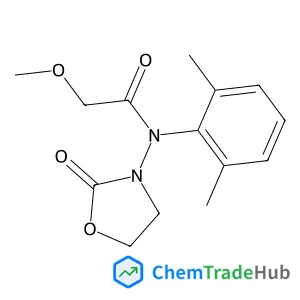
N-(2,6-Dimethylphenyl)-2-methoxy-N-(2-oxo-1,3-oxazolidin-3-yl)acetamide
CAS Number:
77732-09-3
Molecular Formula:
C14H18N2O4
Shengjie Xia, Ziying Yuan, Yue Meng, Chen Zhang, Xianglong Li, Zheming Ni, Xueqiang Zhang
A novel methodology harnessing the synergistic influence of bimetallic and non-metallic dual vacancies within a unified catalyst for enabling highly efficient bifunctional photocatalysis encompassing oxidation and reduction processes is presented. ZnIn2S4, engineered to possess concurrent zinc and sulfur dual vacancies (ZnIn2S4-VZn+S), underwent synthesis and rigorous characterization employing atomic-resolution HAADF-STEM. This tailored catalyst was subsequently employed for pivotal photocatalytic processes, including nitrogen reduction (pNRR) and the photooxidative degradation of hexachlorobenzene (HCB). Computational analyses using Density Functional Theory (DFT) unveiled site-specific activation facilitated by Zn and S dual vacancies, activating water molecules and nitrogen, culminating in a synergistic effect driving ammonia synthesis. Additionally, X-ray Absorption Near Edge Structure (XANES) spectroscopy elucidated the role of photogenerated electrons confined within the sulfur vacancy, utilizing In3+ as an intermediary for electron migration, instigating a reaction with N2 to yield NH3 (In3+–N2 + H+ + VS(e−) → In2+ + NH3), further augmenting the collaborative effect of dual vacancies on nitrogen reduction. Furthermore, the Zn and S vacancies emerged as active sites for hydroxyl and superoxide radical generation, facilitating enhanced participation of photogenerated carriers in radical generation reactions. This distinctive electron aggregation pathway engendered significant synergy, markedly enhancing the photodegradation prowess. Thus, the observed synergistic effect of site activation between Zn and S vacancies yielded a cumulative effect surpassing individual contributions (1 + 1 ≫ 2), thereby facilitating efficient photoreduction and photooxidation.
Christophe Pichon, Barbara Odell, John M. Brown
DOI: 10.1039/B314641C
Mohammmad Afzaal, Mohammad A. Malik, Paul O'Brien
DOI: 10.1039/B313116E
John D. Spence, Eric D. Cline, Domingo M. LLagostera, Patrick S. O'Toole
DOI: 10.1039/B312001E
Hemant K. Sharma, Keith H. Pannell
DOI: 10.1039/B410822A
Julian Eastoe, Margarita Sánchez-Dominguez, Paul Wyatt, Richard K. Heenan
DOI: 10.1039/B410158H
Naoufel Haddour, Serge Cosnier, Chantal Gondran
DOI: 10.1039/B410727F
N. Hickey, P. Fornasiero, R. Di Monte, J. Kašpar, J. R. González-Velasco, M. A. Gutiérrez-Ortiz, M. P. González-Marcos, J. M. Gatica, S. Bernal
DOI: 10.1039/B308321G
Peter J. Cragg, Fenton R. Heirtzler, Mark J. Howard, Ivan Prokes, Thomas Weyhermüller
DOI: 10.1039/B310558J
T. F. Otero, M. T. Cortes
DOI: 10.1039/B313132G
Wenzhen Li, Zhenhua Zhou, Shaohua Yang, Gongquan Sun
DOI: 10.1039/B409539A
When handling 2-Chloro-1,2-bis(4-methylphenyl)ethanone (CAS: 71193-32-3), it is ...
4-Ethoxy-3-(5-methyl-4-oxo-7-propyl-1,4-dihydroimidazo[5,1-f][1,2,4]triazin-2-yl...
Methyl 3-Oxo-4-Androsten-17-Carboxylate (CAS: 2681-55-2) should be stored in a c...
(R)-3-Amino-4-(3-hexylphenylamino)-4-oxobutylphosphonic acid is primarily used i...
2-Methyl-2-propanyl 3-amino-3-carbamoyl-1-azetidinecarboxylate (CAS: 1254120-14-...
There are alternative reagents that can be used in synthesis instead of (E)-4-(t...
[2-(3-Chlorophenyl)-1,3-thiazol-4-yl]methanol (CAS: 121202-20-8) is a crystallin...
The market and research trends for Methyl (2S)-[(4S)-2,2-dimethyl-1,3-dioxolan-4...
The market for 1-Bromo-2-isocyanatoethane (CAS: 42865-19-0) is driven by its use...
4-Nitro-D-phenylalanine hydrochloride (CAS: 147065-06-3) is primarily used in re...
Journal of Materials Chemistry A, B & C cover high quality studies across all fields of materials chemistry. The journals focus on those theoretical or experimental studies that report new understanding, applications, properties and synthesis of materials. The journals have a strong history of publishing quality reports of interest to interdisciplinary communities and providing an efficient and rigorous service through peer review and publication. The journals are led by an international team of Editors-in-Chief and Associate Editors who are all active researchers in their fields. Journal of Materials Chemistry A, B & C are separated by the intended application of the material studied. Broadly, applications in energy and sustainability are of interest to Journal of Materials Chemistry A, applications in biology and medicine are of interest to Journal of Materials Chemistry B, and applications in optical, magnetic and electronic devices are of interest to Journal of Materials Chemistry C. More than one Journal of Materials Chemistry journal may be suitable for certain fields and researchers are encouraged to submit their paper to the journal that they feel best fits for their particular article. Example topic areas within the scope of Journal of Materials Chemistry A are listed below. This list is neither exhaustive nor exclusive. Artificial photosynthesis Batteries Carbon dioxide conversion Catalysis Fuel cells Gas capture/separation/storage Green/sustainable materials Hydrogen generation Hydrogen storage Photocatalysis Photovoltaics Self-cleaning materials Self-healing materials Sensors Supercapacitors Thermoelectrics Water splitting Water treatment