












Mechanism and selectivity of MOF-supported Cu single-atom catalysts for preferential CO oxidation
Literature Information
Publication Date
2023-10-24
DOI
10.1039/D3TA05047E
Impact Factor
12.732
Authors
Sarawoot Impeng, Evaristo Salaya-Gerónimo, Benny Kunkel, Stephan Bartling, Kajornsak Faungnawakij, Bunyarat Rungtaweevoranit, Ali M. Abdel-Mageed
View Original
Abstract
Zr-based UiO-66 metal–organic frameworks are ideal platforms for the design and development of heterogeneous single-atom catalysts (SACs) because of their thermal and chemical stability with the presence of structural defects, enabling the introduction of isolated metal atoms. Elucidating the structure–reactivity relationships and understanding reaction mechanisms for these catalysts are crucial for their industrial applications. We focus here on these aspects for a technically important reaction, preferential CO oxidation (PROX) on a UiO-66-supported Cu SAC by following temperature perturbations in catalytic performance in correlation with changes in the electronic and adsorption properties, which are validated by comprehensive DFT computations. In situ DR-UV-VIS, XANES and NAP-XPS measurements indicated an increase of Cu1+-like states and partial reduction of ZrOx nodes with the increase in reaction temperature, which correlated with a decrease in PROX selectivity. Under similar conditions, DRIFTS measurements revealed a decay of COad adsorption on Cu (i.e., COad@Cu1+ species) and a corresponding red-shift under PROX conditions compared to CO oxidation, suggesting reduction-mediated charge transfer at the Cu–ZrOx interface. In contrast to the CO oxidation cycle which commences by CO adsorption on Cu1+-like sites, DFT computations revealed that the H2 oxidation cycle starts with the reaction of H2 with a pre-adsorbed O2 molecule on Cu1+-like sites, resulting in the generation of a H2O molecule and Cu2+-like sites, which are subsequently reduced to Cu1+-like sites through a successive reaction with a second H2 (or CO) molecule. Adsorption configurations and energies of CO and H2O co-adsorption indicated a competitive adsorption phenomenon on Cu species, which depends on the oxidation state of the Cu ion with a preference for CO adsorption on Cu1+-like sites, while H2O exhibits a stronger affinity for Cu2+-like sites. These results are discussed in terms of the reaction mechanism and PROX selectivity in Cu SAC catalysts and present a model for understanding the catalytic phenomena on MOF-supported SACs.
Recommended Journals
Related Literature
Structure and bonding of [VIVO(acac)2] on the surface of AlF3 as studied by pulsed electron nuclear double resonance and hyperfine sublevel correlation spectroscopy
Vijayasarathi Nagarajan, Barbara Müller, Oksana Storcheva, Klaus Köhler, Andreas Pöppl
2009-06-10
Paper
DOI: 10.1039/B903826B
Calculation of local spins for correlated wave functions
I. Mayer, E. Matito
2010-08-02
Paper
DOI: 10.1039/C004427J
O2 adsorption and dissociation on neutral, positively and negatively charged Aun (n = 5–79) clusters
Josep Manel Ricart, Gianfranco Pacchioni
2010-07-08
Paper
DOI: 10.1039/C004110F
Enantioselective binding of structural epoxide isomers by a chiral vanadyl salen complex: a pulsed EPR, cw-ENDOR and DFT investigation
Damien M. Murphy, Ian A. Fallis, Emma Carter, David J. Willock, James Landon, Sabine Van Doorslaer, Evi Vinck
2009-06-25
Paper
DOI: 10.1039/B907807J
The influence of concentration on the molecular surface structure of simple and mixed aqueous electrolytes
Niklas Ottosson, Jan Heyda, Erik Wernersson, Wandared Pokapanich, Svante Svensson, Bernd Winter, Gunnar Öhrwall, Pavel Jungwirth, Olle Björneholm
2010-07-08
Paper
DOI: 10.1039/C0CP00365D
Hot plasmonic interactions: a new look at the photothermal efficacy of gold nanoparticles
Ekaterina Y. Lukianova-Hleb, Lindsey J. E. Anderson, Seunghyun Lee
2010-08-16
Paper
DOI: 10.1039/C0CP00499E
Refractive indices for molecular crystals from the response of X-ray constrained Hartree–Fock wavefunctions
Dylan Jayatilaka, Parthapratim Munshi, Michael J. Turner, Judith A. K. Howard, Mark A. Spackman
2009-06-10
Paper
DOI: 10.1039/B906072C
Translational, rotational and vibrational energy partitioning in the sequential loss of carbon dimers from fullerenes
2009-06-03
Paper
DOI: 10.1039/B901557D
In situ infrared (FTIR) study of the mechanism of the borohydride oxidation reaction
B. Molina Concha, M. Chatenet, F. Maillard, E. A. Ticianelli, F. H. B. Lima, R. B. de Lima
2010-08-02
Paper
DOI: 10.1039/C003652H
Solvent-shift Monte Carlo: a cluster algorithm for solvated systems
Christopher Adam Hixson, James P. Benigni, David J. Earl
2009-06-15
Communication
DOI: 10.1039/B905254B
You might also like
Compound Q&A
What precautions should be taken when handling 2-Chloro-1,2-bis(4-methylphenyl)ethanone (CAS: 71193-32-3)?
When handling 2-Chloro-1,2-bis(4-methylphenyl)ethanone (CAS: 71193-32-3), it is ...
71193-32-32-Chloro-1,2-bis(4-m...
Compound Q&A
What industries use 4-Ethoxy-3-(5-methyl-4-oxo-7-propyl-1,4-dihydroimidazo[5,1-f][1,2,4]triazin-2-yl)benzenesulfonyl chloride (CAS: 224789-26-8)?
4-Ethoxy-3-(5-methyl-4-oxo-7-propyl-1,4-dihydroimidazo[5,1-f][1,2,4]triazin-2-yl...
224789-26-84-Ethoxy-3-(5-methyl...
Compound Q&A
How should Methyl 3-Oxo-4-Androsten-17-Carboxylate (CAS: 2681-55-2) be stored?
Methyl 3-Oxo-4-Androsten-17-Carboxylate (CAS: 2681-55-2) should be stored in a c...
2681-55-2Methyl 3-Oxo-4-Andro...
Compound Q&A
What are the main uses of (R)-3-Amino-4-(3-hexylphenylamino)-4-oxobutylphosphonic acid (CAS: 909725-61-7)?
(R)-3-Amino-4-(3-hexylphenylamino)-4-oxobutylphosphonic acid is primarily used i...
909725-61-7(R)-3-Amino-4-(3-hex...
Compound Q&A
What regulatory guidelines apply to 2-Methyl-2-propanyl 3-amino-3-carbamoyl-1-azetidinecarboxylate (CAS: 1254120-14-3)?
2-Methyl-2-propanyl 3-amino-3-carbamoyl-1-azetidinecarboxylate (CAS: 1254120-14-...
1254120-14-32-Methyl-2-propanyl ...
Compound Q&A
Are there alternatives to (E)-4-(tert-Butoxy)-4-oxobut-2-enoic acid (CAS: 135355-96-3) in synthesis?
There are alternative reagents that can be used in synthesis instead of (E)-4-(t...
135355-96-3(E)-4-(tert-Butoxy)-...
Compound Q&A
What are the physical and chemical properties of [2-(3-Chlorophenyl)-1,3-thiazol-4-yl]methanol (CAS: 121202-20-8)?
[2-(3-Chlorophenyl)-1,3-thiazol-4-yl]methanol (CAS: 121202-20-8) is a crystallin...
121202-20-8[2-(3-Chlorophenyl)-...
Compound Q&A
What is the market or research trend for Methyl (2S)-[(4S)-2,2-dimethyl-1,3-dioxolan-4-yl]{[(4-methylphenyl)sulfonyl]oxy}acetate (CAS: 166249-17-8)?
The market and research trends for Methyl (2S)-[(4S)-2,2-dimethyl-1,3-dioxolan-4...
166249-17-8Methyl (2S)-[(4S)-2,...
Compound Q&A
What is the market or research trend for 1-Bromo-2-isocyanatoethane (CAS: 42865-19-0)?
The market for 1-Bromo-2-isocyanatoethane (CAS: 42865-19-0) is driven by its use...
42865-19-01-Bromo-2-isocyanato...
Compound Q&A
What are the main uses of 4-Nitro-D-phenylalanine hydrochloride (CAS: 147065-06-3)?
4-Nitro-D-phenylalanine hydrochloride (CAS: 147065-06-3) is primarily used in re...
147065-06-34-Nitro-D-phenylalan...
Source Journal
Journal of Materials Chemistry A

CiteScore:
19.5
Self-citation Rate:
4.7%
Articles per Year:
2211
Journal of Materials Chemistry A, B & C cover high quality studies across all fields of materials chemistry. The journals focus on those theoretical or experimental studies that report new understanding, applications, properties and synthesis of materials. The journals have a strong history of publishing quality reports of interest to interdisciplinary communities and providing an efficient and rigorous service through peer review and publication. The journals are led by an international team of Editors-in-Chief and Associate Editors who are all active researchers in their fields. Journal of Materials Chemistry A, B & C are separated by the intended application of the material studied. Broadly, applications in energy and sustainability are of interest to Journal of Materials Chemistry A, applications in biology and medicine are of interest to Journal of Materials Chemistry B, and applications in optical, magnetic and electronic devices are of interest to Journal of Materials Chemistry C. More than one Journal of Materials Chemistry journal may be suitable for certain fields and researchers are encouraged to submit their paper to the journal that they feel best fits for their particular article. Example topic areas within the scope of Journal of Materials Chemistry A are listed below. This list is neither exhaustive nor exclusive. Artificial photosynthesis Batteries Carbon dioxide conversion Catalysis Fuel cells Gas capture/separation/storage Green/sustainable materials Hydrogen generation Hydrogen storage Photocatalysis Photovoltaics Self-cleaning materials Self-healing materials Sensors Supercapacitors Thermoelectrics Water splitting Water treatment
Recommended Compounds
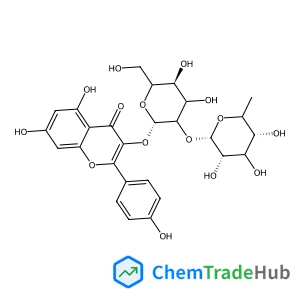
5,7-Dihydroxy-2-(4-hydroxyphenyl)-4-oxo-4H-chromen-3-yl 2-O-(6-deoxy-alpha-L-mannopyranosyl)-beta-D-glucopyranoside
CAS Number:
32602-81-6
Molecular Formula:
C27H30O15

Recommended Suppliers







Disclaimer
This page provides academic journal information for reference and research purposes only. We are not affiliated with any journal publishers and do not handle publication submissions. For publication-related inquiries, please contact the respective journal publishers directly.
If you notice any inaccuracies in the information displayed, please contact us at support@chemtradehub.com. We will promptly review and address your concerns.