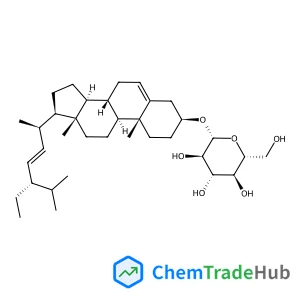
(3beta,22E)-Stigmasta-5,22-dien-3-yl beta-D-glucopyranoside
CAS Number:
19716-26-8
Molecular Formula:
C35H58O6
Vijayasarathi Nagarajan, Barbara Müller, Oksana Storcheva, Klaus Köhler, Andreas Pöppl
Well defined isolated [VIVO(acac)2] surface complexes have been prepared on aluminium trifluoride, α-AlF3, as solid support by equilibrium adsorption from liquid solution. The paramagnetic vanadium(IV) surface complexes were studied by pulsed electron spin resonance spectroscopy in combination with quantum chemical calculations using density functional theory. 19F and 27Al ligand hyperfine interactions with the nuclei of the AlF3 support observed by pulsed electron nuclear double resonance and hyperfine sublevel correlation spectroscopy experiments verify the direct chemical bonding between the vanadium and a surface fluorine atom. Detailed analysis of the ligand hyperfine couplings supported by quantum chemical calculations indicates that the axial position of [VIVO(acac)2]trans to the oxo ligand is bound directly to a terminal fluorine atom of the support. Analysis of the 1H ligand hyperfine interaction revealed that an acidic H+ of the AlF3 surface protonated a donor oxygen of the acetylacetone ligand in the surface complex.
Nan Li, Hai-Bo Wang, Jing-Yuan Wang, Xin Wang
DOI: 10.1039/C4AN01900H
Yanyan Wang, Bin Liu
DOI: 10.1039/B806908E
Jin-Feng Chen, Yue-Lin Song, Xiao-Yu Guo, Yong Jiang
DOI: 10.1039/C4AN01707B
Peng Gao, Chen Lu, Xiang Li, Hongwei Kong, Peiyuan Yin, Xin Lu, Aiping Lu, Guowang Xu
DOI: 10.1039/B807369D
Maria Jose Ruedas-Rama, Elizabeth A. H. Hall
DOI: 10.1039/B801507D
Chunyan Gao, Henan Li, Yuanjian Liu, Wei Wei, Yuanjian Zhang, Songqin Liu
DOI: 10.1039/C4AN01359J
S. Sandron, B. Heery, V. Gupta, D. A. Collins, E. P. Nesterenko, P. N. Nesterenko, M. Talebi, S. Beirne, F. Thompson, G. G. Wallace, D. Brabazon, F. Regan, B. Paull
DOI: 10.1039/C4AN01476F
Tie Cai, Hu Ting, Zhang Xin-Xiang, Zhou Jiang, Zhang Jin-Lan
DOI: 10.1039/C4AN01314J
Zhong Chen, Shubao Xie, Li Shen, Yu Du, Shali He, Qing Li, Zhongwei Liang, Xin Meng, Bo Li, Xiaodong Xu, Hongwei Ma, Yanyi Huang, Yuanhua Shao
DOI: 10.1039/B807057A
Kuang-Hsuan Yang, Chung-Chin Yu
DOI: 10.1039/C4AN01037J
When handling 2-Chloro-1,2-bis(4-methylphenyl)ethanone (CAS: 71193-32-3), it is ...
4-Ethoxy-3-(5-methyl-4-oxo-7-propyl-1,4-dihydroimidazo[5,1-f][1,2,4]triazin-2-yl...
Methyl 3-Oxo-4-Androsten-17-Carboxylate (CAS: 2681-55-2) should be stored in a c...
(R)-3-Amino-4-(3-hexylphenylamino)-4-oxobutylphosphonic acid is primarily used i...
2-Methyl-2-propanyl 3-amino-3-carbamoyl-1-azetidinecarboxylate (CAS: 1254120-14-...
There are alternative reagents that can be used in synthesis instead of (E)-4-(t...
[2-(3-Chlorophenyl)-1,3-thiazol-4-yl]methanol (CAS: 121202-20-8) is a crystallin...
The market and research trends for Methyl (2S)-[(4S)-2,2-dimethyl-1,3-dioxolan-4...
The market for 1-Bromo-2-isocyanatoethane (CAS: 42865-19-0) is driven by its use...
4-Nitro-D-phenylalanine hydrochloride (CAS: 147065-06-3) is primarily used in re...

Physical Chemistry Chemical Physics (PCCP) is an international journal co-owned by 19 physical chemistry and physics societies from around the world. This journal publishes original, cutting-edge research in physical chemistry, chemical physics and biophysical chemistry. To be suitable for publication in PCCP, articles must include significant innovation and/or insight into physical chemistry; this is the most important criterion that reviewers and Editors will judge against when evaluating submissions. The journal has a broad scope and welcomes contributions spanning experiment, theory, computation and data science. Topical coverage includes spectroscopy, dynamics, kinetics, statistical mechanics, thermodynamics, electrochemistry, catalysis, surface science, quantum mechanics, quantum computing and machine learning. Interdisciplinary research areas such as polymers and soft matter, materials, nanoscience, energy, surfaces/interfaces, and biophysical chemistry are welcomed if they demonstrate significant innovation and/or insight into physical chemistry. Joined experimental/theoretical studies are particularly appreciated when complementary and based on up-to-date approaches.