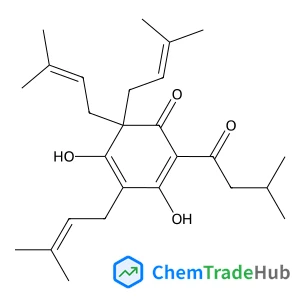
3,5-Dihydroxy-4-(3-methylbutanoyl)-2,6,6-tris(3-methyl-2-buten-1-yl)-2,4-cyclohexadien-1-one
CAS Number:
468-28-0
Molecular Formula:
C26H38O4
The sequential thermal dissociation of up to five carbon dimers from neutral, singly and doubly charged C60 molecules is theoretically investigated in the framework of phase space theory. Using a semiclassical treatment of vibrations and rotations, we quantify the amount of kinetic energies released in the form of translation, rotation, and vibration under realistic experimental conditions. Our results reveal that translational and vibrational energies of the dimers are nearly equilibrated after a few emissions, whereas the rotational contribution lies far below equipartition. An approximate treatment in which dimers are rotationally and vibrationally frozen essentially leads to the same conclusions.
Xiaohao Yang, Ahmad S. Masadeh, James R. McBride, Emil S. Božin, Sandra J. Rosenthal
DOI: 10.1039/C3CP00111C
Paola D'Angelo, Valentina Migliorati, Riccardo Spezia, Simone De Panfilis, Ingmar Persson, Andrea Zitolo
DOI: 10.1039/C3CP50842K
Maria Baias, Cory M. Widdifield, Jean-Nicolas Dumez, Hugh P. G. Thompson, Timothy G. Cooper, Elodie Salager, Sirena Bassil, Robin S. Stein, Anne Lesage, Graeme M. Day, Lyndon Emsley
DOI: 10.1039/C3CP41095A
Sergey Sirotin, Philippe Bazin, Françoise Maugé, Arnaud Travert
DOI: 10.1039/C3CP51146D
Florian Löw, Katrin Amann-Winkel, Thomas Loerting, Franz Fujara, Burkhard Geil
DOI: 10.1039/C3CP50818H
Anke Horneber, Anne-Laure Baudrion, Pierre-Michel Adam, Alfred J. Meixner, Dai Zhang
DOI: 10.1039/C3CP43349H
Joseph Mason, Christopher Batchelor-McAuley, Richard G. Compton
DOI: 10.1039/C3CP50607J
Adrian H. Hill, Mattia Allieta
DOI: 10.1039/C3CP44322A
Chaolong Tang, Chengming Jiang, Wenqiang Lu, Jinhui Song
DOI: 10.1039/C3CP50679G
When handling 2-Chloro-1,2-bis(4-methylphenyl)ethanone (CAS: 71193-32-3), it is ...
4-Ethoxy-3-(5-methyl-4-oxo-7-propyl-1,4-dihydroimidazo[5,1-f][1,2,4]triazin-2-yl...
Methyl 3-Oxo-4-Androsten-17-Carboxylate (CAS: 2681-55-2) should be stored in a c...
(R)-3-Amino-4-(3-hexylphenylamino)-4-oxobutylphosphonic acid is primarily used i...
2-Methyl-2-propanyl 3-amino-3-carbamoyl-1-azetidinecarboxylate (CAS: 1254120-14-...
There are alternative reagents that can be used in synthesis instead of (E)-4-(t...
[2-(3-Chlorophenyl)-1,3-thiazol-4-yl]methanol (CAS: 121202-20-8) is a crystallin...
The market and research trends for Methyl (2S)-[(4S)-2,2-dimethyl-1,3-dioxolan-4...
The market for 1-Bromo-2-isocyanatoethane (CAS: 42865-19-0) is driven by its use...
4-Nitro-D-phenylalanine hydrochloride (CAS: 147065-06-3) is primarily used in re...

Physical Chemistry Chemical Physics (PCCP) is an international journal co-owned by 19 physical chemistry and physics societies from around the world. This journal publishes original, cutting-edge research in physical chemistry, chemical physics and biophysical chemistry. To be suitable for publication in PCCP, articles must include significant innovation and/or insight into physical chemistry; this is the most important criterion that reviewers and Editors will judge against when evaluating submissions. The journal has a broad scope and welcomes contributions spanning experiment, theory, computation and data science. Topical coverage includes spectroscopy, dynamics, kinetics, statistical mechanics, thermodynamics, electrochemistry, catalysis, surface science, quantum mechanics, quantum computing and machine learning. Interdisciplinary research areas such as polymers and soft matter, materials, nanoscience, energy, surfaces/interfaces, and biophysical chemistry are welcomed if they demonstrate significant innovation and/or insight into physical chemistry. Joined experimental/theoretical studies are particularly appreciated when complementary and based on up-to-date approaches.