












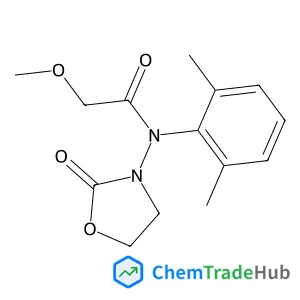
N-(2,6-Dimethylphenyl)-2-methoxy-N-(2-oxo-1,3-oxazolidin-3-yl)acetamide
CAS Number:
77732-09-3
Molecular Formula:
C14H18N2O4
Niklas Ottosson, Jan Heyda, Erik Wernersson, Wandared Pokapanich, Svante Svensson, Bernd Winter, Gunnar Öhrwall, Pavel Jungwirth, Olle Björneholm
We investigate various mechanisms contributing to the surface ion distributions in simple and mixed aqueous alkali-halide solutions depending on the total salt concentration, using a combination of photoelectron spectroscopy and molecular dynamics simulations. In simple solutions, the surface enhancement of large polarizable anions is reduced with increasing concentration. In the case of a NaBr/NaCl mixed aqueous solution, with bromide as the minority component, the situation is more complex. While the total anion/cation charge separation is similarly reduced with increasing salt content, this alone does not uniquely determine the ion distribution due to the co-existence of two different anions, Br− and Cl−. We show that bromide is selectively surface enhanced at higher concentrations, despite the fact that the total anion surface enhancement is reduced. This phenomenon, which can be viewed as “salting out” of bromide by NaCl might have consequences for our understanding of the surface structure of mixed aqueous solutions subjected to concentration increase due to dehydration, such as seawater-born aerosols.
Jiangli Xue, Yang Zhao, Huhu Cheng, Chuangang Hu, Yue Hu, Yuning Meng, Huibo Shao, Zhipan Zhang, Liangti Qu
DOI: 10.1039/C3CP51571K
Narendra Kurra, Dipanwita Dutta, Giridhar U. Kulkarni
DOI: 10.1039/C3CP50675D
Armin Hoffmann, Krishna Neupane
DOI: 10.1039/C3CP44564J
Maxim F. Gelin, Dassia Egorova, Wolfgang Domcke
DOI: 10.1039/C3CP44454F
Damien Thompson, Mateusz Sikora, Piotr Szymczak, Marek Cieplak
DOI: 10.1039/C3CP50523E
Jan Rongé, Dorien Nijs, Stef Kerkhofs, Kasper Masschaele, Johan A. Martens
DOI: 10.1039/C3CP50890K
Piotr Bernatowicz
DOI: 10.1039/C3CP50963J
Zhiguo Wang, Qiulei Su, Huiqiu Deng
DOI: 10.1039/C3CP51167G
John L. Provis, Breaunnah Bloomer, Neil J. Henson, Katharine Page
DOI: 10.1039/C3CP44342F
When handling 2-Chloro-1,2-bis(4-methylphenyl)ethanone (CAS: 71193-32-3), it is ...
4-Ethoxy-3-(5-methyl-4-oxo-7-propyl-1,4-dihydroimidazo[5,1-f][1,2,4]triazin-2-yl...
Methyl 3-Oxo-4-Androsten-17-Carboxylate (CAS: 2681-55-2) should be stored in a c...
(R)-3-Amino-4-(3-hexylphenylamino)-4-oxobutylphosphonic acid is primarily used i...
2-Methyl-2-propanyl 3-amino-3-carbamoyl-1-azetidinecarboxylate (CAS: 1254120-14-...
There are alternative reagents that can be used in synthesis instead of (E)-4-(t...
[2-(3-Chlorophenyl)-1,3-thiazol-4-yl]methanol (CAS: 121202-20-8) is a crystallin...
The market and research trends for Methyl (2S)-[(4S)-2,2-dimethyl-1,3-dioxolan-4...
The market for 1-Bromo-2-isocyanatoethane (CAS: 42865-19-0) is driven by its use...
4-Nitro-D-phenylalanine hydrochloride (CAS: 147065-06-3) is primarily used in re...

Physical Chemistry Chemical Physics (PCCP) is an international journal co-owned by 19 physical chemistry and physics societies from around the world. This journal publishes original, cutting-edge research in physical chemistry, chemical physics and biophysical chemistry. To be suitable for publication in PCCP, articles must include significant innovation and/or insight into physical chemistry; this is the most important criterion that reviewers and Editors will judge against when evaluating submissions. The journal has a broad scope and welcomes contributions spanning experiment, theory, computation and data science. Topical coverage includes spectroscopy, dynamics, kinetics, statistical mechanics, thermodynamics, electrochemistry, catalysis, surface science, quantum mechanics, quantum computing and machine learning. Interdisciplinary research areas such as polymers and soft matter, materials, nanoscience, energy, surfaces/interfaces, and biophysical chemistry are welcomed if they demonstrate significant innovation and/or insight into physical chemistry. Joined experimental/theoretical studies are particularly appreciated when complementary and based on up-to-date approaches.

![2-Hydroxy-4-[({[(4-methylphenyl)sulfonyl]oxy}acetyl)amino]benzoic acid structure](https://static.chemtradehub.com/structs/501/501919-59-1-579f.webp "2-Hydroxy-4-[({[(4-methylphenyl)sulfonyl]oxy}acetyl)amino]benzoic acid structure")





