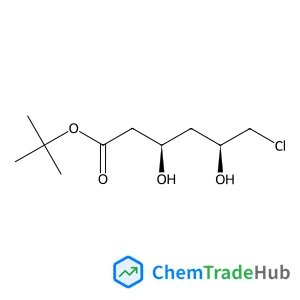
2-Methyl-2-propanyl (3R,5S)-6-chloro-3,5-dihydroxyhexanoate
CAS Number:
154026-93-4
Molecular Formula:
C10H19ClO4
Soumya Ranjan Mishra, Vishal Gadore, Md. Ahmaruzzaman
Due to its distinct electrical structure and environmental compatibility, graphitic carbon nitride (g-C3N4) has become a viable photocatalyst for various applications. Significant initiatives are currently being implemented to enhance the photocatalytic activity of g-C3N4 by adding oxygen dopants to its structure. The unique characteristics of oxygen-doped g-C3N4 (O@g-C3N4), including enhanced charge carrier mobility and changed electronic structure, make it especially appealing for photocatalytic applications. The synthetic techniques used to create O@g-C3N4 are thoroughly examined in this paper, along with the structural changes brought on by oxygen doping and the processes underpinning its increased photocatalytic activity. The methods for adding oxygen atoms to the g-C3N4 lattice are covered in the synthesis section, including solid-state processes, chemical vapor deposition, hydrothermal synthesis, co-precipitation, and post-treatment procedures. Using these techniques, the type and density of oxygen functional groups may be precisely controlled, allowing O@g-C3N4's photocatalytic characteristics to be tailored. O@g-C3N4's characteristics are discussed, emphasizing its modified electronic band structure, better surface reactivity, and enhanced light absorption abilities. Recent developments in the field are also presented, exhibiting cutting-edge techniques, including heteroatom doping, nanostructuring, and co-catalyst integration that further enhance O@g-C3N4's photocatalytic capabilities. As a versatile photocatalyst, O@g-C3N4 has been extensively reviewed in this study, emphasizing its synthesis processes, structural characteristics, and current developments in improving its photocatalytic activity. Our understanding of O@g-C3N4 is deepened by this review's insights, which also open the door for future research into using the compound in environmentally friendly and sustainable technology.
S. P. Cork, G. Cressey, R. H. Jones, S. J. Teat, V. L. Zholobenko
DOI: 10.1039/B410366C
Yoshihiko Yamamoto, Tomoaki Saigoku, Takashige Ohgai, Hisao Nishiyama, Kenji Itoh
DOI: 10.1039/B411442F
Dongliang Chang, Zunsheng Wang, Maarten F. Heringa, Renato Wirthner, Bernard Witholt, Zhi Li
DOI: 10.1039/B300435J
Bas G. G. Lohmeijer, Daan Wouters, Zhihui Yin, Ulrich S. Schubert
DOI: 10.1039/B411777H
Seong Jin Park, Dong Mok Shin, Shigeru Sakamoto, Kentaro Yamaguchi, Young Keun Chung, Myoung Soo Lah
DOI: 10.1039/B212855A
John J. Perry, Gregory J. McManus, Michael J. Zaworotko
DOI: 10.1039/B408973A
Cinzia Chiappe, Elsa Leandri, Daniela Pieraccini
DOI: 10.1039/B410796A
Robin B. Bedford, Duncan W. Bruce, Robert M. Frost, John W. Goodby, Michael Hird
DOI: 10.1039/B413790F
Hiroyuki Kodama, Sachiko Matsumura, Taro Yamashita, Hisakazu Mihara
DOI: 10.1039/B409641J
DOI: 10.1039/B300963G
(1R,3S)-1,3-Cyclopentanediol finds applications in various industries. In the ph...
When handling N'-[4-(Dimethylamino)phenyl]-N,N-dimethyl-1,4-benzenediamine, it i...
There are several alternatives to 5-(2,4-Difluorophenyl)-2-methoxypyrimidine in ...
1-(3-Methoxyphenoxy)propan-2-ol (CAS: 382141-68-6) must comply with the Globally...
Tetrodotoxin Citrate is extremely dangerous and should be handled with extreme c...
2-Methyl-2-propanyl [(1R,3S)-3-hydroxycyclopentyl]carbamate (CAS: 225641-84-9) i...
Waste containing 4-(2-Hydroxyhexafluoroisopropyl)Benzoic Acid (CAS: 16261-80-6) ...
2-Methyl-2-proanyl {(2S)-1-[(benzyloxy)amino]-3-hydroxy-3-methyl-1-oxo-2-butanyl...
Benzeneethanamine, α-ethyl-, hydrochloride (1:1) is an organic compound with the...
In the synthesis of compounds similar to 3-{(E)-[4-(Dimethylamino)phenyl]diazeny...