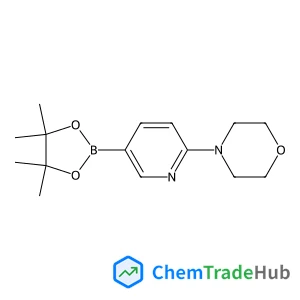
4-(5-(4,4,5,5-tetramethyl-1,3,2-dioxaborolan-2-yl)pyridin-2-yl)morpholine
CAS Number:
485799-04-0
Molecular Formula:
C15H23BN2O3
Yoshihiko Yamamoto, Tomoaki Saigoku, Takashige Ohgai, Hisao Nishiyama, Kenji Itoh
In the presence of catalytic amounts of Cp*RuCl(cod), the cycloaddition of 1,6-diynes with various C-alkynylglycosides proceeded at ambient temperature to afford C-arylglycosides in 46–93% yields.

Journal of the Indian Institute of Science

Journal of Asian Natural Products Research

Herald of the Russian Academy of Sciences

Electroanalysis

Critical Reviews in Solid State and Materials Sciences

Colloid Journal

Bioorganic & Medicinal Chemistry

Heteroatom Chemistry

Biocatalysis and Biotransformation

NDT & E International
Xin Cui, Huijuan Li, Jianjun Lu, Qi Kang, Dazhong Shen
DOI: 10.1039/C9AN00775J
Neeraj Prakash, Arun Ramachandran, Ravi Varma, Jun Chen, Claudio Mazzoleni, Ke Du
DOI: 10.1039/C8AN00819A
Hanchuang Zhu, Caiyun Liu, Ruifang Yuan, Ruikang Wang, Hanming Zhang, Zilu Li, Pan Jia, Baocun Zhu, Wenlong Sheng
DOI: 10.1039/C9AN00818G
Hongfang Gao, Hetong Qi, Yijin Peng, Honglan Qi, Chengxiao Zhang
DOI: 10.1039/C8AN00640G
Boris Brkić, Neil France
DOI: 10.1039/C8AN00862K
Hugo Knobel, Hans Weda, Lieuwe D. Bos, Tamara M. E. Nijsen, Royston Goodacre
DOI: 10.1039/C8AN00759D
(1R,3S)-1,3-Cyclopentanediol finds applications in various industries. In the ph...
When handling N'-[4-(Dimethylamino)phenyl]-N,N-dimethyl-1,4-benzenediamine, it i...
There are several alternatives to 5-(2,4-Difluorophenyl)-2-methoxypyrimidine in ...
1-(3-Methoxyphenoxy)propan-2-ol (CAS: 382141-68-6) must comply with the Globally...
Tetrodotoxin Citrate is extremely dangerous and should be handled with extreme c...
2-Methyl-2-propanyl [(1R,3S)-3-hydroxycyclopentyl]carbamate (CAS: 225641-84-9) i...
Waste containing 4-(2-Hydroxyhexafluoroisopropyl)Benzoic Acid (CAS: 16261-80-6) ...
2-Methyl-2-proanyl {(2S)-1-[(benzyloxy)amino]-3-hydroxy-3-methyl-1-oxo-2-butanyl...
Benzeneethanamine, α-ethyl-, hydrochloride (1:1) is an organic compound with the...
In the synthesis of compounds similar to 3-{(E)-[4-(Dimethylamino)phenyl]diazeny...

ChemComm publishes urgent research which is of outstanding significance and interest to experts in the field, while also appealing to the journal’s broad chemistry readership. Our communication format is ideally suited to short, urgent studies that are of such importance that they require accelerated publication. Our scope covers all topics in chemistry, and research at the interface of chemistry and other disciplines (such as materials science, nanoscience, physics, engineering and biology) where there is a significant novelty in the chemistry aspects. Major topic areas covered include: Analytical Chemistry Catalysis Chemical Biology and medicinal chemistry Computational Chemistry and Machine Learning Energy and sustainable chemistry Environmental Chemistry Green Chemistry Inorganic Chemistry Materials Chemistry Nanoscience Organic Chemistry Physical Chemistry Polymer Chemistry Supramolecular Chemistry