












Degradation of herbicide atrazine in water by high voltage electrical discharge in comparison with Fenton oxidation and ultrasound treatments
Literature Information
Publication Date
2023-07-25
DOI
10.1039/D3SU00103B
Impact Factor
0
Authors
Nadia Boussetta, Gérald Enderlin, Franck Merlier, Nabil Grimi
View Original
Abstract
Atrazine, the most commonly used herbicide, has been reported to pollute the water environment and do harm to human health. It is thus urgent to find an efficient way to degrade atrazine. Although various advanced oxidation processes including high voltage electrical discharge (HVED) have been applied to degrade atrazine, the formation kinetics of its metabolites are still incomplete, and the detoxification of the degradation process remains to be clarified. Here, the degradation of atrazine by HVED was investigated, in comparison with traditional Fenton oxidation and ultrasound treatment. Nineteen metabolites of atrazine degradation were identified and quantified by high performance liquid chromatography coupled with high resolution mass spectrometry (HPLC-HRMS) techniques. Results show that HVED is more advantageous because of its high degradation rate for atrazine (89%), short processing time (1000 s, corresponding to 10 ms effective time), and the presence of the less toxic main metabolite hydroxyatrazine. Hydroxyl radicals (˙OH) play an important role in atrazine degradation. Adding ferrous ions (Fe2+) during HVED and ultrasound processes is beneficial for the degradation of atrazine, because of the ˙OH radicals released from hydrogen peroxide (H2O2). Based on the formation kinetics of atrazine degradation metabolites, detailed mechanisms of atrazine degradation pathways were proposed.
Recommended Journals
Related Literature
Development of novel microsphere structured – calcium tungstate as efficacious electrocatalyst for the detection of antibiotic drug nitrofurantoin
P. Manikanta, Mounesh, Rohit Rangnath Nikam, S. Sandeep, Bhari Mallanna Nagaraja
2023-11-20
Paper
DOI: 10.1039/D3TB02087H
Injectable spontaneously formed asymmetric adhesive hydrogel with controllable removal for wound healing
Lei Liang, Xi Li, Zhouying Tan, Min Liu, Yuwei Qiu, Qingyu Yu, Chaojie Yu, Mengmeng Yao, Bingyan Guo, Pengcheng Che, Hong Zhang
2023-10-26
Paper
DOI: 10.1039/D3TB02014B
Smart stimuli-responsive polysaccharide nanohydrogels for drug delivery: a review
Ahmed Fatimi, Rajender S. Varma, Mohammed Berrada
2023-11-01
Review Article
DOI: 10.1039/D3TB01712E
An aptamer-assisted nanopore strategy with a salt gradient for direct protein sensing
Peng Tang, Liang Wang, Wanyi Xie, Xiaohan Chen, Yunjiao Wang, Ting Weng, Rong Tian, Shuo Zhou, Zuobin Wang
2023-11-01
Paper
DOI: 10.1039/D3TB01875J
Self-driven immune checkpoint blockade and spatiotemporal-sensitive immune response monitoring in acute myeloid leukemia using an all-in-one turn-on bionanoprobe
Honglian Wu, Tianci Wang, Yuting Wang, Sixi Liu, Feiqiu Wen, Gerile Oudeng, Mo Yang
2023-10-17
Paper
DOI: 10.1039/D3TB01553J
Enhanced visible-light photocatalysis in three-dimensional rose-like ZnO with oxygen vacancies and Ag nanoparticles
Shuoyu Chen, Tengfei Bi, Zhenxi Du, Shenghao Luo, Yuechun Fu, Huan He, Xiaoming Shen
2023-12-05
Paper
DOI: 10.1039/D3NJ04722A
Dendronization of chitosan to afford unprecedent thermoresponsiveness and tunable microconfinement
Yi Yao, Xiaoxin Shi, Zihong Zhao, Afang Zhang, Wen Li
2023-11-07
Perspective
DOI: 10.1039/D3TB01803B
Highly efficient degradation of tetracycline by activated peroxymonosulfate over MoS2/ZnO heterostructure nanocomposites
Lili Wang, Yuyang Zhou, Haixiang Wang, Qiaoli Lu, Jinmei Wang, Dawei Gao
2023-11-10
Paper
DOI: 10.1039/D3NJ04717B
Diglycolamic acid for the mutual separation of lanthanides and actinides from dilute nitric acid solution: solvent extraction, dynamic light scattering, and spectroscopic investigations
Jammu Ravi, N. R. Jawahar
2023-11-22
Paper
DOI: 10.1039/D3NJ02840B
You might also like
Compound Q&A
Is 6-(3-Fluorophenyl)picolinic acid (CAS: 887982-40-3) safe?
6-(3-Fluorophenyl)picolinic acid is generally considered safe for laboratory use...
887982-40-36-(3-Fluorophenyl)pi...
Compound Q&A
What industries use (3R)-3-Pyrrolidinol (CAS: 2799-21-5)?
(3R)-3-Pyrrolidinol is used in the pharmaceutical industry as a precursor for dr...
2799-21-5(3R)-3-Pyrrolidinol
Compound Q&A
What precautions should be taken when handling (4R,5R)-4,5-Diethoxycarbonyl-2,2-dimethyldioxolane (CAS: 59779-75-8)?
When handling (4R,5R)-4,5-Diethoxycarbonyl-2,2-dimethyldioxolane (CAS: 59779-75-...
59779-75-8(4R,5R)-4,5-Diethoxy...
Compound Q&A
How is 1-(6-Chloroimidazo[1,2-b]pyridazin-3-yl)ethanone (CAS: 90734-71-7) typically synthesized?
1-(6-Chloroimidazo[1,2-b]pyridazin-3-yl)ethanone is often synthesized via a mult...
90734-71-71-(6-Chloroimidazo[1...
Compound Q&A
What is the market or research trend for N-Ethyl-3,4-dimethylbenzylamine (CAS: 39180-83-1)?
The market for N-Ethyl-3,4-dimethylbenzylamine (CAS: 39180-83-1) remains steady,...
39180-83-1N-Ethyl-3,4-dimethyl...
Compound Q&A
What is Tert-butyl 3-(pyrrolidin-1-yl)azetidine-1-carboxylate (CAS: 1019008-21-9)?
Tert-butyl 3-(pyrrolidin-1-yl)azetidine-1-carboxylate is a chemical compound wit...
1019008-21-9Tert-butyl 3-(pyrrol...
Compound Q&A
What regulatory guidelines apply to 1-Bromo-3-chloro-2,4-dimethoxybenzene (CAS: 1228956-93-1)?
1-Bromo-3-chloro-2,4-dimethoxybenzene (CAS: 1228956-93-1) falls under the classi...
1228956-93-11-Bromo-3-chloro-2,4...
Compound Q&A
Is 8-Bromo-2-methyl-3,4-dihydroisoquinolin-1(2H)-one (CAS: 1368622-07-4) safe?
The safety of 8-Bromo-2-methyl-3,4-dihydroisoquinolin-1(2H)-one (CAS: 1368622-07...
1368622-07-48-Bromo-2-methyl-3,4...
Compound Q&A
Is Benzyl [(3S)-2,6-dioxo-3-piperidinyl]carbamate (CAS: 22785-43-9) safe?
Benzyl [(3S)-2,6-dioxo-3-piperidinyl]carbamate is generally safe when handled wi...
22785-43-9Benzyl [(3S)-2,6-dio...
Compound Q&A
How should 1-{[4-(4,4,5,5-Tetramethyl-1,3,2-dioxaborolan-2-yl)phenyl]sulfonyl}pyrrolidine (CAS: 928657-21-0) be stored?
1-{[4-(4,4,5,5-Tetramethyl-1,3,2-dioxaborolan-2-yl)phenyl]sulfonyl}pyrrolidine s...
928657-21-01-{[4-(4,4,5,5-Tetra...
Source Journal
Recommended Compounds
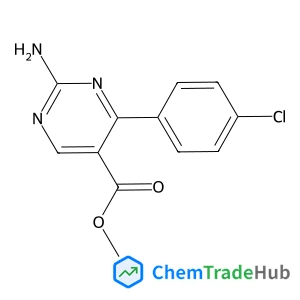
Methyl 2-amino-4-(4-chlorophenyl)-5-pyrimidinecarboxylate
CAS Number:
1133115-56-6
Molecular Formula:
C12H10ClN3O2
Recommended Suppliers




Disclaimer
This page provides academic journal information for reference and research purposes only. We are not affiliated with any journal publishers and do not handle publication submissions. For publication-related inquiries, please contact the respective journal publishers directly.
If you notice any inaccuracies in the information displayed, please contact us at support@chemtradehub.com. We will promptly review and address your concerns.