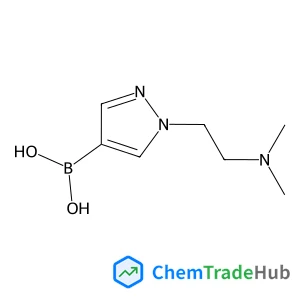
(1-(2-(Dimethylamino)ethyl)-1H-pyrazol-4-yl)boronic acid
CAS Number:
1086063-73-1
Molecular Formula:
C7H14BN3O2
Yaquan Liang, Evan Wei Long Ng, Ekaterina Sviriaeva, Chenyu Li, Yilin Zhao, Xiao-Lin Zhang, Xue-Wei Liu, Sunny H. Wong, Yuan Qiao
Peptidoglycan is an essential exoskeletal polymer across all bacteria. Gut microbiota-derived peptidoglycan fragments (PGNs) are increasingly recognized as key effector molecules that impact host biology. However, the current peptidoglycan analysis workflow relies on laborious manual identification from tandem mass spectrometry (MS/MS) data, impeding the discovery of novel bioactive PGNs in the gut microbiota. In this work, we built a computational tool PGN_MS2 that reliably simulates MS/MS spectra of PGNs and integrated it into the user-defined MS library of in silico PGN search space, facilitating automated PGN identification. Empowered by PGN_MS2, we comprehensively profiled gut bacterial peptidoglycan composition. Strikingly, the probiotic Bifidobacterium spp. manifests an abundant amount of the 1,6-anhydro-MurNAc moiety that is distinct from Gram-positive bacteria. In addition to biochemical characterization of three putative lytic transglycosylases (LTs) that are responsible for anhydro-PGN production in Bifidobacterium, we established that these 1,6-anhydro-PGNs exhibit potent anti-inflammatory activity in vitro, offering novel insights into Bifidobacterium-derived PGNs as molecular signals in gut microbiota-host crosstalk.
G. Carrone, L. Zayat, L. D. Slep, R. Etchenique
DOI: 10.1039/C6CP06580E
Alejandro Cadranel, Jaired E. Tate, Paola S. Oviedo, Shiori Yamazaki, José H. Hodak, Luis M. Baraldo, Valeria D. Kleiman
DOI: 10.1039/C6CP06562G
Zhen-Yu Zhang, Hai-Yu Wang, Yan-Xia Zhang, Kai-Jiao Li, Xue-Peng Zhan, Bing-Rong Gao, Qi-Dai Chen, Hong-Bo Sun
DOI: 10.1039/C6CP07522C
Furong Wang, Uli Schmidhammer, Aurélien de La Lande, Mehran Mostafavi
DOI: 10.1039/C6CP07013B
Jingxin Shao, Caixia Wen, Mingjun Xuan, Hongyue Zhang, Johannes Frueh, Mingwei Wan, Lianghui Gao, Qiang He
DOI: 10.1039/C6CP06787E
Antonina N. Arkhipova, Yuri V. Fedorov, Marina A. Zakharko, Dmitry E. Arkhipov, Gediminas Jonusauskas
DOI: 10.1039/C6CP07255K
Hongyu Shi, Yuhong Liu, Qingdao Zeng, Yanlian Yang, Chen Wang, Xinchun Lu
DOI: 10.1039/C6CP06759J
K. Ragavendran, H. Xia, P. Mandal, A. K. Arof
DOI: 10.1039/C6CP07289E
Daniel Bellinger, Christoph Brüning, Volker Engel, Bernd Engels
DOI: 10.1039/C6CP07673D
DOI: 10.1039/C6CP06735B
2-(2-Chloroacetamido)-3-phenylpropanoic acid (CAS: 7765-11-9) is generally consi...
2-(Benzyloxy)-5-bromobenzoic acid can be handled safely if appropriate precautio...
(4-Methyl-1,2,5-oxadiazol-3-yl)methanamine hydrochloride is a chemical compound ...
2-(5-Hexylthiophen-2-yl)-4,4,5,5-tetramethyl-1,3,2-dioxaborolane (CAS: 917985-54...
While 4-(8-Methyl-9H-1,3-dioxolo[4,5-h][2,3]benzodiazepin-5-yl)benzenamine (CAS:...
The market for tert-butyl 3-hydroxy-4,5,7,8-tetrahydro-2H-pyrazolo[3,4-d]azepine...
Waste containing 3,5-Diamino-1H-pyrazole-4-carbonitrile (CAS: 6844-58-2) should ...
(6-Fluoro-3-pyridinyl)boronic acid can be synthesized through the reaction of 6-...
Dibenzyl carbonimidoylbiscarbamate (CAS: 10065-79-9) finds applications in vario...
The market for (beta,beta,2,3,4,5,6-~2~H_7_)Phenylalanine (CAS: 74228-83-4) is g...
Our journal has a wide-ranging scope which covers the full breadth of the chemical sciences. The research we publish contains the sorts of novel ideas, challenging questions and progressive thinking that bring undiscovered breakthroughs within reach. Your paper could focus on a single area, or cross many. It could be beyond the accepted bounds of the chemical sciences. It might address an immediate challenge, contribute to a future breakthrough or be wholly conceptual. We’re a team from every field of the chemical sciences, and know from experience that breakthroughs that drive the solutions to global challenges can come from anywhere, at any time. You could even start an entirely new area of research. Too bold? Too progressive? No such thing
![Heptadecanoic Acid 3-[2-[4-(6-Fluoro-1,2-benzisoxazol-3-yl)-1-piperidinyl]ethyl]-6,7,8,9-tetrahydro-2-methyl-4-oxo-4H-pyrido[1,2-a]pyrimidin-9-yl Ester structure](https://static.chemtradehub.com/structs/140/1404053-62-8-9da4.webp "Heptadecanoic Acid 3-[2-[4-(6-Fluoro-1,2-benzisoxazol-3-yl)-1-piperidinyl]ethyl]-6,7,8,9-tetrahydro-2-methyl-4-oxo-4H-pyrido[1,2-a]pyrimidin-9-yl Ester structure")