












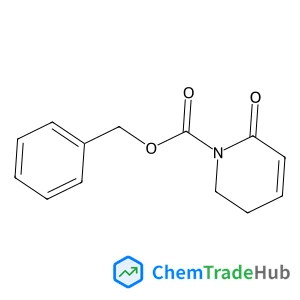
Benzyl 6-oxo-3,6-dihydro-1(2H)-pyridinecarboxylate
CAS Number:
725746-35-0
Molecular Formula:
C13H13NO3
Wenhui Li, Shuangping Huang, Qiang Liu, Xing Li, Wenwen Chen
An unprecedented tandem strategy for the construction of an array of 3-CF3-4-acyl functionalized quinolines has been described from readily available nitrosoarenes and β-CF3-1,3-enynes as starting materials by the combined use of Cu(OTf)2 as a catalyst and DMAP as a base. This reaction proceeds via a sequential formation of C–N, C–O and C–C bonds and the steric hindrance effect of substituents (R1) on the benzene ring of nitrosoarenes has a crucial impact on the reaction reactivity and site-selectivity. This cascade transformation features a novel annulation, easy C–H bond activation, readily available starting materials, good step-economy, good site-selectivity, generation of three new bonds and mild reaction conditions.
Jingde Li, Eric Croiset, Luis Ricardez-Sandoval
DOI: 10.1039/C3CP54376E
DOI: 10.1039/C3CP54041C
T. A. Nirmal Peiris, K. G. Upul Wijayantha, Jorge García-Cañadas
DOI: 10.1039/C3CP53260G
Simon Gallagher, Andrew Kavanagh, Bartosz Zíołkowski, Larisa Florea, Douglas R. MacFarlane, Kevin Fraser, Dermot Diamond
DOI: 10.1039/C3CP53397B
Lihao Han, Paula Perez Rodriguez, Bernard Dam, Miro Zeman, Arno H. M. Smets
DOI: 10.1039/C3CP55035D
David Ruzafa, Lorena Varela, Ana I. Azuaga, Francisco Conejero-Lara, Bertrand Morel
DOI: 10.1039/C3CP54383H
DOI: 10.1039/C3CP54300E
Ting Yang, Bingan Lu
DOI: 10.1039/C3CP54144D
Claudia Gomes da Rocha, P. Andre Clayborne, Pekka Koskinen
DOI: 10.1039/C3CP53780C
Luciano Carta, Malgorzata Biczysko, Daniele Licari, Vincenzo Barone
DOI: 10.1039/C3CP50499A
N-(4-Methoxybenzyl)-2-pyridinamine (CAS: 52818-63-0) is increasingly being used ...
When handling Ethyl 4-(2-chlorophenyl)-1,3-thiazole-2-carboxylate, appropriate p...
Diethyldiselane (CAS: 628-39-7) is classified under the Globally Harmonized Syst...
The market for oxocopper (CAS: 12053-18-8) is primarily driven by its use in cat...
The market for 5-{[(2-Methyl-2-propanyl)oxy]carbonyl}-5-azaspiro[2.4]heptane-7-c...
2-(1-Pyrrolidinyl)-4-pyridinamine is a chemical compound with the CAS number 359...
2-(3-Pyridinyl)-1-azabicyclo[2.2.2]octane (CAS: 91556-75-1) is a crystalline sol...
(S)-Alpha-allyl-proline hydrochloride is usually synthesized via a Wittig reacti...
3-Methyl-1,2-oxazole-5-carboxylic acid (CAS: 4857-42-5) is an organic compound w...
Lys-SMCC-DM1 is synthesized via a multi-step process involving the coupling of S...

Organic Chemistry Frontiers publishes high-quality research from across organic chemistry. Emphases are placed on studies that make significant contributions to the field of organic chemistry by reporting either new or significantly improved protocols or methodologies. Topics include, but are not limited to the following: Organic synthesis Development of synthetic methodologies Catalysis Natural products Functional organic materials Supramolecular and macromolecular chemistry Physical and computational organic chemistry
![N-{[(2-Methyl-2-propanyl)oxy]carbonyl}-L-methionylglycine structure](https://static.chemtradehub.com/structs/234/23446-03-9-e1e5.webp "N-{[(2-Methyl-2-propanyl)oxy]carbonyl}-L-methionylglycine structure")




