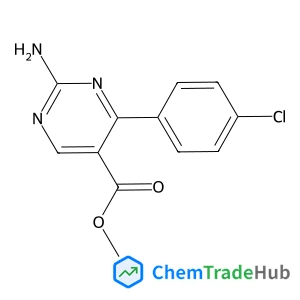
Methyl 2-amino-4-(4-chlorophenyl)-5-pyrimidinecarboxylate
CAS Number:
1133115-56-6
Molecular Formula:
C12H10ClN3O2
Tommy Fraser, Sébastien Cardinal
Herein, we report the first solid-phase total synthesis of the natural cyclic peptide anabaenopeptin F and the use of metallaphotoredox catalysis to overcome the key challenges associated with the preparation of the non-proteinogenic amino acid homotyrosine contained in these peptides. Starting from L-homoserine, enantiopure Fmoc-protected homotyrosine was prepared in a straightforward manner by metallaphotoredox catalysis with N-Fmoc-(S)-2-amino-4-bromobutanoic acid and 4-tert-butoxybromobenzene partners. The prepared protected amino acid was used in solid-phase peptide synthesis to achieve the total synthesis of anabaenopeptin F and establish the stereochemistry of the isoleucine residue. Protease inhibition studies with the synthesized anabaenopeptin F showed inhibitory activities against carboxypeptidase B in the low nanomolar range. The high convergency of the synthetic methodologies paves the way for the rapid access to N-Fmoc-protected non-proteinogenic and unnatural amino acids and the total synthesis of complex bioactive peptides containing these amino acids.
Matthew J. Gaunt, Helen F. Sneddon, Peter R. Hewitt, Paolo Orsini, David F. Hook, Steven V. Ley.
DOI: 10.1039/B208982C
Robert Chang, Adam R. Yeager, Nathaniel S. Finney
DOI: 10.1039/B208953J
Xianshun Zeng, Langxing Chen, Xuebing Leng, Fengbo Xu, Qinshan Li, Xiwen He, Wenqin Zhang, Zheng-Zhi Zhang
DOI: 10.1039/B211381C
Charuvila T. Aravindakumar, Man Nien Schuchmann, Balijepalli S. M. Rao, Justus von Sonntag
DOI: 10.1039/B209626A
Ahmad Allouch, Valérie Roubaud, Robert Lauricella, Jean-Claude Bouteiller, Béatrice Tuccio
DOI: 10.1039/B210035E
Anthony D. Wright, Claudia Osterhage, Gabriele M. König
DOI: 10.1039/B208588G
Yuichiro Kawamoto, Daiki Ozone, Toyoharu Kobayashi, Hisanaka Ito
DOI: 10.1039/C8OB02557F
Joffrey Pijeat, Yannick J. Dappe, Pierre Thuéry, Stéphane Campidelli
DOI: 10.1039/C8OB02150C
Jili Li, Jinlong Zhang, Qiuping Zhang, Zhongjie Bai, Quanyi Zhao, Dian He, Zhen Wang, Yonglin Chen, Bin Liu
DOI: 10.1039/C8OB01921E
DOI: 10.1039/C8OB02271B
2-Methylbenzene-1,4-diamine dihydrochloride (CAS: 615-45-2) should be stored in ...
(1S,4S)-2,5-Diazabicyclo[2.2.1]heptane dihydrobromide is generally considered sa...
(6-Chloropyridazin-3-YL)methanamine finds applications in the pharmaceutical ind...
2-Fluoro-3-methylphenol is primarily used in the synthesis of pharmaceuticals, p...
When handling 3-Methoxy-4-nitrobenzonitrile, it is important to wear appropriate...
When handling 1,3-Oxazolo[4,5-b]pyridine-2(3H)-thione (CAS: 211949-57-4), it is ...
4-Ethynylbenzamide (CAS: 90347-86-7) falls under various regulatory guidelines i...
3-(2-Ethylphenyl)-2-thioxo-4-imidazolidinone is primarily used as an intermediat...
(2-Fluoro-6-methoxyphenyl)acetic acid, also known as 4-fluoro-3-methoxybenzoic a...
Market trends for 2-[4-(Hydroxymethyl)phenoxy]ethanol (CAS: 102196-18-9) indicat...

Organic & Biomolecular Chemistry (OBC) publishes original and high impact research and reviews in organic chemistry. We welcome research that shows new or significantly improved protocols or methodologies in total synthesis, synthetic methodology or physical and theoretical organic chemistry as well as research that shows a significant advance in the organic chemistry or molecular design aspects of chemical biology, catalysis, supramolecular and macromolecular chemistry, theoretical chemistry, mechanism-oriented physical organic chemistry, medicinal chemistry or natural products. Articles published in the journal should report new work which makes a highly-significant impact in the field. Routine and incremental work is generally not suitable for publication in the journal. More details about key areas of our scope are below. In all cases authors should include in their article clear rationale for why their research has been carried out.
![[1-(5-Methyl-2-pyridinyl)-1H-pyrazol-4-yl]methanol structure](https://static.chemtradehub.com/structs/143/1439822-99-7-6cc9.webp "[1-(5-Methyl-2-pyridinyl)-1H-pyrazol-4-yl]methanol structure")