












![N-[(E)-Phenylmethylene]benzenesulfonamide structure](https://static.chemtradehub.com/structs/139/13909-34-7-8167.webp "N-[(E)-Phenylmethylene]benzenesulfonamide structure")
Evaluation of using the time-dependent density functional theory in studying the fluorescence properties of coumarin derivatives
Literature Information
Publication Date
2023-12-11
DOI
10.1039/D3NJ05220F
Impact Factor
3.591
Authors
Nguyen Khoa Hien, Mai Van Bay, Quan V. Vo, Ngo Duy Y., Duong Tuan Quang, Pham Cam Nam
View Original
Abstract
In this study, the performance of predicting fluorescence properties using 11 density functional theory (DFT) functionals was evaluated through a comparison with experimental results of 30 coumarin derivatives. The results revealed that there was no significant difference in the predictive performance of maximum emission wavelengths (MEWs) when using the optimized geometries obtained with the PBE0 functional compared to the other studied functionals. The global hybrid functionals with a small constant fraction of HF exchange (B3LYP, PBE0, M06), double-hybrid functionals (APDF and PW6B9D3), global hybrid functionals with a large constant fraction of HF exchange (M06-2X), and long-range correction functionals (CAM-B3LYP and ωB97X-D) exhibited good predictive ability. The linear relationship coefficient (R) values, between the experimental and calculated MEWs, ranked in the strong linear correlation group. Among them, the functionals B3LYP, PBE0, M06, APDF, and PW6B9D3 yielded the best mean signed error (MSE), mean absolute error (MAE), and root mean square error (RMSE) values. The values (MSE, MAE, RMSE) for the B3LYP, PBE0, M06, APDF, and PW6B9D3 functionals in nanometers (nm) were as follows: (−47, 53, 58), (−59, 61, 66), (−56, 58, 63), (−55, 59, 64), and (−58, 59, 65), respectively. In electronvolts (eV), the values were: (0.34, 0.37, 0.41), (0.44, 0.45, 0.49), (0.41, 0.42, 0.46), (0.41, 0.42, 0.46), and (0.43, 0.43, 0.47), respectively. The pure density functionals (PBE and BP86) and LC-ωPBE exhibited poor predictive ability, with a linear relationship coefficient (R) only ranking in the medium linear correlation group. To enhance prediction accuracy, the corrected calculated MEWs, based on the linear correlation between the calculated and experimental MEWs, were determined. This correction resulted in substantially reduced values for the corrected statistical parameters (MSEcor, MAEcor, and RMSEcor) when compared to the uncorrected values. Importantly, this correction also minimized the variation in prediction performance among different DFT functionals, providing users with greater flexibility in selecting the most suitable DFT functional for their specific needs.
Related Literature
Correction: Synergistic effects of hydrophobicity and gas barrier properties on the anticorrosion property of PMMA nanocomposite coatings embedded with graphene nanosheets
Kung-Chin Chang, Wei-Fu Ji, Mei-Chun Lai, You-Rong Hsiao, Chien-Hua Hsu, Tsao-Li Chuang, Yen Wei, Jui-Ming Yeh, Wei-Ren Liu
2014-10-21
Correction
DOI: 10.1039/C4PY90078B
Synthesis, morphology, and electrical memory application of oligosaccharide-based block copolymers with π-conjugated pyrene moieties and their supramolecules
Han-Sheng Sun, Yougen Chen, Wen-Ya Lee, Yu-Cheng Chiu, Takuya Isono, Toshifumi Satoh, Toyoji Kakuchi, Wen-Chang Chen
2015-12-09
Paper
DOI: 10.1039/C5PY01697E
BODIPY-based macromolecular photosensitizer with cation-enhanced antibacterial activity
Zhentan Lu, Xinge Zhang, Yu Zhao, Yinan Xue, Tingting Zhai, Zhongming Wu, Chaoxing Li
2014-10-06
Paper
DOI: 10.1039/C4PY00715H
Hyperbranched poly(phosphoester)s as flame retardants for technical and high performance polymers
Karoline Täuber, Frederik R. Wurm, Bernhard Schartel
2014-09-08
Paper
DOI: 10.1039/C4PY00830H
Surface modification of silicone via colloidal deposition of amphiphilic block copolymers
Ghislaine Robert-Nicoud, Roberto Donno, Christopher J. Cadman, Morgan R. Alexander
2014-08-07
Paper
DOI: 10.1039/C4PY00941J
Branched polythiophenes by Ni-catalyzed Kumada coupling
Martin Scheuble, Thomas V. Richter, Miriam Goll, Steffen Link, Juan T. López Navarrete, Adrian Ruff, M. Carmen Ruiz Delgado, Sabine Ludwigs
2014-09-01
Paper
DOI: 10.1039/C4PY00899E
Synthesis of 9,9′-spirobifluorene-based conjugated microporous polymers by FeCl3-mediated polymerization
Arindam Modak, Yoshifumi Maegawa, Yasutomo Goto, Shinji Inagaki
2015-12-28
Paper
DOI: 10.1039/C5PY01900A
Synthesis and characterization of half-salen complexes and their application in the polymerization of lactide and ε-caprolactone
Xuan Pang, Ranlong Duan, Xiang Li, Zhiqiang Sun, Han Zhang, Xianhong Wang, Xuesi Chen
2014-09-10
Paper
DOI: 10.1039/C4PY00734D
You might also like
Compound Q&A
How should waste containing (6-Bromo-2-naphthyl)oxy](dimethyl)(2-methyl-2-propanyl)silane be handled?
Waste containing (6-Bromo-2-naphthyl)oxy](dimethyl)(2-methyl-2-propanyl)silane (...
100751-65-3[(6-Bromo-2-naphthyl...
Compound Q&A
How is 7-Fluoro-4-isoquinolinecarboxylic acid (CAS: 1841081-40-0) typically synthesized?
7-Fluoro-4-isoquinolinecarboxylic acid can be synthesized via a multi-step proce...
1841081-40-07-Fluoro-4-isoquinol...
Compound Q&A
What are the physical and chemical properties of 2,3,5,6-Tetrabromothieno[3,2-b]thiophene (CAS: 124638-53-5)?
2,3,5,6-Tetrabromothieno[3,2-b]thiophene is a crystalline compound with a high m...
124638-53-52,3,5,6-Tetrabromoth...
Compound Q&A
Is 1-[4-(Benzylamino)-7,8-dihydro-5H-pyrano[4,3-d]pyrimidin-2-yl]-2-methyl-1H-indole-4-carboxamide (CAS: 1542705-92-9) safe?
1-[4-(Benzylamino)-7,8-dihydro-5H-pyrano[4,3-d]pyrimidin-2-yl]-2-methyl-1H-indol...
1542705-92-91-[4-(Benzylamino)-7...
Compound Q&A
What is the market or research trend for imidazo[5,1-d]-1,2,3,5-tetrazine-8-carboxylic acid, 3,4-dihydro-3-methyl-4-oxo- (CAS: 113942-30-6)?
The market for imidazo[5,1-d]-1,2,3,5-tetrazine-8-carboxylic acid, 3,4-dihydro-3...
113942-30-6Imidazo[5,1-d]-1,2,3...
Compound Q&A
What is 3-(Triisopropylsilyl)propiolaldehyde (CAS: 163271-80-5)?
3-(Triisopropylsilyl)propiolaldehyde is a synthetic organic compound with the CA...
163271-80-53-(Triisopropylsilyl...
Compound Q&A
What regulatory guidelines apply to 6-Nitro-2H-1,4-benzoxazin-3(4H)-one (CAS: 81721-87-1)?
6-Nitro-2H-1,4-benzoxazin-3(4H)-one (CAS: 81721-87-1) is subject to various regu...
81721-87-16-Nitro-2H-1,4-benzo...
Compound Q&A
How should waste containing (3-Fluorophenyl)(4-{[(2-methyl-2-propanyl)oxy]carbonyl}-1-piperazinyl)acetic acid (CAS: 885272-91-3) be handled?
Waste containing (3-Fluorophenyl)(4-{[(2-methyl-2-propanyl)oxy]carbonyl}-1-piper...
885272-91-3(3-Fluorophenyl)(4-{...
Compound Q&A
What are the physical and chemical properties of N,N'-4,4'-Biphenyldiyldiisonicotinamide (CAS: 55119-40-9)?
N,N'-4,4'-Biphenyldiyldiisonicotinamide is a white crystalline solid with a mole...
55119-40-9N,N'-4,4'-Biphenyldi...
Compound Q&A
What industries use 6-Bromo-8-fluoro-2-quinazolinol (CAS: 1036756-15-6)?
6-Bromo-8-fluoro-2-quinazolinol is primarily used in the pharmaceutical industry...
1036756-15-66-Bromo-8-fluoro-2-q...
Source Journal
New Journal of Chemistry

CiteScore:
5.3
Self-citation Rate:
3.7%
Articles per Year:
2153
NJC (New Journal of Chemistry) is a broad-based primary journal encompassing all branches of chemistry and its sub-disciplines. It contains full research articles, communications, perspectives and focus articles. This well-established journal, owned by the Centre National de la Recherche Scientifique (CNRS) of France, has been co-published with the Royal Society of Chemistry since January 1998. NJC is the forum for the publication of high-quality, original and significant work that opens new directions in chemistry or other scientific disciplines. In addition to having a significant chemical component, work published in NJC must demonstrate that it will have an impact on areas of research other than that of the reported work.
Recommended Compounds

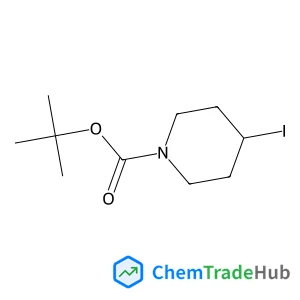
2-Methyl-2-propanyl 4-iodo-1-piperidinecarboxylate
CAS Number:
301673-14-3
Molecular Formula:
C10H18INO2
Recommended Suppliers






Disclaimer
This page provides academic journal information for reference and research purposes only. We are not affiliated with any journal publishers and do not handle publication submissions. For publication-related inquiries, please contact the respective journal publishers directly.
If you notice any inaccuracies in the information displayed, please contact us at support@chemtradehub.com. We will promptly review and address your concerns.