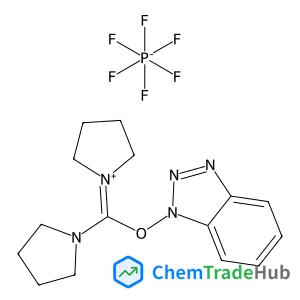
(1H-Benzotriazol-1-yloxy)(di-1-pyrrolidinyl)methylium hexafluorophosphate
CAS Number:
105379-24-6
Molecular Formula:
C15H21F6N5OP
Zhi-Yuan Cao, Lei Chen, Le-Le Song, Ding Weng, Yuan Ma, Bo-Wen Yu, Xuan Li, Xing-Fu Shang, Jia-Dao Wang
Flexible microcircuits are developing rapidly with the trends of miniaturization and foldability in modern electronic products. The chemical growth welding technique of silver seeds offers several advantages, including compatibility with a wide range of substrates, ease of operation, and room temperature growth, making it a promising method for use in the manufacturing of flexible electronics. In this paper, we demonstrated a feasible solution based on silver seeds and the chemical welding process of copper at near room temperature. The growth of copper microcircuits was directly determined by the size and distribution of silver seeds. Seeding parameters for preparing long copper microcircuits were optimized, and two types of possible defects in the as-prepared copper microcircuits were analyzed. Based on the optimized parameters, patterned fine copper microcircuits and large-area copper wires were prepared, and the conductivity and fatigue resistance were verified.
H. Fabio Busnengo
DOI: 10.1039/C8CP03515F
DOI: 10.1039/C8CP01594E
Nobuyoshi Koga, Satoki Kodani
DOI: 10.1039/C8CP05701J
Pilar Herrasti
DOI: 10.1039/C8CP02513D
Huan Zong, Xinxin Wang, Jun Quan, Chunhua Tian, Mengtao Sun
DOI: 10.1039/C8CP03442G
Jiajun Wang, Baozeng Zhou, Fang Wang, Yinping Miao, Junqing Wei, Baojun Zhang, Kailiang Zhang
DOI: 10.1039/C8CP04337J
Anthony C. Legon, Nicholas R. Walker
DOI: 10.1039/C8CP03432J
Nimisha Singh, Jyotsnamayee Nayak, Khushbu Patel, Suban K. Sahoo, Rajender Kumar
DOI: 10.1039/C8CP05391J
Yingxiang Cai, Li Zeng, Yu Zhang, Xuechun Xu
DOI: 10.1039/C8CP03447H
Javor K. Novev, Richard G. Compton
DOI: 10.1039/C8CP91865A
When handling 4-(2-Furylmethyl)thiomorpholine 1,1-dioxide (CAS: 79206-94-3), it ...
When handling 4-Chloro-N-[2-(4-morpholinyl)ethyl]benzamide (CAS: 71320-77-9), it...
Waste containing this compound (CAS: 62921-74-8) should be handled according to ...
Waste containing (S)-Methyl 2-amino-3-cyclohexylpropanoate should be collected i...
This compound can be synthesized using a multi-step process involving the conjug...
There are several alternatives to (2E)-3-(3,4-Dichlorophenyl)acrylic acid in syn...
Ethyl 6-(2-nitrophenyl)imidazo[2,1-b][1,3]thiazole-3-carboxylate (CAS: 925437-84...
Waste containing 2-(1,3-Thiazol-2-yl)ethanamine (CAS: 18453-07-1) should be coll...
Methyl 5-iodo-2-methylbenzoate can be synthesized through the iodination of meth...
5-Chloro[1,2,4]triazolo[1,5-a]pyridine is commonly synthesized via the condensat...

NJC (New Journal of Chemistry) is a broad-based primary journal encompassing all branches of chemistry and its sub-disciplines. It contains full research articles, communications, perspectives and focus articles. This well-established journal, owned by the Centre National de la Recherche Scientifique (CNRS) of France, has been co-published with the Royal Society of Chemistry since January 1998. NJC is the forum for the publication of high-quality, original and significant work that opens new directions in chemistry or other scientific disciplines. In addition to having a significant chemical component, work published in NJC must demonstrate that it will have an impact on areas of research other than that of the reported work.