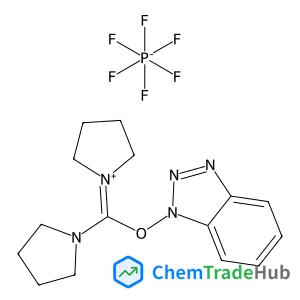
(1H-Benzotriazol-1-yloxy)(di-1-pyrrolidinyl)methylium hexafluorophosphate
CAS Number:
105379-24-6
Molecular Formula:
C15H21F6N5OP
Nanoparticle-induced aggregation and fragmentation phenomena in liquid media are investigated by applying a model of preferential attachment of dispersing molecules to randomly chosen nanoparticles and larger particles, each containing a single nanoparticle. The model is based on the assumption that immersed nanoparticles, media molecules, and the resulting composite particles do not form any self-linked structures, i.e., that they do not undergo homoaggregation as a consequence of, e.g., electrostatic repulsion. Probabilities of both connecting and disconnecting a molecule are considered as being proportional to the surface area of a target particle. Additionally, the aggregation probability is assumed to be driven by van der Waals interactions. The interplay between aggregation and fragmentation processes is studied for different relative efficiencies (frequencies) of these processes. In particular, the time evolution of the particle size distribution is analyzed at various values of the relative frequency rate between aggregation and fragmentation events. It is shown that the evolution of an ensemble of particles over relatively long time periods can lead to very peculiar particle size distributions, including nearly homogeneous and highly heterogeneous partitioning. This indicates that, by controlling the frequency rate, one can obtain materials with very diverse and unique properties. Theoretical results obtained within the studied model are compared with corresponding experimental data.
Lingfeng Xu, Ling Ni, Lihe Sun, Fang Zeng, Shuizhu Wu
DOI: 10.1039/C9AN01582E
Zoë J. Ayres, Mark E. Newton, Julie V. Macpherson
DOI: 10.1039/C6AN00340K
Yuan Yu, Jie Shen, Jinfang Zhi
DOI: 10.1039/C5AN02478A
Manman Lin, Bin Xu, Huilu Yao, Aiguo Shen, Jiming Hu
DOI: 10.1039/C5AN02315G
Wanyu Zhang, Lihua Jia, Rui Yang, Yu Zhang, Zhenlong Zhao
DOI: 10.1039/C9AN01953G
Wen Yang, Jianniao Tian, Lijun Wang, Shui Fu, Hongyun Huang, Yanchun Zhao, Shulin Zhao
DOI: 10.1039/C6AN00184J
Bartolomeo Della Ventura, Martina Banchelli, Riccardo Funari, Anna Illiano, Marella De Angelis, Paola Taroni, Angela Amoresano, Paolo Matteini, Raffaele Velotta
DOI: 10.1039/C9AN00443B
Luca Guerrini
DOI: 10.1039/C9AN02040C
When handling 4-(2-Furylmethyl)thiomorpholine 1,1-dioxide (CAS: 79206-94-3), it ...
When handling 4-Chloro-N-[2-(4-morpholinyl)ethyl]benzamide (CAS: 71320-77-9), it...
Waste containing this compound (CAS: 62921-74-8) should be handled according to ...
Waste containing (S)-Methyl 2-amino-3-cyclohexylpropanoate should be collected i...
This compound can be synthesized using a multi-step process involving the conjug...
There are several alternatives to (2E)-3-(3,4-Dichlorophenyl)acrylic acid in syn...
Ethyl 6-(2-nitrophenyl)imidazo[2,1-b][1,3]thiazole-3-carboxylate (CAS: 925437-84...
Waste containing 2-(1,3-Thiazol-2-yl)ethanamine (CAS: 18453-07-1) should be coll...
Methyl 5-iodo-2-methylbenzoate can be synthesized through the iodination of meth...
5-Chloro[1,2,4]triazolo[1,5-a]pyridine is commonly synthesized via the condensat...

Physical Chemistry Chemical Physics (PCCP) is an international journal co-owned by 19 physical chemistry and physics societies from around the world. This journal publishes original, cutting-edge research in physical chemistry, chemical physics and biophysical chemistry. To be suitable for publication in PCCP, articles must include significant innovation and/or insight into physical chemistry; this is the most important criterion that reviewers and Editors will judge against when evaluating submissions. The journal has a broad scope and welcomes contributions spanning experiment, theory, computation and data science. Topical coverage includes spectroscopy, dynamics, kinetics, statistical mechanics, thermodynamics, electrochemistry, catalysis, surface science, quantum mechanics, quantum computing and machine learning. Interdisciplinary research areas such as polymers and soft matter, materials, nanoscience, energy, surfaces/interfaces, and biophysical chemistry are welcomed if they demonstrate significant innovation and/or insight into physical chemistry. Joined experimental/theoretical studies are particularly appreciated when complementary and based on up-to-date approaches.
![1,2-Diphenyl-4-[2-(phenylsulfinyl)ethyl]-3,5-pyrazolidinedione structure](https://static.chemtradehub.com/structs/57-/57-96-5-efcc.webp "1,2-Diphenyl-4-[2-(phenylsulfinyl)ethyl]-3,5-pyrazolidinedione structure")