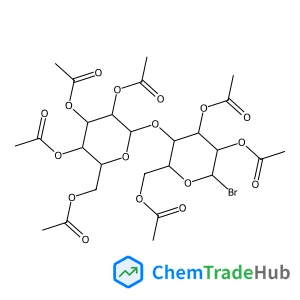
2,3,6-Tri-O-acetyl-4-O-(2,3,4,6-tetra-O-acetyl-beta-D-galactopyranosyl)-alpha-D-glucopyranosyl bromide
CAS Number:
4753-07-5
Molecular Formula:
C26H35BrO17
René S. Rojas, Fernando Carrillo-Hermosilla, Javier Martínez, Antonio Antiñolo, Oleksandra S. Trofymchuk, Fabiane M. Nachtigall, Leonardo S. Santos, Constantin G. Daniliuc
In this study, we present the synthesis, characterization and catalytic reactions of a new family of one-component catalysts based on guanidinium salts. The synthesis of cyclic carbonates from epoxides and CO2 at 70–80 °C under 1–5 bar of CO2 pressure is demonstrated using the new one-component guanidinium salts with various substituents. The 1e catalytic system, which has isopropyl-type substituents in its structure, has the best conversion rates; the TON for the synthesis of styrene carbonate was 92. The production of cyclic carbonates from the internal epoxides is another application for these catalytic systems with the conversion of cyclohexane oxide to the respective cyclic carbonate at 86% with 1e catalyst. Finally, ESI-MS was used to examine the interaction of the new organocatalysts with CO2 and epichlorohydrin. These findings led to catalysts made of organic molecules that are suitable for organocatalysis since they do not require a co-catalyst and can operate effectively at moderate pressures and temperatures.
Jun Li, Changjian Xie, Hua Guo
DOI: 10.1039/C7CP04578F
X. Liu, Y. Geng, A. Forni, E. Lucenti, S. Righetto, S. Decurtins, S.-X. Liu
DOI: 10.1039/C7CP04687A
Jie Yang, Zhijun Xu, Xiaoning Yang
DOI: 10.1039/C7CP04236A
Qun Zeng, Xianggui Xue, Zengming Zhang, Fude Nie, Chaoyang Zhang
DOI: 10.1039/C7CP04015F
Xinyu Wang, Man Wang, Yang Hong, Zongrong Wang, Jingchao Zhang
DOI: 10.1039/C7CP04219A
Lucas Schwob, Mathieu Lalande, Dmitrii Egorov, Jimmy Rangama, Ronnie Hoekstra, Violaine Vizcaino, Thomas Schlathölter, Jean-Christophe Poully
DOI: 10.1039/C7CP03376A
Vadym V. Kulish, Daniel Koch, Sergei Manzhos
DOI: 10.1039/C7CP04360K
Olfa Ferchichi, Najoua Derbel, Nejm-Eddine Jaidane, Thibaud Cours, Alexander Alijah
DOI: 10.1039/C7CP03134C
Cuiping Wang, Cong Li, Jiajia Han, Lihui Yan, Bin Deng, Xingjun Liu
DOI: 10.1039/C7CP03775A
6-(3-Fluorophenyl)picolinic acid is generally considered safe for laboratory use...
(3R)-3-Pyrrolidinol is used in the pharmaceutical industry as a precursor for dr...
When handling (4R,5R)-4,5-Diethoxycarbonyl-2,2-dimethyldioxolane (CAS: 59779-75-...
1-(6-Chloroimidazo[1,2-b]pyridazin-3-yl)ethanone is often synthesized via a mult...
The market for N-Ethyl-3,4-dimethylbenzylamine (CAS: 39180-83-1) remains steady,...
Tert-butyl 3-(pyrrolidin-1-yl)azetidine-1-carboxylate is a chemical compound wit...
1-Bromo-3-chloro-2,4-dimethoxybenzene (CAS: 1228956-93-1) falls under the classi...
The safety of 8-Bromo-2-methyl-3,4-dihydroisoquinolin-1(2H)-one (CAS: 1368622-07...
Benzyl [(3S)-2,6-dioxo-3-piperidinyl]carbamate is generally safe when handled wi...
1-{[4-(4,4,5,5-Tetramethyl-1,3,2-dioxaborolan-2-yl)phenyl]sulfonyl}pyrrolidine s...

NJC (New Journal of Chemistry) is a broad-based primary journal encompassing all branches of chemistry and its sub-disciplines. It contains full research articles, communications, perspectives and focus articles. This well-established journal, owned by the Centre National de la Recherche Scientifique (CNRS) of France, has been co-published with the Royal Society of Chemistry since January 1998. NJC is the forum for the publication of high-quality, original and significant work that opens new directions in chemistry or other scientific disciplines. In addition to having a significant chemical component, work published in NJC must demonstrate that it will have an impact on areas of research other than that of the reported work.
![1-Benzyl-1,7-diazaspiro[4.4]nonane dihydrochloride structure](https://static.chemtradehub.com/structs/115/1159822-71-5-0320.webp "1-Benzyl-1,7-diazaspiro[4.4]nonane dihydrochloride structure")