












![6-Nitro-2-(4-nitrophenyl)imidazo[1,2-a]pyridine structure](https://static.chemtradehub.com/structs/118/118000-57-0-cb82.webp "6-Nitro-2-(4-nitrophenyl)imidazo[1,2-a]pyridine structure")
Novel methoxyphenylthio-substituted phthalocyanines: synthesis, characterization, proton-transfer, and acid-sensing properties
Literature Information
Publication Date
2024-01-03
DOI
10.1039/D3NJ03944G
Impact Factor
3.591
Authors
Rüveyda Ağcaabat, Cemile Seslikaya, Volkan Fındık, Safiye Sağ Erdem, Zafer Odabaş
View Original
Abstract
This study involves the synthesis of novel methoxyphenylthio-substituted phthalocyanines and their starting phthalonitriles as well as the characterization and investigation of their physical and spectral properties. Herein, although phthalocyanines were categorized as alpha and beta-substituted, the numbers of external substituent methoxy groups selected to obtain soluble phthalocyanines were also different. After their molecular structure was characterized using elemental analysis, FT-IR, NMR, and MALDI-TOF-MS techniques, the exhaustive electronic spectra of novel phthalocyanines were studied. During extensive UV-Vis spectroscopy studies, proton transfer complexes in basic coordinating solvents and protonated species in solvents containing acids as impurities occurred incidentally in some phthalocyanines. Then, it was investigated whether this incidentally encountered situation was related to the number of methoxy groups as external substituents. Consequently, it was revealed that the acidity of H atoms in the center of phenylthio-substituted phthalocyanines could be altered by outer groups in the substituents, and the wavelengths of the Q bands of the novel Pcs changed under the influence of these outer groups. Computational TD-DFT study at the ωB97XD/6-311G(d,p) level confirmed the redshift observed in electronic spectra upon inserting two additional OCH3 at outer groups, originating from small decreases in the HOMO–LUMO energy gap. The NBO charge distribution justified the electron donation from sulfur atoms to the phthalocyanine ring.
Related Literature
Temperature-sensitive nanogels: poly(N-vinylcaprolactam) versus poly(N-isopropylacrylamide)
Jose Ramos, Ainara Imaz, Jacqueline Forcada
2011-12-16
Minireview
DOI: 10.1039/C2PY00485B
High relaxivity MRI imaging reagents from bimodal star polymers
Chinessa T. Adkins, Julia N. Dobish, Clifford S. Brown, Brian Mayrsohn, Sharon K. Hamilton, Felicia Udoji, Kelly Radford, Thomas E. Yankeelov, John C. Gore, Eva Harth
2011-11-29
Paper
DOI: 10.1039/C1PY00474C
Hyperbranched glycoconjugated polymer from natural small molecule kanamycin as a safe and efficient gene vector
Jieli Wu, Linzhu Zhou, Chengyu Jin, Chunlai Tu, Bangshang Zhu, Qi Zhu, Deyue Yan
2011-09-19
Paper
DOI: 10.1039/C1PY00333J
Photo-cross-linked mPEG-poly(γ-cinnamyl-l-glutamate) micelles as stable drug carriers
Xiuli Hu, Zhigang Xie, Yubin Huang, Xiabin Jing
2012-03-23
Paper
DOI: 10.1039/C2PY20049J
Upgrading of bio-oil and subsequent co-processing under FCC conditions for fuel production
Udo Armbruster, Hanan Atia, Ursula Bentrup, Binh Minh Quoc Phan, Reinhard Eckelt, Luong Huu Nguyen, Duc Anh Nguyen, Andreas Martin
2015-12-14
Paper
DOI: 10.1039/C5RE00068H
Boron-containing polymers as versatile building blocks for functional nanostructured materials
Fei Cheng, Frieder Jäkle
2011-05-18
Review Article
DOI: 10.1039/C1PY00123J
A simple microfluidic device for fabrication of double emulsion droplets and polymer microcapsules
Gabit Nurumbetov, Nicholas Ballard, Stefan A. F. Bon
2012-02-06
Paper
DOI: 10.1039/C2PY00605G
Preparation of jellyfish-shaped amphiphilic block-graft copolymers consisting of a poly(ε-caprolactone)-block-poly(pentafluorostyrene) ring and poly(ethylene glycol) lateral brushes
Tao Cai, Wen Jing Yang
2012-02-08
Paper
DOI: 10.1039/C2PY00609J
You might also like
Compound Q&A
What industries use 4-(4-tert-Butylphenyl)-1H-pyrazol-3-amine (CAS: 1015845-73-4)?
4-(4-tert-Butylphenyl)-1H-pyrazol-3-amine finds applications in various industri...
1015845-73-44-(4-tert-Butylpheny...
Compound Q&A
What industries use H3TATAB (CAS: 63557-10-8)?
H3TATAB is used in the pharmaceutical industry for the synthesis of certain orga...
63557-10-8H3TATAB
Compound Q&A
What are the main uses of 1-Ethyl-3-fluorobenzene (CAS: 696-39-9)?
1-Ethyl-3-fluorobenzene (CAS: 696-39-9) is primarily used as a precursor in the ...
696-39-91-Ethyl-3-fluorobenz...
Compound Q&A
What are the main uses of 1-(tert-Butoxycarbonyl)-4-(4-methoxyphenyl)pyrrolidine-3-carboxylic acid (CAS: 851484-94-1)?
1-(tert-Butoxycarbonyl)-4-(4-methoxyphenyl)pyrrolidine-3-carboxylic acid is prim...
851484-94-11-(tert-Butoxycarbon...
Compound Q&A
What are the physical and chemical properties of 1-Cyclobutyl-4-piperidinone (CAS: 359880-05-0)?
1-Cyclobutyl-4-piperidinone (CAS: 359880-05-0) is a colorless or white crystalli...
359880-05-01-Cyclobutyl-4-piper...
Compound Q&A
What is Pyridine-2,6-dicarboxylic acid mono-tert-butyl ester (CAS: 575433-76-0)?
Pyridine-2,6-dicarboxylic acid mono-tert-butyl ester (CAS: 575433-76-0) is a che...
575433-76-0Pyridine-2,6-dicarbo...
Compound Q&A
What is the market or research trend for 2,3-Difluorophenylalanine (CAS: 236754-62-4)?
The market for 2,3-Difluorophenylalanine (CAS: 236754-62-4) is growing with incr...
236754-62-42,3-Difluorophenylal...
Compound Q&A
How is (2-Hydroxy-1-naphthyl)boronic acid (CAS: 898257-48-2) typically synthesized?
(2-Hydroxy-1-naphthyl)boronic acid can be synthesized through the reduction of 2...
898257-48-2(2-Hydroxy-1-naphthy...
Compound Q&A
What are the physical and chemical properties of tert-Butyl (5-bromo-6-methyl-3-(4,4,5,5-tetramethyl-1,3,2-dioxaborolan-2-yl)pyridin-2-yl)carbamate (CAS: 1315351-28-0)?
This compound is a crystalline solid with a molecular weight of approximately 52...
1315351-28-0tert-Butyl (5-bromo-...
Compound Q&A
Are there alternatives to 5,7-Dihydroxy-4-oxo-2-(3,4,5-trihydroxyphenyl)-4H-chromen-3-yl beta-D-glucopyranoside (CAS: 19833-12-6) in synthesis?
While 5,7-Dihydroxy-4-oxo-2-(3,4,5-trihydroxyphenyl)-4H-chromen-3-yl beta-D-gluc...
19833-12-65,7-Dihydroxy-4-oxo-...
Source Journal
New Journal of Chemistry

CiteScore:
5.3
Self-citation Rate:
3.7%
Articles per Year:
2153
NJC (New Journal of Chemistry) is a broad-based primary journal encompassing all branches of chemistry and its sub-disciplines. It contains full research articles, communications, perspectives and focus articles. This well-established journal, owned by the Centre National de la Recherche Scientifique (CNRS) of France, has been co-published with the Royal Society of Chemistry since January 1998. NJC is the forum for the publication of high-quality, original and significant work that opens new directions in chemistry or other scientific disciplines. In addition to having a significant chemical component, work published in NJC must demonstrate that it will have an impact on areas of research other than that of the reported work.
Recommended Compounds
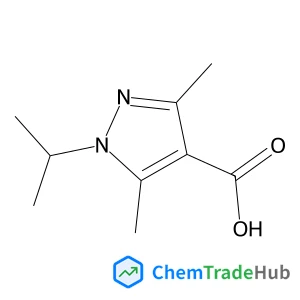
1-isopropyl-3,5-dimethyl-1H-pyrazole-4-carboxylic acid
CAS Number:
1007542-01-9
Molecular Formula:
C9H14N2O2
![Ethyl 2-[(3-bromo-4-pyridinyl)sulfanyl]-2-methylpropanoate structure](https://static.chemtradehub.com/structs/135/1352794-86-5-a8aa.webp "Ethyl 2-[(3-bromo-4-pyridinyl)sulfanyl]-2-methylpropanoate structure")
Ethyl 2-[(3-bromo-4-pyridinyl)sulfanyl]-2-methylpropanoate
CAS Number:
1352794-86-5
Molecular Formula:
C11H14BrNO2S
Recommended Suppliers




Disclaimer
This page provides academic journal information for reference and research purposes only. We are not affiliated with any journal publishers and do not handle publication submissions. For publication-related inquiries, please contact the respective journal publishers directly.
If you notice any inaccuracies in the information displayed, please contact us at support@chemtradehub.com. We will promptly review and address your concerns.