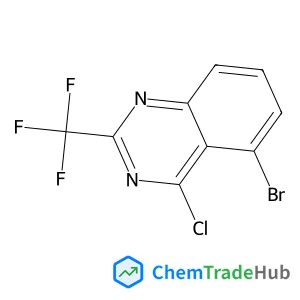
5-Bromo-4-chloro-2-(trifluoromethyl)quinazoline
CAS Number:
2089311-03-3
Molecular Formula:
C9H3BrClF3N2
Vijay Sai Krishna Cheerala, Abdul Akhir, Deepanshi Saxena, Rahul Maitra, Sundaresan Chittor Neelakantan
Antibiotic resistance is rapidly exacerbating the unceasing rise in nosocomial infections caused by drug-resistant bacterial pathogens such as methicillin-resistant Staphylococcus aureus (MRSA), carbapenem-resistant Enterobacteriaceae (CRE) and vancomycin-resistant Enterococcus (VRE). Therefore, there is a dire need for new therapeutic agents that can mitigate the unbridled emergence of drug-resistant pathogens. In the present study, several benzoxazole–thiazolidinone hybrids (BT hybrids) were synthesized and evaluated for their antibacterial activity against the ESKAP pathogen panel. The preliminary screening revealed the selective and potent inhibitory activity of hydroxy BT hybrids against S. aureus with MIC ≤ 4 μg mL−1. Hydroxy compounds (BT25, BT26, BT18, BT12, and BT11) exhibited a good selectivity index (SI > 20), which were determined to be non-toxic to Vero cells. An engaging fact is that two compounds BT25 and BT26 showed potent activity against various clinically-relevant and highly drug resistant S. aureus (MRSA & VRSA) and Enterococcus (VRE) isolates. These hybrids showed concentration-dependent bactericidal activity that is comparable to vancomycin. These experimental results were corroborated with docking, molecular dynamics, and free energy studies to discern the antibacterial mechanisms of hydroxy BT hybrids with three bacterial enzymes DNA gyrase B, MurB, and penicillin binding protein 4 (PBP4). The reassuring outcome of the current investigation confirmed that the aforementioned BT hybrids could be used as very promisingly potent antibacterial agents for the treatment of Staphylococcus aureus and Enterococcus infections.
Yi Wang, Hao-Yi Wang, Man Yu, Li-Min Fu, Yujun Qin, Jian-Ping Zhang, Xi-Cheng Ai
DOI: 10.1039/C5CP04360C
Danila A. Barskiy
DOI: 10.1039/C5CP05134G
N. R. Jena, Vivek Gaur, P. C. Mishra
DOI: 10.1039/C5CP02636A
R. Janicki, A. Mondry
DOI: 10.1039/C5CP02429C
Martin Gouverneur, Jakob Kopp, Leo van Wüllen, Monika Schönhoff
DOI: 10.1039/C5CP05753A
Ruvini Dharmadasa, I. M. Dharmadasa, Thad Druffel
DOI: 10.1039/C5CP01652E
Stephan Mohr, Luigi Genovese, Damien Caliste, Paul Boulanger, Stefan Goedecker, Thierry Deutsch
DOI: 10.1039/C5CP00437C
Sonia Marggi Poullain, Marta G. González, Peter C. Samartzis, Luis Rubio-Lago, Luis Bañares
DOI: 10.1039/C5CP04850H
Waste containing 6-Chloro-5-(2'-hydroxy-3'-methoxy-4-biphenylyl)-3-(3-methoxyphe...
(3alpha,5alpha)-3-Hydroxypregnane-11,20-dione is primarily used in the pharmaceu...
The market for 4-Amino-6-chloro-2-pyridinecarboxylic acid (CAS: 546141-56-4) is ...
Alternatives to (2-Benzoylethyl)trimethylammonium chloride (CAS: 24472-88-6) in ...
N-[4-Nitro-3-(trifluoromethyl)phenyl]acetamide (CAS: 393-12-4) is generally safe...
Alternative reagents such as other phosphates or similar functional groups can b...
There are alternatives to N,N'-Bis(3-aminopropyl)-1,3-propanediamine (CAS: 4605-...
When handling Aluminium trihexadecanoate, it is important to use appropriate per...
(1,1-Dioxido-3-oxo-1,2-benzothiazol-2(3H)-yl)acetic acid is a chemical compound ...
Several alternatives to 5,5-dimethyloxolan-2-one (CAS: 3123-97-5) can be used in...
![Benzo[b]naphtho[2,1-d]thiophene structure](https://static.chemtradehub.com/structs/239/239-35-0-ff90.webp "Benzo[b]naphtho[2,1-d]thiophene structure")