












The R- and S-diastereoisomeric effects on the guanidinohydantoin-induced mutations in DNA
Literature Information
Publication Date
2015-06-15
DOI
10.1039/C5CP02636A
Impact Factor
3.676
Authors
N. R. Jena, Vivek Gaur, P. C. Mishra
View Original
Abstract
Direct and indirect oxidation of guanine in DNA produces guanidinohydantoin (Gh), which is capable of inhibiting replication and inducing mutations during cellular activities. Although some biochemical studies have proposed that Gh may induce exclusively G to C mutations in DNA, other studies have predicted the occurrence of both G to C and G to T mutations. However, the exact reasons for these mutations and the dubious character of Gh in this context are not yet understood. Further, due to insufficient structural data, the electronic structure of Gh that can participate in the formation of different base pair complexes in DNA is also not known. Here, density functional theory (DFT) is used to find the most stable tautomers of Gh at the base level out of a total 112 possible tautomers and their involvement in mutagenesis is investigated by computing structures, energies and electronic properties of different base pair complexes formed between the syn- and anti-conformations of the most stable tautomer of Gh (aGh) and all the bases of DNA. It is found that aGh can coexist in R- and S-diastereoisomeric configurations. Due to the flexible guanidinium group, it can rotate about the N3–C4 bond in each of the above diastereoisomers to form two different stable conformations (aGh1 and aGh2). It is further shown that among the different base pair complexes involving aGh1, syn-aGh1:G is the most stable. This indicates that G would be easily incorporated against syn-aGh1 giving rise to G to C mutations in DNA. However, in the case of aGh2, G is the preferred base pair partner of syn-aGh2 and T is the preferred base pair partner of anti-aGh2. This implies that in addition to G to C mutations, the occurrence of aGh2 in DNA may also induce G to A mutations. Further, due to similarities between base pairing patterns and binding energies of syn-aGh1:A and syn-aGh2:A complexes with those of the T:A complex, DNA polymerases may mistakenly insert A opposite aGh1 or aGh2 by misrecognizing the latter as T. This may ultimately induce G to T mutations in DNA. However, as the constraints imposed by the DNA backbones and stacking interactions were not considered here, the possibilities of aGh2:T and aGh2:A base pairs need to be investigated experimentally. It is further found that the mutagenic character of aGh in the R- and S-diastereoisomeric forms is similar.
Related Literature
Template-assisted synthesis of isomeric copper(i) clusters with tunable structures showing photophysical and electrochemical properties
Jun-Jie Fang, Zheng Liu, Yang-Lin Shen, Yun-Peng Xie, Xing Lu
2023-10-13
Edge Article
DOI: 10.1039/D3SC04682F
Mechanisms and models for water transport in reverse osmosis membranes: history, critical assessment, and recent developments
Hanqing Fan, Xinglin Lu, Menachem Elimelech
2023-10-27
Tutorial Review
DOI: 10.1039/D3CS00395G
Recent advances in supramolecular fullerene chemistry
Youzhi Xu, Max von Delius
2023-10-18
Review Article
DOI: 10.1039/D2CS00937D
Multiconfigurational photodynamics simulations reveal the mechanism of photodecarbonylations of cyclopropenones in explicit aqueous environments
Daniel M. Adrion, Waruni V. Karunaratne, Steven A. Lopez
2023-11-10
Edge Article
DOI: 10.1039/D3SC03805J
Metal nitrides for seawater electrolysis
Huashuai Hu, Xiaoli Wang, J. Paul Attfield, Minghui Yang
2023-11-29
Review Article
DOI: 10.1039/D3CS00717K
Interfacial engineering of transition metal dichalcogenide/carbon heterostructures for electrochemical energy applications
Fang He, Shi-Zhang Qiao
2023-10-23
Review Article
DOI: 10.1039/D3CS00445G
Functional materials for aqueous redox flow batteries: merits and applications
Fulong Zhu, Wei Guo, Yongzhu Fu
2023-11-10
Review Article
DOI: 10.1039/D3CS00703K
Stimulus-responsive polymer materials toward multi-mode and multi-level information anti-counterfeiting: recent advances and future challenges
2023-12-15
Tutorial Review
DOI: 10.1039/D3CS00753G
Electrocatalysis of nitrogen pollution: transforming nitrogen waste into high-value chemicals
Qilong Wu, Fangfang Zhu, Gordon Wallace, Xiangdong Yao, Jun Chen
2023-12-15
Viewpoint
DOI: 10.1039/D3CS00714F
You might also like
Compound Q&A
How should waste containing 6-Chloro-5-(2'-hydroxy-3'-methoxy-4-biphenylyl)-3-(3-methoxyphenyl)-1H-pyrrolo[3,2-d]pyrimidine-2,4(3H,5H)-dione (CAS: 1346607-05-3) be handled?
Waste containing 6-Chloro-5-(2'-hydroxy-3'-methoxy-4-biphenylyl)-3-(3-methoxyphe...
1346607-05-36-Chloro-5-(2'-hydro...
Compound Q&A
What are the main uses of (3alpha,5alpha)-3-Hydroxypregnane-11,20-dione (CAS: 23930-19-0)?
(3alpha,5alpha)-3-Hydroxypregnane-11,20-dione is primarily used in the pharmaceu...
23930-19-0(3alpha,5alpha)-3-Hy...
Compound Q&A
What is the market or research trend for 4-Amino-6-chloro-2-pyridinecarboxylic acid (CAS: 546141-56-4)?
The market for 4-Amino-6-chloro-2-pyridinecarboxylic acid (CAS: 546141-56-4) is ...
546141-56-44-Amino-6-chloro-2-p...
Compound Q&A
Are there alternatives to (2-Benzoylethyl)trimethylammonium chloride (CAS: 24472-88-6) in synthesis?
Alternatives to (2-Benzoylethyl)trimethylammonium chloride (CAS: 24472-88-6) in ...
24472-88-6(2-Benzoylethyl)trim...
Compound Q&A
Is N-[4-Nitro-3-(trifluoromethyl)phenyl]acetamide (CAS: 393-12-4) safe?
N-[4-Nitro-3-(trifluoromethyl)phenyl]acetamide (CAS: 393-12-4) is generally safe...
393-12-4N-[4-Nitro-3-(triflu...
Compound Q&A
Are there alternatives to [(4R,5R,6S)-5-hydroxy-10-imino-3,7-dioxa-1,9-diazatricyclo[6.4.0.02,6]dodeca-8,11-dien-4-yl]methyl dihydrogen phosphate (CAS: 39679-56-6) in synthesis?
Alternative reagents such as other phosphates or similar functional groups can b...
39679-56-6[(4R,5R,6S)-5-hydrox...
Compound Q&A
Are there alternatives to N,N'-Bis(3-aminopropyl)-1,3-propanediamine (CAS: 4605-14-5) in synthesis?
There are alternatives to N,N'-Bis(3-aminopropyl)-1,3-propanediamine (CAS: 4605-...
4605-14-5N,N'-Bis(3-aminoprop...
Compound Q&A
What precautions should be taken when handling Aluminium trihexadecanoate (CAS: 555-35-1)?
When handling Aluminium trihexadecanoate, it is important to use appropriate per...
555-35-1Aluminium trihexadec...
Compound Q&A
What is (1,1-Dioxido-3-oxo-1,2-benzothiazol-2(3H)-yl)acetic acid (CAS: 52188-11-1)?
(1,1-Dioxido-3-oxo-1,2-benzothiazol-2(3H)-yl)acetic acid is a chemical compound ...
52188-11-1(1,1-Dioxido-3-oxo-1...
Compound Q&A
Are there alternatives to 5,5-dimethyloxolan-2-one (CAS: 3123-97-5) in synthesis?
Several alternatives to 5,5-dimethyloxolan-2-one (CAS: 3123-97-5) can be used in...
3123-97-55,5-dimethyloxolan-2...
Source Journal
Physical Chemistry Chemical Physics

CiteScore:
5.5
Self-citation Rate:
10.3%
Articles per Year:
3036
Physical Chemistry Chemical Physics (PCCP) is an international journal co-owned by 19 physical chemistry and physics societies from around the world. This journal publishes original, cutting-edge research in physical chemistry, chemical physics and biophysical chemistry. To be suitable for publication in PCCP, articles must include significant innovation and/or insight into physical chemistry; this is the most important criterion that reviewers and Editors will judge against when evaluating submissions. The journal has a broad scope and welcomes contributions spanning experiment, theory, computation and data science. Topical coverage includes spectroscopy, dynamics, kinetics, statistical mechanics, thermodynamics, electrochemistry, catalysis, surface science, quantum mechanics, quantum computing and machine learning. Interdisciplinary research areas such as polymers and soft matter, materials, nanoscience, energy, surfaces/interfaces, and biophysical chemistry are welcomed if they demonstrate significant innovation and/or insight into physical chemistry. Joined experimental/theoretical studies are particularly appreciated when complementary and based on up-to-date approaches.
Recommended Compounds
![(3-{[4-(Aminomethyl)-6-(trifluoromethyl)-2-pyridinyl]oxy}phenyl)[(3R,4R)-3-fluoro-4-hydroxy-1-pyrrolidinyl]methanone structure](https://static.chemtradehub.com/structs/200/2007885-39-2-affc.webp "(3-{[4-(Aminomethyl)-6-(trifluoromethyl)-2-pyridinyl]oxy}phenyl)[(3R,4R)-3-fluoro-4-hydroxy-1-pyrrolidinyl]methanone structure")
(3-{[4-(Aminomethyl)-6-(trifluoromethyl)-2-pyridinyl]oxy}phenyl)[(3R,4R)-3-fluoro-4-hydroxy-1-pyrrolidinyl]methanone
CAS Number:
2007885-39-2
Molecular Formula:
C18H17F4N3O3
-1,2-cyclohexanediamine structure](https://static.chemtradehub.com/structs/928/928769-12-4-a4f0.webp "N,N'-Bis[3-(2-methoxyphenyl)-2-hydroxybenzyl](1R,2R)-1,2-cyclohexanediamine structure")
N,N'-Bis[3-(2-methoxyphenyl)-2-hydroxybenzyl](1R,2R)-1,2-cyclohexanediamine
CAS Number:
928769-12-4
Molecular Formula:
C34H38N2O4
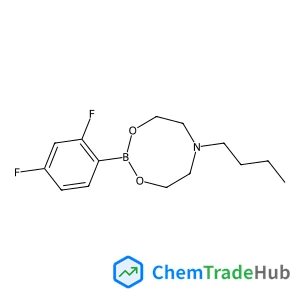
6-Butyl-2-(2,4-difluorophenyl)-1,3,6,2-dioxazaborocane
CAS Number:
1190988-98-7
Molecular Formula:
C14H20BF2NO2
Recommended Suppliers




Disclaimer
This page provides academic journal information for reference and research purposes only. We are not affiliated with any journal publishers and do not handle publication submissions. For publication-related inquiries, please contact the respective journal publishers directly.
If you notice any inaccuracies in the information displayed, please contact us at support@chemtradehub.com. We will promptly review and address your concerns.