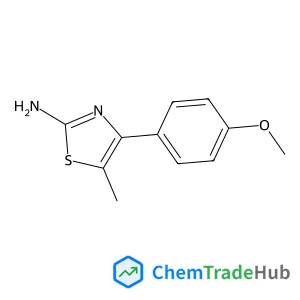
4-(4-Methoxyphenyl)-5-methyl-1,3-thiazol-2-amine
CAS Number:
105512-88-7
Molecular Formula:
C11H12N2OS
Daniele Alves, P. Rupa Kasturi, Gillian Collins, Tara N Barwa, Sukanya Ramaraj, Raj Karthik
The effects of Climate Change are now clearly evident across the world, with increasing storms, precipitation, rising sea levels and draughts, with an ever increasing need to develop energy storage and conversion approaches and devices to alleviate these issues. Hydrogen has emerged as a clean fuel with no environmental issues and it can be coupled with renewable energy sources such as wind, solar and wave energy. The excess energy from renewables can be employed to power electrolysis cells giving rise to green or renewable hydrogen. This approach is attracting considerable attention as it has the potential not only to provide a very clean energy source, but it also enables more efficient use of renewable energy resources. One of the limiting factors in achieving high volumes of pure hydrogen is the electrocatalytic materials used for the hydrogen evolution reaction (HER) and the oxygen evolution reaction (OER). In this review, we cover the progress made largely within the last six years in the development of two materials that satisfy the conditions of being cost-effective, earth-abundant, simple to form with little or no environmental concerns. The two materials are transition metal dichalcogenides (TMDs) and layered double hydroxides (LDHs), with the latter often described as clays. Following a short overview of the main synthetic methods used to form the TMDs and LDHs, and a short introduction to the HER and OER, the performance of different LDHs, TMDs and their composites in the electrochemical splitting of water, and as bifunctional electrodes is discussed. Finally, the ability of these materials to act as electrocatalysts in seawater electrolysis and to serve as electrocatalytic materials for the oxidation of alternative half-reactions to the sluggish OER is reviewed. Although more studies are required, it is clear that these earth-abundant materials are promising electrocatalysts for the generation of renewable hydrogen.

Russian Journal of Bioorganic Chemistry

Drug Discovery Today

Saudi Pharmaceutical Journal

Journal of Peptide Science

Chemistry Education Research and Practice

Journal of Natural Medicines

Organic Process Research & Development

Current Opinion in Solid State & Materials Science

Russian Journal of Organic Chemistry

New Journal of Chemistry
Pãmyla L. dos Santos, Juliano A. Bonacin, Edmund M. Keefe
DOI: 10.1039/C9SE00679F
Bingbing Shi, Danyu Xia, Yong Yao
DOI: 10.1039/C4CC06971D
Zhenpin Lu, Tanya K. Ronson, Jonathan R. Nitschke
DOI: 10.1039/C9SC05728E
Sung Gyu Han, Honggon Kim, Jongwon Ko, Sejin Park, Oh-Shim Joo, Yoonmook Kang
DOI: 10.1039/C9SE00647H
Yamuna Ariyarathna, Jon A. Tunge
DOI: 10.1039/C4CC07253G
Satoshi Muratsugu, Hiroshi Baba, Tatsuya Tanimoto, Kana Sawaguchi, Satoru Ikemoto, Masahiro Tasaki, Yosuke Terao
DOI: 10.1039/C8CC00896E
Sebastian Weske, Richard A. Hardin, Thomas Auth, Konrad Koszinowski, Craig A. Ogle
DOI: 10.1039/C8CC01707G
Hailiang Chu, Ying Zhu, Tingting Fang, Junqiang Hua, Shujun Qiu, Haidong Liu, Liyuan Qin, Qiuhong Wei, Yongjin Zou, Cuili Xiang, Fen Xu, Lixian Sun
DOI: 10.1039/C9SE00712A
Tzu-Hsi Huang, Hong-Sheng Zheng, Yih-Ming Cheng, Chen-Wei Liu, Sheng-Wei Lee, Jeng-Han Wang, Kuan-Wen Wang
DOI: 10.1039/C9SE00474B
(5-Sulfamoyl-3-pyridinyl)boronic acid is primarily used in chemical synthesis, p...
Benzyl 2-methyl-2-(methylsulfonyl)-4-pentenoate is typically synthesized via est...
When handling 8-Fluoroquinolin-6-ol (CAS: 209353-22-0), it is important to use p...
1,3-Dibromo-5-(2-methyl-2-propanyl)benzene (CAS: 129316-09-2) is a crystalline c...
Ethyl 7-chloro-4-oxo-1-(1,3-thiazol-2-yl)-1,4-dihydro-1,8-naphthyridine-3-carbox...
When handling Delta-7-Avenasterol (CAS: 23290-26-8), it is important to wear app...
Proper handling involves the use of personal protective equipment such as gloves...
When handling 2-Methyl-2-proanyl 4-[(2-aminophenyl)amino]-1-piperidinecarboxylat...
N-Methyl-4-chlorobenzylamine hydrochloride (CAS: 65542-24-7) is a organic compou...
[2-(Dodecyloxy)ethoxy]acetic acid (CAS: 27306-90-7) is generally considered safe...