













The synthesis and combined electrical–magnetic and toxic dye sequestration properties of a Cr(iii)-metallogel
Literature Information
Publication Date
2023-11-03
DOI
10.1039/D3MA00645J
Impact Factor
0
Authors
Krishna Sundar Das, Mainak Das, Sayan Saha, Amit Adhikary, Sukhen Bala, Partha Pratim Ray, Raju Mondal
View Original
Abstract
Materials based on typical inorganic compounds, along with their embodied metal-specific features like redox, magnetic, catalytic and spectroscopic properties, in their as-synthesized economical, end-user friendly and commercially viable gel states, have manifold practical and strategic advantages. Along these lines, the work presented herein aims to explore the usefulness of porous gel-based inorganic compounds, in their original as-synthesized states, for probing their combined electrical, magnetic and adsorption properties. Accordingly, we have synthesized and thoroughly characterized a benzene dicarboxylic acid based Cr(III)-metallogel for magnetic and electrical device fabrication. The metallogel shows an interesting NMOP morphology and is thoroughly characterized using various microscopic and spectroscopic techniques. Furthermore, rheological studies on the resultant metallogel reveal its interesting thixotropic behaviour. The Cr-gel has been successfully utilized for fabricating an electrical Schottky barrier diode with a befitting conductivity value of 1.61 × 10⁻² S cm−1. Moreover, the free immobilized azide group, featuring in-built charge-separated resonance structures, acts as a proton carrier facilitator-cum-transporter and shows an impressive proton conductivity value of 3.3 × 10⁻⁴ S cm−1 at 95% relative humidity and 85 °C. The presence of paramagnetic chromium ions also renders a special physicochemical property, namely magnetism, to the system. The porous and magnetic nature of the as-synthesized metallogel was also evaluated. DC magnetic susceptibility data confirm the antiferromagnetic nature of the material. Gas sorption studies, on the other hand, confirm the porous nature and show the selective CO2 uptake ability of the xerogel. Subsequently, the as-synthesized, by default porous, magnetic metallogel was utilized as an adsorbent for removing toxic organic dyes like methylene blue, rhodamine B and crystal violet. Interestingly, the as-prepared metallogel also enables the substantial release of the adsorbed dye molecules for re-use. To the best of our knowledge, this kind of electrical–magnetic Cr-gel based wastewater treatment technique was not reported hitherto in the literature but has a huge potential application in adsorbent based environmental remediation as well as in magnetic or electrical device fabrication.
Related Literature
Random introduction of degradable linkages into functional vinyl polymers by radical ring-opening polymerization, tailored for soft tissue engineering
Jenny Undin, Teresa Illanes, Anna Finne-Wistrand, Ann-Christine Albertsson
2012-03-19
Paper
DOI: 10.1039/C2PY20034A
Synthesis of novel cylindrical bottlebrush polypseudorotaxane via inclusion complexation of high density poly(ε-caprolactone) bottlebrush polymer and α-cyclodextrins
Qiang Fu, Jing. M. Ren, Greg. G. Qiao
2011-11-11
Paper
DOI: 10.1039/C1PY00362C
Efficient synthesis of poly(2-hydroxypropyl methacrylate)-silica colloidal nanocomposite particles via aqueous dispersion polymerization
Hua Zou, Steven P. Armes
2011-11-17
Paper
DOI: 10.1039/C1PY00406A
Synthesis of low-temperature benzocyclobutene cross-linker and utilization
Julia N. Dobish, Sharon K. Hamilton, Eva Harth
2012-01-30
Communication
DOI: 10.1039/C2PY00606E
Investigations on the spermine provoked liquid crystalline phase behavior of high molecular weight DNA in the presence of alkali and alkaline earth metal ions
Neethu Sundaresan, Thresia Thomas, T. J. Thomas, C. K. S. Pillai
2011-10-05
Paper
DOI: 10.1039/C1PY00302J
Lubrication mechanism of concentrated polymer brushes in solvents: effect of solvent viscosity
Akihiro Nomura, Kohji Ohno, Takeshi Fukuda
2011-11-14
Paper
DOI: 10.1039/C1PY00215E
Macromolecular design of poly(vinyl alcohol) by RAFT polymerization
Anton A. A. Smith, Thomas Hussmann, Joseph Elich, Almar Postma, Marie-Helene Alves, Alexander N. Zelikin
2011-10-19
Communication
DOI: 10.1039/C1PY00429H
Polysaccharide-stabilized core cross-linked polymer micelle analogues
Daniel J. Krasznai, Timothy F. L. McKenna, Michael F. Cunningham, Pascale Champagne, Niels M. B. Smeets
2012-02-03
Paper
DOI: 10.1039/C2PY00601D
You might also like
Compound Q&A
What industries use 4-(4-tert-Butylphenyl)-1H-pyrazol-3-amine (CAS: 1015845-73-4)?
4-(4-tert-Butylphenyl)-1H-pyrazol-3-amine finds applications in various industri...
1015845-73-44-(4-tert-Butylpheny...
Compound Q&A
What industries use H3TATAB (CAS: 63557-10-8)?
H3TATAB is used in the pharmaceutical industry for the synthesis of certain orga...
63557-10-8H3TATAB
Compound Q&A
What are the main uses of 1-Ethyl-3-fluorobenzene (CAS: 696-39-9)?
1-Ethyl-3-fluorobenzene (CAS: 696-39-9) is primarily used as a precursor in the ...
696-39-91-Ethyl-3-fluorobenz...
Compound Q&A
What are the main uses of 1-(tert-Butoxycarbonyl)-4-(4-methoxyphenyl)pyrrolidine-3-carboxylic acid (CAS: 851484-94-1)?
1-(tert-Butoxycarbonyl)-4-(4-methoxyphenyl)pyrrolidine-3-carboxylic acid is prim...
851484-94-11-(tert-Butoxycarbon...
Compound Q&A
What are the physical and chemical properties of 1-Cyclobutyl-4-piperidinone (CAS: 359880-05-0)?
1-Cyclobutyl-4-piperidinone (CAS: 359880-05-0) is a colorless or white crystalli...
359880-05-01-Cyclobutyl-4-piper...
Compound Q&A
What is Pyridine-2,6-dicarboxylic acid mono-tert-butyl ester (CAS: 575433-76-0)?
Pyridine-2,6-dicarboxylic acid mono-tert-butyl ester (CAS: 575433-76-0) is a che...
575433-76-0Pyridine-2,6-dicarbo...
Compound Q&A
What is the market or research trend for 2,3-Difluorophenylalanine (CAS: 236754-62-4)?
The market for 2,3-Difluorophenylalanine (CAS: 236754-62-4) is growing with incr...
236754-62-42,3-Difluorophenylal...
Compound Q&A
How is (2-Hydroxy-1-naphthyl)boronic acid (CAS: 898257-48-2) typically synthesized?
(2-Hydroxy-1-naphthyl)boronic acid can be synthesized through the reduction of 2...
898257-48-2(2-Hydroxy-1-naphthy...
Compound Q&A
What are the physical and chemical properties of tert-Butyl (5-bromo-6-methyl-3-(4,4,5,5-tetramethyl-1,3,2-dioxaborolan-2-yl)pyridin-2-yl)carbamate (CAS: 1315351-28-0)?
This compound is a crystalline solid with a molecular weight of approximately 52...
1315351-28-0tert-Butyl (5-bromo-...
Compound Q&A
Are there alternatives to 5,7-Dihydroxy-4-oxo-2-(3,4,5-trihydroxyphenyl)-4H-chromen-3-yl beta-D-glucopyranoside (CAS: 19833-12-6) in synthesis?
While 5,7-Dihydroxy-4-oxo-2-(3,4,5-trihydroxyphenyl)-4H-chromen-3-yl beta-D-gluc...
19833-12-65,7-Dihydroxy-4-oxo-...
Source Journal
Recommended Compounds
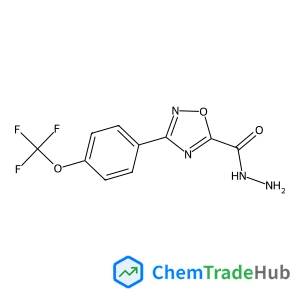
3-(4-(Trifluoromethoxy)phenyl)-1,2,4-oxadiazole-5-carbohydrazide
CAS Number:
883028-82-8
Molecular Formula:
C10H7F3N4O3
Recommended Suppliers




Disclaimer
This page provides academic journal information for reference and research purposes only. We are not affiliated with any journal publishers and do not handle publication submissions. For publication-related inquiries, please contact the respective journal publishers directly.
If you notice any inaccuracies in the information displayed, please contact us at support@chemtradehub.com. We will promptly review and address your concerns.