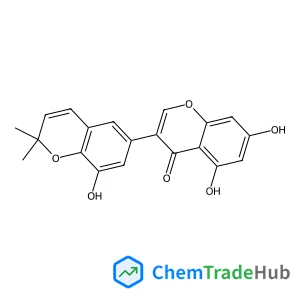
5,7,8'-Trihydroxy-2',2'-dimethyl-2'H,4H-3,6'-bichromen-4-one
CAS Number:
129280-33-7
Molecular Formula:
C20H16O6
Cheng-Wei Lin, Zhiyin Yang, Ailun Huang, Xueying Chang, Chenxiang Wang, Fan Yang, Chen Wei, Markus Thiel, Yuto Katsuyama, Lihua Jin
Interactions between ammonia gas and graphitic materials, including adsorptions and N-doping at elevated temperatures, are known. However, liquid ammonia has rarely been studied other than for the Birch reduction reaction. Here, we report influences of liquid ammonia on graphite oxide (GO) and reduced graphite oxide (rGO), at both the atomic and macroscopic scales. It is demonstrated that GO and rGO do not disperse in liquid ammonia regardless of charge transfer due to the incompatible surface energy and polarity. X-ray photoelectron spectroscopy (XPS), X-ray diffraction (XRD), and Raman spectroscopy studies of GO sheets treated with liquid ammonia, and liquid nitrogen as a control, for different time periods demonstrate ∼0.6 at% pyridinic N-doping and non-restoration of conjugation in the absence of thermal energy. Macroscopically, liquid ammonia is incapable of altering the shape or size of assembled GO and single walled carbon nanotube (SWCNT) freestanding membranes. However, loud popping sounds along with the generation of pockets, which leads to lower stiffness within the GO membranes, were observed after treating with liquid ammonia. In addition, shrinkage of porous rGO aerogels and counter-intuitively an increase in electrical resistance of SWCNT/cellulose composite membranes after treatment with liquid ammonia, are reported.

Medicinal Chemistry Research

Journal of the Indian Institute of Science

Heteroatom Chemistry

Cellulose

Acta Metallurgica Sinica-English Letters

Topics in Catalysis

Chinese Journal of Chemistry

Main Group Chemistry

Critical Reviews in Solid State and Materials Sciences

Herald of the Russian Academy of Sciences
Bas G. G. Lohmeijer, Daan Wouters, Zhihui Yin, Ulrich S. Schubert
DOI: 10.1039/B411777H
Richard T. Baker, Leila Naji, Karen Lochhead, John A. Chudek
DOI: 10.1039/B301039B
Gabriela A. Grasa, Rohit Singh, Natalie M. Scott, Edwin D. Stevens, Steven P. Nolan
DOI: 10.1039/B410986D
S. P. Cork, G. Cressey, R. H. Jones, S. J. Teat, V. L. Zholobenko
DOI: 10.1039/B410366C
Seong Jin Park, Dong Mok Shin, Shigeru Sakamoto, Kentaro Yamaguchi, Young Keun Chung, Myoung Soo Lah
DOI: 10.1039/B212855A
Jiang Shen, Wei Shan, Yahong Zhang, Junming Du, Hualong Xu, Kangnian Fan, Wei Shen, Yi Tang
DOI: 10.1039/B412986E
W. Matthew Leevy, Michelle E. Weber, Paul H. Schlesinger
DOI: 10.1039/B413588A
Sarah E. Lister, Ivana Radosavljevic Evans, Judith A. K. Howard, Alan Coelho, John S. O. Evans
DOI: 10.1039/B408413F
Luke E. Turner, Matthew G. Thorn, Phillip E. Fanwick, Ian P. Rothwell
DOI: 10.1039/B212724E
James C. Errey, Balaram Mukhopadhyay, K. P. Ravindranathan Kartha, Robert A. Field
DOI: 10.1039/B410184G
(1R,3S)-1,3-Cyclopentanediol finds applications in various industries. In the ph...
When handling N'-[4-(Dimethylamino)phenyl]-N,N-dimethyl-1,4-benzenediamine, it i...
There are several alternatives to 5-(2,4-Difluorophenyl)-2-methoxypyrimidine in ...
1-(3-Methoxyphenoxy)propan-2-ol (CAS: 382141-68-6) must comply with the Globally...
Tetrodotoxin Citrate is extremely dangerous and should be handled with extreme c...
2-Methyl-2-propanyl [(1R,3S)-3-hydroxycyclopentyl]carbamate (CAS: 225641-84-9) i...
Waste containing 4-(2-Hydroxyhexafluoroisopropyl)Benzoic Acid (CAS: 16261-80-6) ...
2-Methyl-2-proanyl {(2S)-1-[(benzyloxy)amino]-3-hydroxy-3-methyl-1-oxo-2-butanyl...
Benzeneethanamine, α-ethyl-, hydrochloride (1:1) is an organic compound with the...
In the synthesis of compounds similar to 3-{(E)-[4-(Dimethylamino)phenyl]diazeny...