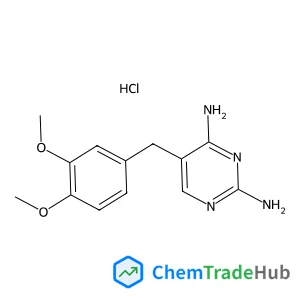
5-(3,4-Dimethoxybenzyl)-2,4-pyrimidinediamine hydrochloride (1:1)
CAS Number:
2507-23-5
Molecular Formula:
C13H17ClN4O2
A graphical abstract is available for this content
Eleanor I. Gillette, Nam Kim, Gary W. Rubloff, Sang Bok Lee
DOI: 10.1039/C6CP05640G
P. J. W. Elder, I. Vargas-Baca
DOI: 10.1039/C6CP05892B
Ian J. Nessler, Jacob M. Litman
DOI: 10.1039/C6CP02595A
L. S. R. Kumara, Anli Yang, Chulho Song, Kohei Kusada, Hirokazu Kobayashi
DOI: 10.1039/C6CP04088H
Yuliang Zhang, Yuzhen Wei, Xiangyun Song, Yanbo Fu, Vincent S. Battaglia
DOI: 10.1039/C6CP06609G
Kela Xiao
DOI: 10.1039/C6CP02526A
Chao Wang, Panlai Li, Zhijun Wang, Yuansheng Sun, Jinge Cheng, Zhenling Li, Miaomiao Tian, Zhiping Yang
DOI: 10.1039/C6CP05490K
Xia Leng, Jin Feng, Tingwei Chen, Chengbu Liu, Yuchen Ma
DOI: 10.1039/C6CP05902C
Kavanal P. Prasanthkumar, Juan R. Alvarez-Idaboy, Pavitra V. Kumar, Beena G. Singh, K. Indira Priyadarsini
DOI: 10.1039/C6CP04483B
J. Pablo Palafox-Hernandez, Yue Li, Chang-Keun Lim, Taylor J. Woehl, Nicholas M. Bedford, Soenke Seifert, Mark T. Swihart, Paras N. Prasad, Tiffany R. Walsh, Marc R. Knecht
DOI: 10.1039/C6CP06135D
When considering alternatives to 1-(4-Chlorophenyl)-N-hydroxymethanimine (CAS: 3...
This compound should be stored in a cool, dry place away from direct sunlight. I...
3-(4-Bromophenyl)-5-(2-fluorophenyl)-1,2,4-oxadiazole is synthesized through a m...
5-Chloro-2-(4-chlorophenyl)-4-methyl-6-[3-(1-piperidinyl)propoxy]pyrimidine (CAS...
2-Chloro-4-(difluoromethoxy)pyridine is used in the pharmaceutical industry for ...
3-Chloro-6-methylpyridazine (CAS: 1121-79-5) is classified under the Globally Ha...
Several alternatives can be used in the synthesis of Methyl 4,5-dimethyl-2-nitro...
Alternatives to (2E,2'E)-3,3'-(1,4-Phenylene)bisacrylaldehyde include other acry...
3-Amino-5-chloropyridin-2-ol hydrochloride is an organic compound with the CAS n...
When handling 6,7-Difluoro-2,3-dihydro-4H-chromen-4-one, it is essential to wear...

Physical Chemistry Chemical Physics (PCCP) is an international journal co-owned by 19 physical chemistry and physics societies from around the world. This journal publishes original, cutting-edge research in physical chemistry, chemical physics and biophysical chemistry. To be suitable for publication in PCCP, articles must include significant innovation and/or insight into physical chemistry; this is the most important criterion that reviewers and Editors will judge against when evaluating submissions. The journal has a broad scope and welcomes contributions spanning experiment, theory, computation and data science. Topical coverage includes spectroscopy, dynamics, kinetics, statistical mechanics, thermodynamics, electrochemistry, catalysis, surface science, quantum mechanics, quantum computing and machine learning. Interdisciplinary research areas such as polymers and soft matter, materials, nanoscience, energy, surfaces/interfaces, and biophysical chemistry are welcomed if they demonstrate significant innovation and/or insight into physical chemistry. Joined experimental/theoretical studies are particularly appreciated when complementary and based on up-to-date approaches.