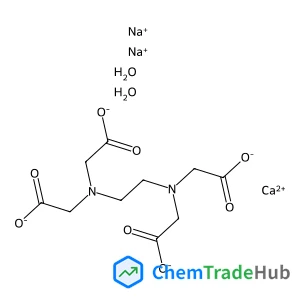
EthylenediaminetetraaceticacidcalciumDisodiumsalthydrate
CAS Number:
23411-34-9
Molecular Formula:
C10H16CaN2Na2O10
Rui Yu, Jorge Barroso, Meng-hui Wang, Wei-yan Liang, Chen Chen, Ximena Zarate, Mesías Orozco-Ic, Gabriel Merino
Correction for ‘Structure and bonding of molecular stirrers with formula B7M2− and B8M2 (M = Zn, Cd, Hg)’ by Rui Yu et al., Phys. Chem. Chem. Phys., 2020, 22, 12312–12320, https://doi.org/10.1039/D0CP01603A.
Helgi Rafn Hróðmarsson, Ágúst Kvaran
DOI: 10.1039/C5CP06185G
Nan Chen, Xianke Huang, Liangti Qu
DOI: 10.1039/C5CP04391C
Linus O. Johannissen, Sam Hay, Nigel S. Scrutton
DOI: 10.1039/C5CP00614G
Sven Stafström
DOI: 10.1039/C5CP06577A
N. Scott Bobbitt, Grady Schofield, Charles Lena, James R. Chelikowsky
DOI: 10.1039/C5CP02561C
Franziska Buchner, Berit Heggen, Hans-Hermann Ritze, Walter Thiel, Andrea Lübcke
DOI: 10.1039/C5CP04394H
Heinz-Jürgen Flad, Gohar Harutyunyan, Bert-Wolfgang Schulze
DOI: 10.1039/C5CP01183C
Hèctor Prats, Pablo Gamallo, Ramón Sayós, Francesc Illas
DOI: 10.1039/C5CP06863K
Monica Marinescu, Teng Zhang, Gregory J. Offer
DOI: 10.1039/C5CP05755H
Li-Yong Gan, Li-Hong Zhang, Qingyun Zhang, Chun-Sheng Guo, Udo Schwingenschlögl
DOI: 10.1039/C5CP05695K
1H-Indazole-6-carbonitrile finds applications in pharmaceuticals, where it serve...
Waste containing Dioctyl (2E)-2-butenedioate (CAS: 2997-85-5) should be collecte...
Sodium [(1,2-benzoxazol-3-ylmethyl)sulfonyl]azanide is primarily used in pharmac...
Dimethyl 4-(4,4,5,5-tetramethyl-1,3,2-dioxaborolan-2-yl)-2,6-pyridinedicarboxyla...
Waste containing 2-Fluoro-6-hydrazinopyridine (CAS: 80714-39-2) should be manage...
6-Formyl-2-pyridinecarboxylic acid is an organic compound with the molecular for...
Research trends for this compound indicate a focus on its potential applications...
9H-Tribenzo[b,d,f]azepine is typically synthesized via a multi-step process invo...
1-Cyclopropyl-7-ethoxy-6-fluoro-8-methoxy-4-oxo-1,4-dihydro-3-quinolinecarboxyli...
Waste containing Methyl 3-oxo-1,2,3,4-tetrahydro-6-quinoxalinecarboxylate (CAS: ...

Physical Chemistry Chemical Physics (PCCP) is an international journal co-owned by 19 physical chemistry and physics societies from around the world. This journal publishes original, cutting-edge research in physical chemistry, chemical physics and biophysical chemistry. To be suitable for publication in PCCP, articles must include significant innovation and/or insight into physical chemistry; this is the most important criterion that reviewers and Editors will judge against when evaluating submissions. The journal has a broad scope and welcomes contributions spanning experiment, theory, computation and data science. Topical coverage includes spectroscopy, dynamics, kinetics, statistical mechanics, thermodynamics, electrochemistry, catalysis, surface science, quantum mechanics, quantum computing and machine learning. Interdisciplinary research areas such as polymers and soft matter, materials, nanoscience, energy, surfaces/interfaces, and biophysical chemistry are welcomed if they demonstrate significant innovation and/or insight into physical chemistry. Joined experimental/theoretical studies are particularly appreciated when complementary and based on up-to-date approaches.