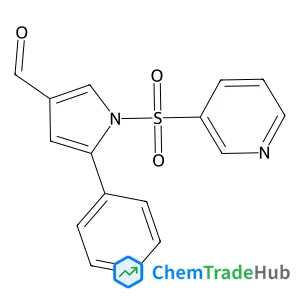
5-Phenyl-1-(pyridin-3-ylsulfonyl)-1H-pyrrole-3-carbaldehyde
CAS Number:
881676-90-0
Molecular Formula:
C16H12N2O3S
D. S. Zamoretskov, I. E. Kuznetsov, M. M. Tepliakova, D. K. Sagdullina, V. G. Kurbatov, A. G. Nasibulin, A. V. Akkuratov
Hybrid organic–inorganic perovskite solar cells (PSCs) have drawn great attention in the past decade due to the rapid growth of their power conversion efficiency (PCE) and the advantage of their low-cost fabrication. The hole-transport materials (HTMs) play a crucial role in achieving high efficiency and operational stability of PSCs. In this work, we report the synthesis of two novel conjugated polymers by coupling of the alkylsilyl-substituted benzo[1,2-b:4,5-b′]dithiophene unit with the thiophene-bridged pyrazine block and their investigation as dopant-free HTMs in n–i–p PSCs. The devices with polymer PBPyT-ex (poly[(4,8-bis(5-(triisopropylsilyl)thiophen-2-yl)-2,6-benzo[1,2-b:4,5-b′]dithiophene)-alt-5,5′-(2,5-bis(4-(2-ethylhexyl)thiophen-2-yl)pyrazine)]) demonstrate PCEs up to 17.5%, outperforming the 14.9% efficiency of PSCs with PBPyT-in (poly[(4,8-bis(5-(triisopropylsilyl)thiophen-2-yl)-2,6-benzo[1,2-b:4,5-b′]dithiophene)-alt-5,5′-(2,5-bis(3-(2-ethylhexyl)thiophen-2-yl)pyrazine)]), which is attributed to the difference in the quality of HTM films. The results obtained feature the combination of pyrazine, thiophene and benzodithiophene units as a successful example of polymeric HTM backbone design for PSCs with encouraging efficiency and high operational stability over 1500 h under continuous illumination.
Anna Kamecka, Kinga Suwińska, Andrzej Kapturkiewicz
DOI: 10.1039/C6CP05856F
Ana B. Muñoz-García, Michele Pavone
DOI: 10.1039/C6CP05089A
DOI: 10.1039/C6CP05052B
Leandro B. Krott
DOI: 10.1039/C6CP05821C
Hacan Ali Ahmad, Sébastien Thomas, Philippe Bazin, Aurélie Vicente, Christian Fernandez, Hussein Awala, Svetlana Mintova
DOI: 10.1039/C6CP05766G
Frank Uhlig, Tihomir Solomun, Jens Smiatek
DOI: 10.1039/C6CP05417J
Wenqi Xiong, Congxin Xia, Tianxing Wang, Juan Du, Yuting Peng, Xu Zhao, Yu Jia
DOI: 10.1039/C6CP04794G
C. Satriano, G. Forte, A. Magrì, P. Di Pietro, A. Travaglia, G. Pandini, F. Gianì, D. La Mendola
DOI: 10.1039/C6CP05476E
Xun-Lei Ding, Heng-Lu Liao, Yi-Ming Chen, Dan Wang, Ya-Ya Wang
DOI: 10.1039/C6CP05595H
When considering alternatives to 1-(4-Chlorophenyl)-N-hydroxymethanimine (CAS: 3...
This compound should be stored in a cool, dry place away from direct sunlight. I...
3-(4-Bromophenyl)-5-(2-fluorophenyl)-1,2,4-oxadiazole is synthesized through a m...
5-Chloro-2-(4-chlorophenyl)-4-methyl-6-[3-(1-piperidinyl)propoxy]pyrimidine (CAS...
2-Chloro-4-(difluoromethoxy)pyridine is used in the pharmaceutical industry for ...
3-Chloro-6-methylpyridazine (CAS: 1121-79-5) is classified under the Globally Ha...
Several alternatives can be used in the synthesis of Methyl 4,5-dimethyl-2-nitro...
Alternatives to (2E,2'E)-3,3'-(1,4-Phenylene)bisacrylaldehyde include other acry...
3-Amino-5-chloropyridin-2-ol hydrochloride is an organic compound with the CAS n...
When handling 6,7-Difluoro-2,3-dihydro-4H-chromen-4-one, it is essential to wear...

Physical Chemistry Chemical Physics (PCCP) is an international journal co-owned by 19 physical chemistry and physics societies from around the world. This journal publishes original, cutting-edge research in physical chemistry, chemical physics and biophysical chemistry. To be suitable for publication in PCCP, articles must include significant innovation and/or insight into physical chemistry; this is the most important criterion that reviewers and Editors will judge against when evaluating submissions. The journal has a broad scope and welcomes contributions spanning experiment, theory, computation and data science. Topical coverage includes spectroscopy, dynamics, kinetics, statistical mechanics, thermodynamics, electrochemistry, catalysis, surface science, quantum mechanics, quantum computing and machine learning. Interdisciplinary research areas such as polymers and soft matter, materials, nanoscience, energy, surfaces/interfaces, and biophysical chemistry are welcomed if they demonstrate significant innovation and/or insight into physical chemistry. Joined experimental/theoretical studies are particularly appreciated when complementary and based on up-to-date approaches.
![4-[(3-Chloro-2-fluorophenyl)amino]-7-methoxy-6-quinazolinyl acetate structure](https://static.chemtradehub.com/structs/740/740081-22-5-f58f.webp "4-[(3-Chloro-2-fluorophenyl)amino]-7-methoxy-6-quinazolinyl acetate structure")