












Neurotrophin-mimicking peptides at the biointerface with gold respond to copper ion stimuli
Literature Information
Publication Date
2016-10-12
DOI
10.1039/C6CP05476E
Impact Factor
3.676
Authors
C. Satriano, G. Forte, A. Magrì, P. Di Pietro, A. Travaglia, G. Pandini, F. Gianì, D. La Mendola
View Original
Abstract
The peptide fragments NGF1–14 and BDNF1–12, encompassing the N-terminal domains, respectively, of the proteins nerve growth factor (NGF) and brain-derived neurotrophic factor (BDNF) were used in this study for the fabrication of a hybrid gold/peptide biointerface. These peptides mimic the Trk receptor activation of the respective whole protein – with a crucial role played by copper ions – and exhibit, in bulk solution, a pH-dependent capability to complex copper. We demonstrate here the maintenance of peptide-specific responses at different pH values as well as the copper binding also for the adlayers formed upon physisorption at the gold surface. The physicochemical properties, including viscoelastic behavior of the adlayer and competitive vs. synergic interactions in sequential adsorption processes, were addressed both experimentally, by quartz crystal microbalance with dissipation monitoring (QCM-D) and circular dichroism (CD), and theoretically, by molecular dynamics (MD) calculations. Proof-of work biological assays with the neuroblastoma SY-SH5H cell line demonstrated that the developed hybrid Au/peptide nanoplatforms are very promising for implementation in pH- and metal-responsive systems for application in nanomedicine.
Related Literature
Electronic and magnetic properties of the one-dimensional interfaces of two-dimensional lateral GeC/BP heterostructures
Hao Wang, Wei Wei, Fengping Li, Baibiao Huang, Ying Dai
2019-04-02
Paper
DOI: 10.1039/C9CP01196J
The canonical behavior of the entropic component of thermodynamic effective molarity. An attempt at unifying covalent and noncovalent cyclizations
Stefano Di Stefano, Luigi Mandolini
2018-12-17
Perspective
DOI: 10.1039/C8CP06344C
Vibronic interaction in CO3− photo-detachment: Jahn–Teller effects beyond structural distortion and general formalisms for vibronic Hamiltonians in trigonal symmetries
Prateek Goel, Xiao-Gang Wang, Bo Chen, Xue-Bin Wang, Tao Zeng
2019-04-05
Paper
DOI: 10.1039/C9CP01352K
Influence of bulky substituents on the photophysical properties of homoleptic iridium(iii) complexes
Jin-Hyoung Kim, So-Yoen Kim, Ho-Jin Son, Sang Ook Kang
2019-03-04
Paper
DOI: 10.1039/C8CP07759B
A single boron atom doped boron nitride edge as a metal-free catalyst for N2 fixation
Xin Mao, Cheng Yan, Zhonghua Zhu, Aijun Du
2018-12-11
Paper
DOI: 10.1039/C8CP07064D
The electric field modulation of electronic properties in a type-II phosphorene/PbI2 van der Waals heterojunction
Fei Wang, Wenli Zhang, Xiuwen Zhang
2019-03-14
Paper
DOI: 10.1039/C9CP00733D
Theoretical design of a series of 2D TM–C3N4 and TM–C3N4@graphene (TM = V, Nb and Ta) nanostructures with highly efficient catalytic activity for the hydrogen evolution reaction
Ting Wang, Guangtao Yu, Jingwei Liu, Xuri Huang, Wei Chen
2018-12-21
Paper
DOI: 10.1039/C8CP06011H
Ultrafast photoinduced flavin dynamics in the unusual active site of the tRNA methyltransferase TrmFO
Nadia Dozova, Fabien Lacombat, Charles Bou-Nader, Djemel Hamdane, Pascal Plaza
2019-04-01
Paper
DOI: 10.1039/C8CP06072J
Theoretical insights into the formation and stability of radical oxygen species in cryptochromes
Padmabati Mondal, Miquel Huix-Rotllant
2019-04-02
Paper
DOI: 10.1039/C9CP00782B
Pyruvic acid proton and hydrogen transfer reactions in clusters
Milan Ončák, Andriy Pysanenko, Michal Fárník
2019-01-15
Paper
DOI: 10.1039/C8CP07008C
You might also like
Compound Q&A
Are there alternatives to 1-(4-Chlorophenyl)-N-hydroxymethanimine (CAS: 3848-36-0) in synthesis?
When considering alternatives to 1-(4-Chlorophenyl)-N-hydroxymethanimine (CAS: 3...
3848-36-01-(4-Chlorophenyl)-N...
Compound Q&A
How should (1R,9S,10S,12S,14E,16S,19R,20R,21S,22R)-3,9,21-Trihydroxy-5,10,12,14,16,20,22-heptamethyl-23,24-dioxatetracyclo[17.3.1.1~6,9~.0~2,7~]tetracosa-2,5,7,14-tetraen-4-one (CAS: 183202-73-5) be stored?
This compound should be stored in a cool, dry place away from direct sunlight. I...
183202-73-5(1R,9S,10S,12S,14E,1...
Compound Q&A
How is 3-(4-Bromophenyl)-5-(2-fluorophenyl)-1,2,4-oxadiazole (CAS: 419553-16-5) typically synthesized?
3-(4-Bromophenyl)-5-(2-fluorophenyl)-1,2,4-oxadiazole is synthesized through a m...
419553-16-53-(4-Bromophenyl)-5-...
Compound Q&A
How is 5-Chloro-2-(4-chlorophenyl)-4-methyl-6-[3-(1-piperidinyl)propoxy]pyrimidine (CAS: 1639220-19-1) typically synthesized?
5-Chloro-2-(4-chlorophenyl)-4-methyl-6-[3-(1-piperidinyl)propoxy]pyrimidine (CAS...
1639220-19-15-Chloro-2-(4-chloro...
Compound Q&A
What industries use 2-Chloro-4-(difluoromethoxy)pyridine (CAS: 1206978-15-5)?
2-Chloro-4-(difluoromethoxy)pyridine is used in the pharmaceutical industry for ...
1206978-15-52-Chloro-4-(difluoro...
Compound Q&A
What regulatory guidelines apply to 3-Chloro-6-methylpyridazine (CAS: 1121-79-5)?
3-Chloro-6-methylpyridazine (CAS: 1121-79-5) is classified under the Globally Ha...
1121-79-53-Chloro-6-methylpyr...
Compound Q&A
Are there alternatives to Methyl 4,5-dimethyl-2-nitrobenzoate in synthesis?
Several alternatives can be used in the synthesis of Methyl 4,5-dimethyl-2-nitro...
90922-74-0Methyl 4,5-dimethyl-...
Compound Q&A
Are there alternatives to (2E,2'E)-3,3'-(1,4-Phenylene)bisacrylaldehyde in synthesis?
Alternatives to (2E,2'E)-3,3'-(1,4-Phenylene)bisacrylaldehyde include other acry...
63405-68-5(2E,2'E)-3,3'-(1,4-P...
Compound Q&A
What is 3-Amino-5-chloropyridin-2-ol hydrochloride (CAS: 1261906-29-9)?
3-Amino-5-chloropyridin-2-ol hydrochloride is an organic compound with the CAS n...
1261906-29-93-Amino-5-chloropyri...
Compound Q&A
What precautions should be taken when handling 6,7-Difluoro-2,3-dihydro-4H-chromen-4-one (CAS: 1092349-93-3)?
When handling 6,7-Difluoro-2,3-dihydro-4H-chromen-4-one, it is essential to wear...
1092349-93-36,7-Difluoro-2,3-dih...
Source Journal
Physical Chemistry Chemical Physics

CiteScore:
5.5
Self-citation Rate:
10.3%
Articles per Year:
3036
Physical Chemistry Chemical Physics (PCCP) is an international journal co-owned by 19 physical chemistry and physics societies from around the world. This journal publishes original, cutting-edge research in physical chemistry, chemical physics and biophysical chemistry. To be suitable for publication in PCCP, articles must include significant innovation and/or insight into physical chemistry; this is the most important criterion that reviewers and Editors will judge against when evaluating submissions. The journal has a broad scope and welcomes contributions spanning experiment, theory, computation and data science. Topical coverage includes spectroscopy, dynamics, kinetics, statistical mechanics, thermodynamics, electrochemistry, catalysis, surface science, quantum mechanics, quantum computing and machine learning. Interdisciplinary research areas such as polymers and soft matter, materials, nanoscience, energy, surfaces/interfaces, and biophysical chemistry are welcomed if they demonstrate significant innovation and/or insight into physical chemistry. Joined experimental/theoretical studies are particularly appreciated when complementary and based on up-to-date approaches.
Recommended Compounds

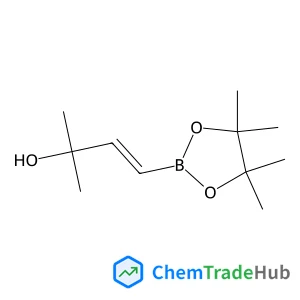
(E)-2-methyl-4-(4,4,5,5-tetramethyl-1,3,2-dioxaborolan-2-yl)but-3-en-2-ol
CAS Number:
581802-26-8
Molecular Formula:
C11H21BO3
Recommended Suppliers





Disclaimer
This page provides academic journal information for reference and research purposes only. We are not affiliated with any journal publishers and do not handle publication submissions. For publication-related inquiries, please contact the respective journal publishers directly.
If you notice any inaccuracies in the information displayed, please contact us at support@chemtradehub.com. We will promptly review and address your concerns.