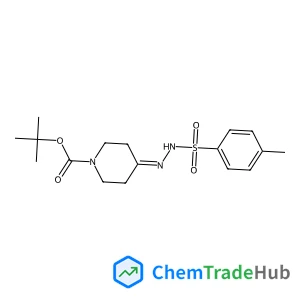
tert-Butyl 4-(2-(p-Tolylsulfonyl)hydrazono)piperidine-1-carboxylate
CAS Number:
1046478-89-0
Molecular Formula:
C17H25N3O4S
Mingna Zheng, Yanwei Li, Qingzhu Zhang, Wenxing Wang
A quantum mechanics/molecular mechanics (QM/MM) approach is a broadly used tool in computational enzymology. Treating the QM region with a high-level DFT method is one of the important branches. Here, taking leaf-branch compost cutinase-catalyzed polyethylene terephthalate depolymerization as an example, the convergence behavior of energy barriers as well as key structural and charge features with respect to the size of the QM region (up to 1000 atoms) is systematically investigated. BP86/6-31G(d)//CHARMM and M06-2X/6-311G(d,p)//CHARMM level of theories were applied for geometry optimizations and single-point energy calculations, respectively. Six independent enzyme conformations for all the four catalytic steps (steps (i)–(iv)) were considered. Most of the twenty-four cases show that at least 500 QM atoms are needed while only two rare cases show that ∼100 QM atoms are sufficient for convergence when only a single conformation was considered. This explains why most previous studies showed that 500 or more QM atoms are required while a few others showed that ∼100 QM atoms are sufficient for DFT/MM calculations. More importantly, average energy barriers and key structural/charge features from six conformations show an accelerated convergence than that in a single conformation. For instance, to reach energy barrier convergence (within 2.0 kcal mol−1) for step (ii), only ∼100 QM atoms are required if six conformations are considered while 500 or more QM atoms are needed with a single conformation. The convergence is accelerated to be more rapid if hundreds and thousands of conformations were considered, which aligns with previous findings that only several dozens of QM atoms are required for convergence with semi-empirical QM/MM MD simulations.
Pablo Pinacho, Susana Blanco, Juan Carlos López
DOI: 10.1039/C8CP06959J
Mauro Boero
DOI: 10.1039/C8CP07467D
H. Khani, M. Esmaeilzadeh, F. Kanjouri
DOI: 10.1039/C8CP07395C
Harry Ramanantoanina, Goutam Kuri, Matthias Martin, Johannes Bertsch
DOI: 10.1039/C9CP01021A
Yu Chen, Junyi Liu, Jiabing Yu
DOI: 10.1039/C8CP04669G
Jacek Wójcik, Andrzej Ejchart, Michał Nowakowski
DOI: 10.1039/C9CP00590K
Philipp Honegger, Othmar Steinhauser
DOI: 10.1039/C9CP00053D
Yi Luo, Sake Wang, Kai Ren, Jyh-Pin Chou, Jin Yu, Zhengming Sun, Minglei Sun
DOI: 10.1039/C8CP06960C
Raunak Kumar Tamrakar, Kanchan Upadhyay, D. P. Bisen
DOI: 10.1039/C9CP90011J
Noura Zamzam, Marius Kaucikas, Dennis J. Nürnberg, A. William Rutherford, Jasper J. van Thor
DOI: 10.1039/C8CP05627G
When considering alternatives to 1-(4-Chlorophenyl)-N-hydroxymethanimine (CAS: 3...
This compound should be stored in a cool, dry place away from direct sunlight. I...
3-(4-Bromophenyl)-5-(2-fluorophenyl)-1,2,4-oxadiazole is synthesized through a m...
5-Chloro-2-(4-chlorophenyl)-4-methyl-6-[3-(1-piperidinyl)propoxy]pyrimidine (CAS...
2-Chloro-4-(difluoromethoxy)pyridine is used in the pharmaceutical industry for ...
3-Chloro-6-methylpyridazine (CAS: 1121-79-5) is classified under the Globally Ha...
Several alternatives can be used in the synthesis of Methyl 4,5-dimethyl-2-nitro...
Alternatives to (2E,2'E)-3,3'-(1,4-Phenylene)bisacrylaldehyde include other acry...
3-Amino-5-chloropyridin-2-ol hydrochloride is an organic compound with the CAS n...
When handling 6,7-Difluoro-2,3-dihydro-4H-chromen-4-one, it is essential to wear...

Physical Chemistry Chemical Physics (PCCP) is an international journal co-owned by 19 physical chemistry and physics societies from around the world. This journal publishes original, cutting-edge research in physical chemistry, chemical physics and biophysical chemistry. To be suitable for publication in PCCP, articles must include significant innovation and/or insight into physical chemistry; this is the most important criterion that reviewers and Editors will judge against when evaluating submissions. The journal has a broad scope and welcomes contributions spanning experiment, theory, computation and data science. Topical coverage includes spectroscopy, dynamics, kinetics, statistical mechanics, thermodynamics, electrochemistry, catalysis, surface science, quantum mechanics, quantum computing and machine learning. Interdisciplinary research areas such as polymers and soft matter, materials, nanoscience, energy, surfaces/interfaces, and biophysical chemistry are welcomed if they demonstrate significant innovation and/or insight into physical chemistry. Joined experimental/theoretical studies are particularly appreciated when complementary and based on up-to-date approaches.
![4-[(3-Chloro-2-fluorophenyl)amino]-7-methoxy-6-quinazolinyl acetate structure](https://static.chemtradehub.com/structs/740/740081-22-5-f58f.webp "4-[(3-Chloro-2-fluorophenyl)amino]-7-methoxy-6-quinazolinyl acetate structure")