












Femtosecond infrared spectroscopy of chlorophyll f-containing photosystem I
Literature Information
Publication Date
2018-12-10
DOI
10.1039/C8CP05627G
Impact Factor
3.676
Authors
Noura Zamzam, Marius Kaucikas, Dennis J. Nürnberg, A. William Rutherford, Jasper J. van Thor
View Original
Abstract
The recent discovery of extremely red-shifted chlorophyll f pigments in both photosystem I (PSI) and photosystem II has led to the conclusion that chlorophyll f plays a role not only in the energy transfer, but also in the charge separation processes [Nürnberg et al., Science, 2018, 360, 1210–1213]. We have employed ultrafast transient infrared absorption spectroscopy to study the contribution of far-red light absorbing chlorophyll f to energy transfer and charge separation processes in far-red light-grown PSI (FRL-PSI) from the cyanobacterium Chroococcidiopsis thermalis PCC 7203. We compare the kinetics and spectra of FRL-grown PSI excited at 670 nm and 740 nm wavelengths to those of white light-grown PSI (WL-PSI) obtained at 675 nm excitation. We report a fast decay of excited state features of chlorophyll a and complete energy transfer from chlorophyll a to chlorophyll f in FRL-PSI upon 670 nm excitation, as indicated by a frequency shift in a carbonyl absorption band occurring within a 1 ps timescale. While the WL-PSI measurements support the assignment of initial charge separation to A−1+˙A0−˙ [Di Donato et al., Biochemistry, 2011, 50, 480–490] from the kinetics of a distinct cation feature at 1710 cm−1, in the case of FRL-PSI, small features at 1715 cm−1 from the chlorophyll cation are present from sub-ps delays instead, supporting the replacement of the A−1 pigment with chlorophyll f. Comparisons of nanosecond spectra show that charge separation proceeds with 740 nm excitation, which selectively excites chlorophyll f, and modifications in specific carbonyl absorption bands assigned to P700+˙ minus P700 and A1−˙ minus A1 indicate dielectric differences of FRL-PSI compared to WL-PSI in one or both of the two electron transfer branches of FRL-PSI.
Recommended Journals
Related Literature
Organocatalysis “on water”. Regioselective [3 + 2]-cycloaddition of nitrones and allenolates
Ezequiel Q. Morales
2006-05-26
Communication
DOI: 10.1039/B606096J
Facile preparation of water-soluble fluorescent silver nanoclusters using a polyelectrolyte template
Li Shang, Shaojun Dong
2008-01-10
Communication
DOI: 10.1039/B717728C
Photoisomerization of the green fluorescence proteinchromophore and the meta- and para-amino analogues
Jye-Shane Yang, Guan-Jhih Huang, Yi-Hung Liu, Shie-Ming Peng
2008-01-18
Communication
DOI: 10.1039/B717714C
The quest for secondary structure in chiral dendrimers
Susan E. Gibson, Jacob T. Rendell
2007-11-26
Feature Article
DOI: 10.1039/B712298E
Synthesis of a stable radical anion via the one electron reduction of a 1,1-bis-phosphinosulfide alkene derivative
Thibault Cantat, Frédéric Biaso, Aurélien Momin, Louis Ricard, Michel Geoffroy, Nicolas Mézailles, Pascal Le Floch
2007-12-19
Communication
DOI: 10.1039/B715380E
Univalent transition metal complexes of arenes stabilized by a bulky terphenylligand: differences in the stability of Cr(i), Mn(i) or Fe(i) complexes
Chengbao Ni, Bobby D. Ellis, James C. Fettinger, Gary J. Long, Philip P. Power
2007-12-20
Communication
DOI: 10.1039/B715027J
An alignable fluorene thienothiophene copolymer with deep-blue electroluminescent emission at 410 nm
Malte C. Gather, Martin Heeney, Weimin Zhang, Katherine S. Whitehead, Donal D. C. Bradley, Iain McCulloch, Alasdair J. Campbell
2008-01-07
Communication
DOI: 10.1039/B716510B
Nanomechanical properties of reversed surfactant bilayers formed in micrometre-sized holes
Jian Jin, Yukihiro Sugiyama, Keita Mitsui, Hideo Arakawa, Izumi Ichinose
2008-01-14
Communication
DOI: 10.1039/B717485C
You might also like
Compound Q&A
Are there alternatives to 1-(4-Chlorophenyl)-N-hydroxymethanimine (CAS: 3848-36-0) in synthesis?
When considering alternatives to 1-(4-Chlorophenyl)-N-hydroxymethanimine (CAS: 3...
3848-36-01-(4-Chlorophenyl)-N...
Compound Q&A
How should (1R,9S,10S,12S,14E,16S,19R,20R,21S,22R)-3,9,21-Trihydroxy-5,10,12,14,16,20,22-heptamethyl-23,24-dioxatetracyclo[17.3.1.1~6,9~.0~2,7~]tetracosa-2,5,7,14-tetraen-4-one (CAS: 183202-73-5) be stored?
This compound should be stored in a cool, dry place away from direct sunlight. I...
183202-73-5(1R,9S,10S,12S,14E,1...
Compound Q&A
How is 3-(4-Bromophenyl)-5-(2-fluorophenyl)-1,2,4-oxadiazole (CAS: 419553-16-5) typically synthesized?
3-(4-Bromophenyl)-5-(2-fluorophenyl)-1,2,4-oxadiazole is synthesized through a m...
419553-16-53-(4-Bromophenyl)-5-...
Compound Q&A
How is 5-Chloro-2-(4-chlorophenyl)-4-methyl-6-[3-(1-piperidinyl)propoxy]pyrimidine (CAS: 1639220-19-1) typically synthesized?
5-Chloro-2-(4-chlorophenyl)-4-methyl-6-[3-(1-piperidinyl)propoxy]pyrimidine (CAS...
1639220-19-15-Chloro-2-(4-chloro...
Compound Q&A
What industries use 2-Chloro-4-(difluoromethoxy)pyridine (CAS: 1206978-15-5)?
2-Chloro-4-(difluoromethoxy)pyridine is used in the pharmaceutical industry for ...
1206978-15-52-Chloro-4-(difluoro...
Compound Q&A
What regulatory guidelines apply to 3-Chloro-6-methylpyridazine (CAS: 1121-79-5)?
3-Chloro-6-methylpyridazine (CAS: 1121-79-5) is classified under the Globally Ha...
1121-79-53-Chloro-6-methylpyr...
Compound Q&A
Are there alternatives to Methyl 4,5-dimethyl-2-nitrobenzoate in synthesis?
Several alternatives can be used in the synthesis of Methyl 4,5-dimethyl-2-nitro...
90922-74-0Methyl 4,5-dimethyl-...
Compound Q&A
Are there alternatives to (2E,2'E)-3,3'-(1,4-Phenylene)bisacrylaldehyde in synthesis?
Alternatives to (2E,2'E)-3,3'-(1,4-Phenylene)bisacrylaldehyde include other acry...
63405-68-5(2E,2'E)-3,3'-(1,4-P...
Compound Q&A
What is 3-Amino-5-chloropyridin-2-ol hydrochloride (CAS: 1261906-29-9)?
3-Amino-5-chloropyridin-2-ol hydrochloride is an organic compound with the CAS n...
1261906-29-93-Amino-5-chloropyri...
Compound Q&A
What precautions should be taken when handling 6,7-Difluoro-2,3-dihydro-4H-chromen-4-one (CAS: 1092349-93-3)?
When handling 6,7-Difluoro-2,3-dihydro-4H-chromen-4-one, it is essential to wear...
1092349-93-36,7-Difluoro-2,3-dih...
Source Journal
Physical Chemistry Chemical Physics

CiteScore:
5.5
Self-citation Rate:
10.3%
Articles per Year:
3036
Physical Chemistry Chemical Physics (PCCP) is an international journal co-owned by 19 physical chemistry and physics societies from around the world. This journal publishes original, cutting-edge research in physical chemistry, chemical physics and biophysical chemistry. To be suitable for publication in PCCP, articles must include significant innovation and/or insight into physical chemistry; this is the most important criterion that reviewers and Editors will judge against when evaluating submissions. The journal has a broad scope and welcomes contributions spanning experiment, theory, computation and data science. Topical coverage includes spectroscopy, dynamics, kinetics, statistical mechanics, thermodynamics, electrochemistry, catalysis, surface science, quantum mechanics, quantum computing and machine learning. Interdisciplinary research areas such as polymers and soft matter, materials, nanoscience, energy, surfaces/interfaces, and biophysical chemistry are welcomed if they demonstrate significant innovation and/or insight into physical chemistry. Joined experimental/theoretical studies are particularly appreciated when complementary and based on up-to-date approaches.
Recommended Compounds
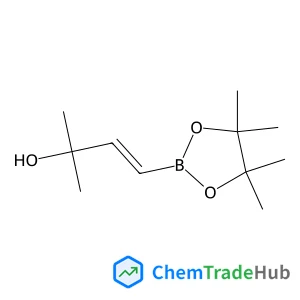
(E)-2-methyl-4-(4,4,5,5-tetramethyl-1,3,2-dioxaborolan-2-yl)but-3-en-2-ol
CAS Number:
581802-26-8
Molecular Formula:
C11H21BO3
Recommended Suppliers





Disclaimer
This page provides academic journal information for reference and research purposes only. We are not affiliated with any journal publishers and do not handle publication submissions. For publication-related inquiries, please contact the respective journal publishers directly.
If you notice any inaccuracies in the information displayed, please contact us at support@chemtradehub.com. We will promptly review and address your concerns.