












Target–ligand binding affinity from single point enthalpy calculation and elemental composition
Literature Information
Publication Date
2023-11-03
DOI
10.1039/D3CP04483A
Impact Factor
3.676
Authors
Viktor Szél, Balázs Zoltán Zsidó, Norbert Jeszenői, Csaba Hetényi
View Original
Abstract
Reliable target–ligand binding thermodynamics data are essential for successful drug design and molecular engineering projects. Besides experimental methods, a number of theoretical approaches have been introduced for the generation of binding thermodynamics data. However, available approaches often neglect electronic effects or explicit water molecules influencing target–ligand interactions. To handle electronic effects within a reasonable time frame, we introduce a fast calculator QMH-L using a single target–ligand complex structure pre-optimized at the molecular mechanics level. QMH-L is composed of the semi-empirical quantum mechanics calculation of binding enthalpy with predicted explicit water molecules at the complex interface, and a simple descriptor based on the elemental composition of the ligand. QMH-L estimates the target–ligand binding free energy with a root mean square error (RMSE) of 0.94 kcal mol−1. The calculations also provide binding enthalpy values and they were compared with experimental binding thermodynamics data collected from the most reliable isothermal titration calorimetry studies of systems including various protein targets and challenging, large peptide ligands with a molecular weight of up to 2–3 thousand. The single point enthalpy calculations of QMH-L require modest computational resources and are based on short runs with open source and/or free software like Gromacs, Mopac, MobyWat, and Fragmenter. QMH-L can be applied for fast, automated scoring of drug candidates during a virtual screen, enthalpic engineering of new ligands or thermodynamic explanation of complex interactions.
Related Literature
Crossover in the inelastic electron tunneling spectra of conjugated molecules with direct Au–C links
Enrique Montes, Giuseppe Foti, Héctor Vázquez
2019-01-08
Paper
DOI: 10.1039/C8CP06290K
Electronic and magnetic properties of the one-dimensional interfaces of two-dimensional lateral GeC/BP heterostructures
Hao Wang, Wei Wei, Fengping Li, Baibiao Huang, Ying Dai
2019-04-02
Paper
DOI: 10.1039/C9CP01196J
Structural manifestation of partial proton ordering and defect mobility in ice Ih
2019-03-28
Paper
DOI: 10.1039/C9CP01234F
Unambiguous hydrogenation of CO2 by coinage-metal hydride anions: an intuitive idea based on in silico experiments
Md Habib, Ritabrata Sarkar, Santu Biswas, Anup Pramanik, Pranab Sarkar, Sougata Pal
2019-03-13
Paper
DOI: 10.1039/C9CP00133F
Fluorescence measurements of peroxynitrite/peroxynitrous acid in cold air plasma treated aqueous solutions
Barbora Tarabová, Petr Lukeš, Malte U. Hammer, Helena Jablonowski, Thomas von Woedtke, Stephan Reuter, Zdenko Machala
2019-04-01
Paper
DOI: 10.1039/C9CP00871C
Al solubility in (Ti1−cAlc)NiSn half-Heusler alloy
David Fuks, Yaniv Gelbstein
2019-03-15
Paper
DOI: 10.1039/C9CP00764D
The synthesis and photophysical properties of tris-coumarins
Olaf W. Morawski, Andrzej L. Sobolewski, Daniel T. Gryko
2019-04-01
Paper
DOI: 10.1039/C9CP00978G
Thermodynamic limits of countercurrent reactor systems, with examples in membrane reactors and the ceria redox cycle
2019-01-08
Paper
DOI: 10.1039/C8CP07077F
Theoretical assessment of wettability on silane coatings: from hydrophilic to hydrophobic
Weiliang Wang
2019-03-22
Paper
DOI: 10.1039/C9CP01232J
Substitutional disorder: structure and ion dynamics of the argyrodites Li6PS5Cl, Li6PS5Br and Li6PS5I
I. Hanghofer, M. Brinek, S. L. Eisbacher, B. Bitschnau, M. Volck, V. Hennige, D. Rettenwander
2019-03-27
Paper
DOI: 10.1039/C9CP00664H
You might also like
Compound Q&A
Are there alternatives to 1-(4-Chlorophenyl)-N-hydroxymethanimine (CAS: 3848-36-0) in synthesis?
When considering alternatives to 1-(4-Chlorophenyl)-N-hydroxymethanimine (CAS: 3...
3848-36-01-(4-Chlorophenyl)-N...
Compound Q&A
How should (1R,9S,10S,12S,14E,16S,19R,20R,21S,22R)-3,9,21-Trihydroxy-5,10,12,14,16,20,22-heptamethyl-23,24-dioxatetracyclo[17.3.1.1~6,9~.0~2,7~]tetracosa-2,5,7,14-tetraen-4-one (CAS: 183202-73-5) be stored?
This compound should be stored in a cool, dry place away from direct sunlight. I...
183202-73-5(1R,9S,10S,12S,14E,1...
Compound Q&A
How is 3-(4-Bromophenyl)-5-(2-fluorophenyl)-1,2,4-oxadiazole (CAS: 419553-16-5) typically synthesized?
3-(4-Bromophenyl)-5-(2-fluorophenyl)-1,2,4-oxadiazole is synthesized through a m...
419553-16-53-(4-Bromophenyl)-5-...
Compound Q&A
How is 5-Chloro-2-(4-chlorophenyl)-4-methyl-6-[3-(1-piperidinyl)propoxy]pyrimidine (CAS: 1639220-19-1) typically synthesized?
5-Chloro-2-(4-chlorophenyl)-4-methyl-6-[3-(1-piperidinyl)propoxy]pyrimidine (CAS...
1639220-19-15-Chloro-2-(4-chloro...
Compound Q&A
What industries use 2-Chloro-4-(difluoromethoxy)pyridine (CAS: 1206978-15-5)?
2-Chloro-4-(difluoromethoxy)pyridine is used in the pharmaceutical industry for ...
1206978-15-52-Chloro-4-(difluoro...
Compound Q&A
What regulatory guidelines apply to 3-Chloro-6-methylpyridazine (CAS: 1121-79-5)?
3-Chloro-6-methylpyridazine (CAS: 1121-79-5) is classified under the Globally Ha...
1121-79-53-Chloro-6-methylpyr...
Compound Q&A
Are there alternatives to Methyl 4,5-dimethyl-2-nitrobenzoate in synthesis?
Several alternatives can be used in the synthesis of Methyl 4,5-dimethyl-2-nitro...
90922-74-0Methyl 4,5-dimethyl-...
Compound Q&A
Are there alternatives to (2E,2'E)-3,3'-(1,4-Phenylene)bisacrylaldehyde in synthesis?
Alternatives to (2E,2'E)-3,3'-(1,4-Phenylene)bisacrylaldehyde include other acry...
63405-68-5(2E,2'E)-3,3'-(1,4-P...
Compound Q&A
What is 3-Amino-5-chloropyridin-2-ol hydrochloride (CAS: 1261906-29-9)?
3-Amino-5-chloropyridin-2-ol hydrochloride is an organic compound with the CAS n...
1261906-29-93-Amino-5-chloropyri...
Compound Q&A
What precautions should be taken when handling 6,7-Difluoro-2,3-dihydro-4H-chromen-4-one (CAS: 1092349-93-3)?
When handling 6,7-Difluoro-2,3-dihydro-4H-chromen-4-one, it is essential to wear...
1092349-93-36,7-Difluoro-2,3-dih...
Source Journal
Physical Chemistry Chemical Physics

CiteScore:
5.5
Self-citation Rate:
10.3%
Articles per Year:
3036
Physical Chemistry Chemical Physics (PCCP) is an international journal co-owned by 19 physical chemistry and physics societies from around the world. This journal publishes original, cutting-edge research in physical chemistry, chemical physics and biophysical chemistry. To be suitable for publication in PCCP, articles must include significant innovation and/or insight into physical chemistry; this is the most important criterion that reviewers and Editors will judge against when evaluating submissions. The journal has a broad scope and welcomes contributions spanning experiment, theory, computation and data science. Topical coverage includes spectroscopy, dynamics, kinetics, statistical mechanics, thermodynamics, electrochemistry, catalysis, surface science, quantum mechanics, quantum computing and machine learning. Interdisciplinary research areas such as polymers and soft matter, materials, nanoscience, energy, surfaces/interfaces, and biophysical chemistry are welcomed if they demonstrate significant innovation and/or insight into physical chemistry. Joined experimental/theoretical studies are particularly appreciated when complementary and based on up-to-date approaches.
Recommended Compounds
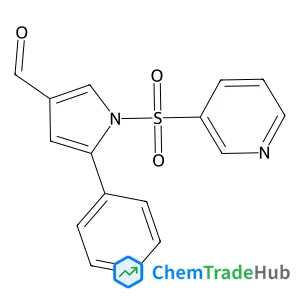
5-Phenyl-1-(pyridin-3-ylsulfonyl)-1H-pyrrole-3-carbaldehyde
CAS Number:
881676-90-0
Molecular Formula:
C16H12N2O3S
Recommended Suppliers





Disclaimer
This page provides academic journal information for reference and research purposes only. We are not affiliated with any journal publishers and do not handle publication submissions. For publication-related inquiries, please contact the respective journal publishers directly.
If you notice any inaccuracies in the information displayed, please contact us at support@chemtradehub.com. We will promptly review and address your concerns.