












Theory and modeling of light-matter interactions in chemistry: current and future
Literature Information
Publication Date
2023-09-27
DOI
10.1039/D3CP01415K
Impact Factor
3.676
Authors
Xinyang Li, Yu Zhang
View Original
Abstract
Light–matter interaction not only plays an instrumental role in characterizing materials' properties via various spectroscopic techniques but also provides a general strategy to manipulate material properties via the design of novel nanostructures. This perspective summarizes recent theoretical advances in modeling light-matter interactions in chemistry, mainly focusing on plasmon and polariton chemistry. The former utilizes the highly localized photon, plasmonic hot electrons, and local heat to drive chemical reactions. In contrast, polariton chemistry modifies the potential energy curvatures of bare electronic systems, and hence their chemistry, via forming light-matter hybrid states, so-called polaritons. The perspective starts with the basic background of light-matter interactions, molecular quantum electrodynamics theory, and the challenges of modeling light-matter interactions in chemistry. Then, the recent advances in modeling plasmon and polariton chemistry are described, and future directions toward multiscale simulations of light–matter interaction-mediated chemistry are discussed.
Recommended Journals
Related Literature
Influence of bulky substituents on the photophysical properties of homoleptic iridium(iii) complexes
Jin-Hyoung Kim, So-Yoen Kim, Ho-Jin Son, Sang Ook Kang
2019-03-04
Paper
DOI: 10.1039/C8CP07759B
Correction: 3T1R model and tuning of thermoluminescence intensity by optimization of dopant concentration in monoclinic Gd2O3:Er3+;Yb3+ co-doped phosphor
Raunak Kumar Tamrakar, Kanchan Upadhyay, D. P. Bisen
2019-01-11
Correction
DOI: 10.1039/C9CP90011J
Theoretical insight into the photophysical properties of long-lifetime Ir(iii) and Rh(iii) complexes for two-photon photodynamic therapy
Xue Yin, Xiao-Yong Lai, Xin Wang, Ying-Tao Liu
2019-03-20
Paper
DOI: 10.1039/C9CP00512A
Theoretical insights into the formation and stability of radical oxygen species in cryptochromes
Padmabati Mondal, Miquel Huix-Rotllant
2019-04-02
Paper
DOI: 10.1039/C9CP00782B
Electric charge of nanopatterned silica surfaces
H. Gokberk Ozcelik, Murat Barisik
2019-03-13
Paper
DOI: 10.1039/C9CP00706G
Modeling of a fast-response magnetic-sensitive hydrogel for dynamic control of microfluidic flow
Qimin Liu, Hua Li, K. Y. Lam
2018-12-19
Paper
DOI: 10.1039/C8CP06556J
Triarylamine-based hydrido-carboxylate rhenium(i) complexes as photosensitizers for dye-sensitized solar cells
Elsa Quartapelle Procopio, Thomas Moehl, Kazuteru Nonomura, Anders Hagfeldt
2019-03-13
Paper
DOI: 10.1039/C9CP00856J
Electronic transport properties and magnetoresistance in the Fe3O4/SiO2/p-Si heterostructure with an in-plane current geometry
Xiang Liu, Wenbo Mi
2019-03-06
Paper
DOI: 10.1039/C9CP00033J
Interactions between cyclic nucleotides and common cations: an ab initio molecular dynamics study
Giuseppe Cassone, Holger Kruse, Jiri Sponer
2019-03-25
Paper
DOI: 10.1039/C8CP07492E
Dynamics of electronically excited states in the eumelanin building block 5,6-dihydroxyindole
Stuart W. Crane, Omair Ghafur, Thomas Y. Cowie, Anita G. Lindsay, James O. F. Thompson, Jason B. Greenwood
2019-04-01
Paper
DOI: 10.1039/C9CP00620F
You might also like
Compound Q&A
Are there alternatives to 1-(4-Chlorophenyl)-N-hydroxymethanimine (CAS: 3848-36-0) in synthesis?
When considering alternatives to 1-(4-Chlorophenyl)-N-hydroxymethanimine (CAS: 3...
3848-36-01-(4-Chlorophenyl)-N...
Compound Q&A
How should (1R,9S,10S,12S,14E,16S,19R,20R,21S,22R)-3,9,21-Trihydroxy-5,10,12,14,16,20,22-heptamethyl-23,24-dioxatetracyclo[17.3.1.1~6,9~.0~2,7~]tetracosa-2,5,7,14-tetraen-4-one (CAS: 183202-73-5) be stored?
This compound should be stored in a cool, dry place away from direct sunlight. I...
183202-73-5(1R,9S,10S,12S,14E,1...
Compound Q&A
How is 3-(4-Bromophenyl)-5-(2-fluorophenyl)-1,2,4-oxadiazole (CAS: 419553-16-5) typically synthesized?
3-(4-Bromophenyl)-5-(2-fluorophenyl)-1,2,4-oxadiazole is synthesized through a m...
419553-16-53-(4-Bromophenyl)-5-...
Compound Q&A
How is 5-Chloro-2-(4-chlorophenyl)-4-methyl-6-[3-(1-piperidinyl)propoxy]pyrimidine (CAS: 1639220-19-1) typically synthesized?
5-Chloro-2-(4-chlorophenyl)-4-methyl-6-[3-(1-piperidinyl)propoxy]pyrimidine (CAS...
1639220-19-15-Chloro-2-(4-chloro...
Compound Q&A
What industries use 2-Chloro-4-(difluoromethoxy)pyridine (CAS: 1206978-15-5)?
2-Chloro-4-(difluoromethoxy)pyridine is used in the pharmaceutical industry for ...
1206978-15-52-Chloro-4-(difluoro...
Compound Q&A
What regulatory guidelines apply to 3-Chloro-6-methylpyridazine (CAS: 1121-79-5)?
3-Chloro-6-methylpyridazine (CAS: 1121-79-5) is classified under the Globally Ha...
1121-79-53-Chloro-6-methylpyr...
Compound Q&A
Are there alternatives to Methyl 4,5-dimethyl-2-nitrobenzoate in synthesis?
Several alternatives can be used in the synthesis of Methyl 4,5-dimethyl-2-nitro...
90922-74-0Methyl 4,5-dimethyl-...
Compound Q&A
Are there alternatives to (2E,2'E)-3,3'-(1,4-Phenylene)bisacrylaldehyde in synthesis?
Alternatives to (2E,2'E)-3,3'-(1,4-Phenylene)bisacrylaldehyde include other acry...
63405-68-5(2E,2'E)-3,3'-(1,4-P...
Compound Q&A
What is 3-Amino-5-chloropyridin-2-ol hydrochloride (CAS: 1261906-29-9)?
3-Amino-5-chloropyridin-2-ol hydrochloride is an organic compound with the CAS n...
1261906-29-93-Amino-5-chloropyri...
Compound Q&A
What precautions should be taken when handling 6,7-Difluoro-2,3-dihydro-4H-chromen-4-one (CAS: 1092349-93-3)?
When handling 6,7-Difluoro-2,3-dihydro-4H-chromen-4-one, it is essential to wear...
1092349-93-36,7-Difluoro-2,3-dih...
Source Journal
Physical Chemistry Chemical Physics

CiteScore:
5.5
Self-citation Rate:
10.3%
Articles per Year:
3036
Physical Chemistry Chemical Physics (PCCP) is an international journal co-owned by 19 physical chemistry and physics societies from around the world. This journal publishes original, cutting-edge research in physical chemistry, chemical physics and biophysical chemistry. To be suitable for publication in PCCP, articles must include significant innovation and/or insight into physical chemistry; this is the most important criterion that reviewers and Editors will judge against when evaluating submissions. The journal has a broad scope and welcomes contributions spanning experiment, theory, computation and data science. Topical coverage includes spectroscopy, dynamics, kinetics, statistical mechanics, thermodynamics, electrochemistry, catalysis, surface science, quantum mechanics, quantum computing and machine learning. Interdisciplinary research areas such as polymers and soft matter, materials, nanoscience, energy, surfaces/interfaces, and biophysical chemistry are welcomed if they demonstrate significant innovation and/or insight into physical chemistry. Joined experimental/theoretical studies are particularly appreciated when complementary and based on up-to-date approaches.
Recommended Compounds
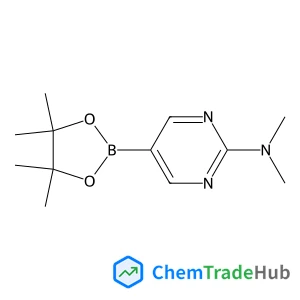
N,N-Dimethyl-5-(4,4,5,5-tetramethyl-1,3,2-dioxaborolan-2-yl)-2-pyrimidinamine
CAS Number:
1032759-30-0
Molecular Formula:
C12H20BN3O2

Recommended Suppliers





Disclaimer
This page provides academic journal information for reference and research purposes only. We are not affiliated with any journal publishers and do not handle publication submissions. For publication-related inquiries, please contact the respective journal publishers directly.
If you notice any inaccuracies in the information displayed, please contact us at support@chemtradehub.com. We will promptly review and address your concerns.