












Role of electron and hole doping in the NdNi1−xVxO3 nanostructure
Literature Information
Publication Date
2023-11-03
DOI
10.1039/D3CP01409F
Impact Factor
3.676
Authors
Raktima Basu, Reshma Kumawat, Mrinmay Sahu, Abu Bakkar Miah, Partha Mitra, Goutam Dev Mukherjee
View Original
Abstract
Neodymium nickelate, NdNiO3, attracts attention due to the simultaneous occurrence of several phase transitions around the same temperature. The electronic properties of NdNiO3 are extremely complex as structural distortion, electron correlation, charge ordering, and orbital overlapping play significant roles in the transitions. We report the effects of electron and hole injection via doping a single 3d metal, V, in the NdNiO3 nanostructure to understand the variations in the electronic properties without any structural distortion. A reversible resistivity modulation of more than five orders of magnitude via hole doping and complete suppression of the metal to insulator transition via electron doping is observed along with the switching of major charge carriers. The modulation of electronic properties without any structural distortion and external strain opens up new directions to consider the NdNi1−xVxO3 nanostructures applicable as emerging electronic devices.
Related Literature
Correction: Theory of solid effect and cross effect dynamic nuclear polarization with half-integer high-spin metal polarizing agents in rotating solids
2016-10-13
Correction
DOI: 10.1039/C6CP90249A
Getting excited: challenges in quantum-classical studies of excitons in polymeric systems
Behnaz Bagheri, Björn Baumeier, Mikko Karttunen
2016-07-18
Paper
DOI: 10.1039/C6CP02944B
Elucidation of the conformational dynamics of multi-body systems by construction of Markov state models
Fu Kit Sheong
2016-06-02
Perspective
DOI: 10.1039/C6CP02545E
Temperature dependence of acoustic vibrations of CdSe and CdSe–CdS core–shell nanocrystals measured by low-frequency Raman spectroscopy
A. Jolene Mork, Elizabeth M. Y. Lee, William A. Tisdale
2016-10-05
Paper
DOI: 10.1039/C6CP05683K
Modelling the chemistry of Mn-doped MgO for bulk and (100) surfaces
Thomas W. Keal, Paul Sherwood, Alexey A. Sokol
2016-09-26
Paper
DOI: 10.1039/C6CP04622C
A comparison of the experimental and theoretical charge density distributions in two polymorphic modifications of piroxicam
Felcia Lai, Jonathan J. Du, Linda Váradi, Daniel Baker, Paul W. Groundwater, Jacob Overgaard, James A. Platts, David E. Hibbs
2016-10-10
Paper
DOI: 10.1039/C6CP02690G
Rationalising pKa shifts in Bacillus circulans xylanase with computational studies
Kela Xiao
2016-07-27
Paper
DOI: 10.1039/C6CP02526A
Heteroleptic [Os(H)(CO)(N∧N)(tpp)2]+ and [Os(Cl)(CO)(N∧N)(tpp)2]+ complexes – comparative studies of their luminescence properties
Anna Kamecka, Kinga Suwińska, Andrzej Kapturkiewicz
2016-10-11
Paper
DOI: 10.1039/C6CP05856F
Modulation of the exfoliated graphene work function through cycloaddition of nitrile imines‡
Myriam Barrejón, María J. Gómez-Escalonilla, José Luis G. Fierro, Pilar Prieto, José R. Carrillo, Gonzalo Abellán, M, Mercedes Gabás, Juan T. López-Navarrete, Fernando Langa
2016-09-30
Paper
DOI: 10.1039/C6CP05285A
You might also like
Compound Q&A
Are there alternatives to 1-(4-Chlorophenyl)-N-hydroxymethanimine (CAS: 3848-36-0) in synthesis?
When considering alternatives to 1-(4-Chlorophenyl)-N-hydroxymethanimine (CAS: 3...
3848-36-01-(4-Chlorophenyl)-N...
Compound Q&A
How should (1R,9S,10S,12S,14E,16S,19R,20R,21S,22R)-3,9,21-Trihydroxy-5,10,12,14,16,20,22-heptamethyl-23,24-dioxatetracyclo[17.3.1.1~6,9~.0~2,7~]tetracosa-2,5,7,14-tetraen-4-one (CAS: 183202-73-5) be stored?
This compound should be stored in a cool, dry place away from direct sunlight. I...
183202-73-5(1R,9S,10S,12S,14E,1...
Compound Q&A
How is 3-(4-Bromophenyl)-5-(2-fluorophenyl)-1,2,4-oxadiazole (CAS: 419553-16-5) typically synthesized?
3-(4-Bromophenyl)-5-(2-fluorophenyl)-1,2,4-oxadiazole is synthesized through a m...
419553-16-53-(4-Bromophenyl)-5-...
Compound Q&A
How is 5-Chloro-2-(4-chlorophenyl)-4-methyl-6-[3-(1-piperidinyl)propoxy]pyrimidine (CAS: 1639220-19-1) typically synthesized?
5-Chloro-2-(4-chlorophenyl)-4-methyl-6-[3-(1-piperidinyl)propoxy]pyrimidine (CAS...
1639220-19-15-Chloro-2-(4-chloro...
Compound Q&A
What industries use 2-Chloro-4-(difluoromethoxy)pyridine (CAS: 1206978-15-5)?
2-Chloro-4-(difluoromethoxy)pyridine is used in the pharmaceutical industry for ...
1206978-15-52-Chloro-4-(difluoro...
Compound Q&A
What regulatory guidelines apply to 3-Chloro-6-methylpyridazine (CAS: 1121-79-5)?
3-Chloro-6-methylpyridazine (CAS: 1121-79-5) is classified under the Globally Ha...
1121-79-53-Chloro-6-methylpyr...
Compound Q&A
Are there alternatives to Methyl 4,5-dimethyl-2-nitrobenzoate in synthesis?
Several alternatives can be used in the synthesis of Methyl 4,5-dimethyl-2-nitro...
90922-74-0Methyl 4,5-dimethyl-...
Compound Q&A
Are there alternatives to (2E,2'E)-3,3'-(1,4-Phenylene)bisacrylaldehyde in synthesis?
Alternatives to (2E,2'E)-3,3'-(1,4-Phenylene)bisacrylaldehyde include other acry...
63405-68-5(2E,2'E)-3,3'-(1,4-P...
Compound Q&A
What is 3-Amino-5-chloropyridin-2-ol hydrochloride (CAS: 1261906-29-9)?
3-Amino-5-chloropyridin-2-ol hydrochloride is an organic compound with the CAS n...
1261906-29-93-Amino-5-chloropyri...
Compound Q&A
What precautions should be taken when handling 6,7-Difluoro-2,3-dihydro-4H-chromen-4-one (CAS: 1092349-93-3)?
When handling 6,7-Difluoro-2,3-dihydro-4H-chromen-4-one, it is essential to wear...
1092349-93-36,7-Difluoro-2,3-dih...
Source Journal
Physical Chemistry Chemical Physics

CiteScore:
5.5
Self-citation Rate:
10.3%
Articles per Year:
3036
Physical Chemistry Chemical Physics (PCCP) is an international journal co-owned by 19 physical chemistry and physics societies from around the world. This journal publishes original, cutting-edge research in physical chemistry, chemical physics and biophysical chemistry. To be suitable for publication in PCCP, articles must include significant innovation and/or insight into physical chemistry; this is the most important criterion that reviewers and Editors will judge against when evaluating submissions. The journal has a broad scope and welcomes contributions spanning experiment, theory, computation and data science. Topical coverage includes spectroscopy, dynamics, kinetics, statistical mechanics, thermodynamics, electrochemistry, catalysis, surface science, quantum mechanics, quantum computing and machine learning. Interdisciplinary research areas such as polymers and soft matter, materials, nanoscience, energy, surfaces/interfaces, and biophysical chemistry are welcomed if they demonstrate significant innovation and/or insight into physical chemistry. Joined experimental/theoretical studies are particularly appreciated when complementary and based on up-to-date approaches.
Recommended Compounds
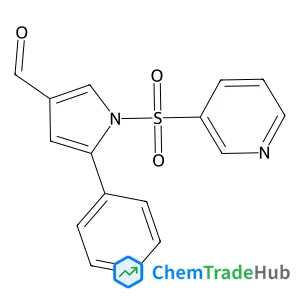
5-Phenyl-1-(pyridin-3-ylsulfonyl)-1H-pyrrole-3-carbaldehyde
CAS Number:
881676-90-0
Molecular Formula:
C16H12N2O3S
Recommended Suppliers





Disclaimer
This page provides academic journal information for reference and research purposes only. We are not affiliated with any journal publishers and do not handle publication submissions. For publication-related inquiries, please contact the respective journal publishers directly.
If you notice any inaccuracies in the information displayed, please contact us at support@chemtradehub.com. We will promptly review and address your concerns.