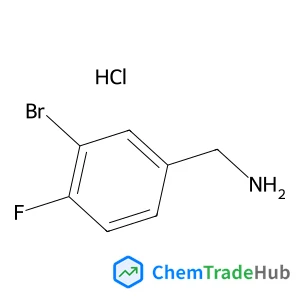
1-(3-Bromo-4-fluorophenyl)methanamine hydrochloride (1:1)
CAS Number:
202865-68-7
Molecular Formula:
C7H8BrClFN
A. Jolene Mork, Elizabeth M. Y. Lee, William A. Tisdale
We measure the temperature dependence of breathing-mode acoustic vibrations of semiconductor nanocrystals using low-frequency Raman spectroscopy. In CdSe core-only nanocrystals, the lowest-energy = 0 mode red-shifts with increasing temperature by ∼5% between 77–300 K. Changes to the interatomic bond distances in the inorganic crystal lattice, with corresponding changes to the bulk modulus and density of the material, contribute to the observed energy shift but do not fully explain its magnitude across all nanocrystal sizes. Invariance of the Raman linewidth over the same temperature range suggests that the acoustic breathing mode is inhomogeneously broadened. The acoustic phonons of CdSe/CdS core–shell composite nanocrystals display similar qualitative behavior. However, for large core–shell nanocrystals, we observe a higher-order Raman peak at approximately twice the energy of the = 0 mode, which we identify as a higher spherical harmonic—the n = 2, = 0 eigenmode—rather than a two-phonon scattering event.
Andy Ch. Laungani, Bernhard Breit
DOI: 10.1039/B716529C
Stephen G. Davies, A. Christopher Garner, Euan C. Goddard, Dennis Kruchinin, Paul M. Roberts, Humberto Rodriguez-Solla, Andrew D. Smith
DOI: 10.1039/B604835H
Placidus B. Amama, Oluwaseyi Ogebule
DOI: 10.1039/B602623K
Dejun Xiong, Mingliang Chen, Haibing Li
DOI: 10.1039/B716270G
Isabella Richter, Jusaku Minari, Philip Axe, John P. Lowe, Tony D. James, Kazuo Sakurai, Steven D. Bull, John S. Fossey
DOI: 10.1039/B716937J
Zhian Liang, Xiaoyu Wu
DOI: 10.1039/B606154K
Malte C. Gather, Martin Heeney, Weimin Zhang, Katherine S. Whitehead, Donal D. C. Bradley, Iain McCulloch, Alasdair J. Campbell
DOI: 10.1039/B716510B
Chayanant Hongfa, Jianhua Tian, Jeremy Andreatta, Donald J. Darensbourg, David E. Bergbreiter
DOI: 10.1039/B711861A
Michael Schmittel, Prasenjit Mal
DOI: 10.1039/B718185J
YooJeong Kwon, Jaephil Cho
DOI: 10.1039/B716694J
When considering alternatives to 1-(4-Chlorophenyl)-N-hydroxymethanimine (CAS: 3...
This compound should be stored in a cool, dry place away from direct sunlight. I...
3-(4-Bromophenyl)-5-(2-fluorophenyl)-1,2,4-oxadiazole is synthesized through a m...
5-Chloro-2-(4-chlorophenyl)-4-methyl-6-[3-(1-piperidinyl)propoxy]pyrimidine (CAS...
2-Chloro-4-(difluoromethoxy)pyridine is used in the pharmaceutical industry for ...
3-Chloro-6-methylpyridazine (CAS: 1121-79-5) is classified under the Globally Ha...
Several alternatives can be used in the synthesis of Methyl 4,5-dimethyl-2-nitro...
Alternatives to (2E,2'E)-3,3'-(1,4-Phenylene)bisacrylaldehyde include other acry...
3-Amino-5-chloropyridin-2-ol hydrochloride is an organic compound with the CAS n...
When handling 6,7-Difluoro-2,3-dihydro-4H-chromen-4-one, it is essential to wear...

Physical Chemistry Chemical Physics (PCCP) is an international journal co-owned by 19 physical chemistry and physics societies from around the world. This journal publishes original, cutting-edge research in physical chemistry, chemical physics and biophysical chemistry. To be suitable for publication in PCCP, articles must include significant innovation and/or insight into physical chemistry; this is the most important criterion that reviewers and Editors will judge against when evaluating submissions. The journal has a broad scope and welcomes contributions spanning experiment, theory, computation and data science. Topical coverage includes spectroscopy, dynamics, kinetics, statistical mechanics, thermodynamics, electrochemistry, catalysis, surface science, quantum mechanics, quantum computing and machine learning. Interdisciplinary research areas such as polymers and soft matter, materials, nanoscience, energy, surfaces/interfaces, and biophysical chemistry are welcomed if they demonstrate significant innovation and/or insight into physical chemistry. Joined experimental/theoretical studies are particularly appreciated when complementary and based on up-to-date approaches.
![(2S)-2-{[(9H-Fluoren-9-ylmethoxy)carbonyl]amino}-4-(methylselanyl)butanoic acid structure](https://static.chemtradehub.com/structs/121/1217852-49-7-f252.webp "(2S)-2-{[(9H-Fluoren-9-ylmethoxy)carbonyl]amino}-4-(methylselanyl)butanoic acid structure")