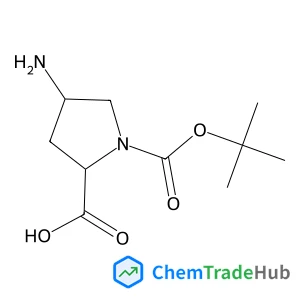
(2R,4R)-1-Boc-4-Aminopyrrolidine-2-carboxylic acid
CAS Number:
132622-98-1
Molecular Formula:
C10H18N2O4
Fu Kit Sheong
Constructing Markov State Models (MSMs) based on short molecular dynamics simulations is a powerful computational technique to complement experiments in predicting long-time kinetics of biomolecular processes at atomic resolution. Even though the MSM approach has been widely applied to study one-body processes such as protein folding and enzyme conformational changes, the majority of biological processes, e.g. protein–ligand recognition, signal transduction, and protein aggregation, essentially involve multiple entities. Here we review the attempts at constructing MSMs for multi-body systems, point out the challenges therein and discuss recent algorithmic progresses that alleviate these challenges. In particular, we describe an automatic kinetics based partitioning method that achieves optimal definition of the conformational states in a multi-body system, and discuss a novel maximum-likelihood approach that efficiently estimates the slow uphill kinetics utilizing pre-computed equilibrium populations of all states. We expect that these new algorithms and their combinations may boost investigations of important multi-body biological processes via the efficient construction of MSMs.
Anne-Laure Barra, Johan van Tol, Sabine Hediger, Daniel Lee, Gaël De Paëpe
DOI: 10.1039/C8CP06819D
Nicolas Schaeffer, German Pérez-Sánchez, Helena Passos, José R. B. Gomes, Nicolas Papaiconomou, João A. P. Coutinho
DOI: 10.1039/C8CP07750A
Sreejith P. Babu, Perumal Elumalai
DOI: 10.1039/C8CP07500J
Marco Fioroni, Robert E. Savage, Nathan J. DeYonker
DOI: 10.1039/C9CP00547A
DOI: 10.1039/C9CP01014A
Kit McColl, Furio Corà
DOI: 10.1039/C9CP00170K
Emilia Olsson, Jonathon Cottom, Xavier Aparicio-Anglès
DOI: 10.1039/C9CP00995G
Mohammad Aarabi, Reza Omidyan, Satchin Soorkia, Gilles Grégoire, Maria-Elisa Crestoni, Aurélien de la Lande, Benoît Soep, Niloufar Shafizadeh
DOI: 10.1039/C8CP06210B
Stuart W. Crane, Omair Ghafur, Thomas Y. Cowie, Anita G. Lindsay, James O. F. Thompson, Jason B. Greenwood
DOI: 10.1039/C9CP00620F
Enamul Haque, M. Anwar Hossain, Catherine Stampfl
DOI: 10.1039/C8CP07634K
When considering alternatives to 1-(4-Chlorophenyl)-N-hydroxymethanimine (CAS: 3...
This compound should be stored in a cool, dry place away from direct sunlight. I...
3-(4-Bromophenyl)-5-(2-fluorophenyl)-1,2,4-oxadiazole is synthesized through a m...
5-Chloro-2-(4-chlorophenyl)-4-methyl-6-[3-(1-piperidinyl)propoxy]pyrimidine (CAS...
2-Chloro-4-(difluoromethoxy)pyridine is used in the pharmaceutical industry for ...
3-Chloro-6-methylpyridazine (CAS: 1121-79-5) is classified under the Globally Ha...
Several alternatives can be used in the synthesis of Methyl 4,5-dimethyl-2-nitro...
Alternatives to (2E,2'E)-3,3'-(1,4-Phenylene)bisacrylaldehyde include other acry...
3-Amino-5-chloropyridin-2-ol hydrochloride is an organic compound with the CAS n...
When handling 6,7-Difluoro-2,3-dihydro-4H-chromen-4-one, it is essential to wear...

Physical Chemistry Chemical Physics (PCCP) is an international journal co-owned by 19 physical chemistry and physics societies from around the world. This journal publishes original, cutting-edge research in physical chemistry, chemical physics and biophysical chemistry. To be suitable for publication in PCCP, articles must include significant innovation and/or insight into physical chemistry; this is the most important criterion that reviewers and Editors will judge against when evaluating submissions. The journal has a broad scope and welcomes contributions spanning experiment, theory, computation and data science. Topical coverage includes spectroscopy, dynamics, kinetics, statistical mechanics, thermodynamics, electrochemistry, catalysis, surface science, quantum mechanics, quantum computing and machine learning. Interdisciplinary research areas such as polymers and soft matter, materials, nanoscience, energy, surfaces/interfaces, and biophysical chemistry are welcomed if they demonstrate significant innovation and/or insight into physical chemistry. Joined experimental/theoretical studies are particularly appreciated when complementary and based on up-to-date approaches.