












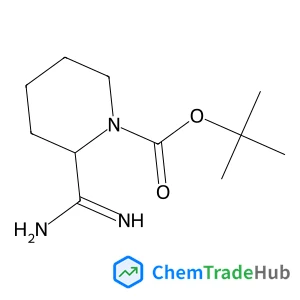
2-Methyl-2-propanyl 2-carbamimidoyl-1-piperidinecarboxylate
CAS Number:
1258640-98-0
Molecular Formula:
C11H21N3O2
Yujing He, Jing Hu, Yunfei Tian
Combining the Hg2+-induced oxidization of silver nanoparticles with the cation exchange reaction between Ag+ and CuS nanoparticles for cascade signal amplification, a sensitive, universal and label-free ICP-MS bioassay for nucleic acids and proteins was developed. By replacing the loop sequence of the T–Hg–T hairpin structure with specific sequences or aptamers to different biomarkers, it has great promise for the early detection of biomarkers potentially for diagnosis of cancerous diseases.
Gongbiao Xin, Yanyan Wang, He Fu, Jie Zheng, Xingguo Li
DOI: 10.1039/C3CP54714K
R. Pérez de Tudela, M. Menéndez, J. F. Castillo, F. J. Aoiz
DOI: 10.1039/C3CP54405B
J. Beltrán, F. Flores, J. Ortega
DOI: 10.1039/C3CP55004D
Wenjing Yang, Xuebo Chen
DOI: 10.1039/C3CP54462A
Masoumeh Ozmaian
DOI: 10.1039/C3CP54015D
Kenji Sakota, Markus Schütz, Matthias Schmies, Raphael Moritz, Aude Bouchet, Takamasa Ikeda, Yuuki Kouno, Hiroshi Sekiya, Otto Dopfer
DOI: 10.1039/C3CP54127D
E. Hüger, J. Rahn, J. Stahn, T. Geue
DOI: 10.1039/C3CP54939A
Catherine Bronner, Oliver S. Wenger
DOI: 10.1039/C3CP55071K
Henrike M. Müller-Werkmeister, Jens Bredenbeck
DOI: 10.1039/C3CP54760D
N-(4-Methoxybenzyl)-2-pyridinamine (CAS: 52818-63-0) is increasingly being used ...
When handling Ethyl 4-(2-chlorophenyl)-1,3-thiazole-2-carboxylate, appropriate p...
Diethyldiselane (CAS: 628-39-7) is classified under the Globally Harmonized Syst...
The market for oxocopper (CAS: 12053-18-8) is primarily driven by its use in cat...
The market for 5-{[(2-Methyl-2-propanyl)oxy]carbonyl}-5-azaspiro[2.4]heptane-7-c...
2-(1-Pyrrolidinyl)-4-pyridinamine is a chemical compound with the CAS number 359...
2-(3-Pyridinyl)-1-azabicyclo[2.2.2]octane (CAS: 91556-75-1) is a crystalline sol...
(S)-Alpha-allyl-proline hydrochloride is usually synthesized via a Wittig reacti...
3-Methyl-1,2-oxazole-5-carboxylic acid (CAS: 4857-42-5) is an organic compound w...
Lys-SMCC-DM1 is synthesized via a multi-step process involving the coupling of S...

ChemComm publishes urgent research which is of outstanding significance and interest to experts in the field, while also appealing to the journal’s broad chemistry readership. Our communication format is ideally suited to short, urgent studies that are of such importance that they require accelerated publication. Our scope covers all topics in chemistry, and research at the interface of chemistry and other disciplines (such as materials science, nanoscience, physics, engineering and biology) where there is a significant novelty in the chemistry aspects. Major topic areas covered include: Analytical Chemistry Catalysis Chemical Biology and medicinal chemistry Computational Chemistry and Machine Learning Energy and sustainable chemistry Environmental Chemistry Green Chemistry Inorganic Chemistry Materials Chemistry Nanoscience Organic Chemistry Physical Chemistry Polymer Chemistry Supramolecular Chemistry
![1,10-bis(3,5-dimethylphenyl)-12-hydroxy-4,5,6,7-tetrahydroiindeno[7,1-de:1',7'-fg][1,3,2]dioxaphosphocine 12-oxide structure](https://static.chemtradehub.com/structs/141/1412439-82-7-b9a9.webp "1,10-bis(3,5-dimethylphenyl)-12-hydroxy-4,5,6,7-tetrahydroiindeno[7,1-de:1',7'-fg][1,3,2]dioxaphosphocine 12-oxide structure")
![1-[6-(1H-Imidazol-1-yl)-3-pyridinyl]methanamine structure](https://static.chemtradehub.com/structs/914/914637-08-4-8825.webp "1-[6-(1H-Imidazol-1-yl)-3-pyridinyl]methanamine structure")




