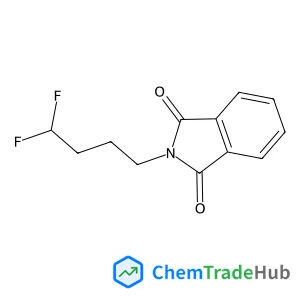
2-(4,4-Difluorobutyl)-1H-isoindole-1,3(2H)-dione
CAS Number:
1265341-14-7
Molecular Formula:
C12H11F2NO2
Zhi-Qiang Zhu, Jia-Yu Hu, Zong-Bo Xie, Zhang-Gao Le
Organophotocatalytic cascade cross-dehydrogenative-coupling/cyclization reaction of o-hydroxyarylenaminones with α-amino acid derivatives for the construction of α-chromone substituted α-amino acid derivatives was developed. Various N-arylglycine esters, amides and dipeptides underwent the cascade cyclization reaction well with o-hydroxyarylenaminones to afford the corresponding 3-aminoalkyl chromones in good to excellent yields. This approach consists of visible-light-promoted oxidation of α-amino acid derivatives, the Mannich reaction, and intramolecular nucleophilic cyclization under acidic conditions, and features a wide reaction scope, a simple operation and mild reaction conditions, which may have the potential to be used for the synthesis of bioactive molecules.
Hien The Ho, Alexandre Bénard, Gwenaël Forcher, Maël Le Bohec, Véronique Montembault, Sagrario Pascual, Laurent Fontaine
DOI: 10.1039/C8OB01807C
Ronghao Xie, Shixiao Chen, Xianping Xiang, Xiangcong Yin, Lubin Xu, Shuai-Shuai Li, Liang Wang, Fengying Dong
DOI: 10.1039/D1QO01530C
Jenny K. Ekegren, Peter Roth, Klas Källström, Tibor Tarnai, Pher G. Andersson
DOI: 10.1039/B208907F
Huanyu Shan, Rihuang Pan, Xufeng Lin
DOI: 10.1039/C8OB01785A
Talal F. Al-Azemi, Mickey Vinodh, Fatemeh H. Alipour, Abdirahman A. Mohamod
DOI: 10.1039/C8OB02074D
Jing Xu, Da-Jun Zheng, Mi-Mi Su, Yan-Chi Chen, Qing-Cai Jiao
DOI: 10.1039/C8OB01908H
Cong Lin, Sai Chen, Yihua Wang, Fei Gao, Liang Shen
DOI: 10.1039/D1QO01579F
Ming Yang, Xue-Cen Xu, Yue Gong, Yu-Long Zhao
DOI: 10.1039/D1QO01506K
N-(4-Methoxybenzyl)-2-pyridinamine (CAS: 52818-63-0) is increasingly being used ...
When handling Ethyl 4-(2-chlorophenyl)-1,3-thiazole-2-carboxylate, appropriate p...
Diethyldiselane (CAS: 628-39-7) is classified under the Globally Harmonized Syst...
The market for oxocopper (CAS: 12053-18-8) is primarily driven by its use in cat...
The market for 5-{[(2-Methyl-2-propanyl)oxy]carbonyl}-5-azaspiro[2.4]heptane-7-c...
2-(1-Pyrrolidinyl)-4-pyridinamine is a chemical compound with the CAS number 359...
2-(3-Pyridinyl)-1-azabicyclo[2.2.2]octane (CAS: 91556-75-1) is a crystalline sol...
(S)-Alpha-allyl-proline hydrochloride is usually synthesized via a Wittig reacti...
3-Methyl-1,2-oxazole-5-carboxylic acid (CAS: 4857-42-5) is an organic compound w...
Lys-SMCC-DM1 is synthesized via a multi-step process involving the coupling of S...

ChemComm publishes urgent research which is of outstanding significance and interest to experts in the field, while also appealing to the journal’s broad chemistry readership. Our communication format is ideally suited to short, urgent studies that are of such importance that they require accelerated publication. Our scope covers all topics in chemistry, and research at the interface of chemistry and other disciplines (such as materials science, nanoscience, physics, engineering and biology) where there is a significant novelty in the chemistry aspects. Major topic areas covered include: Analytical Chemistry Catalysis Chemical Biology and medicinal chemistry Computational Chemistry and Machine Learning Energy and sustainable chemistry Environmental Chemistry Green Chemistry Inorganic Chemistry Materials Chemistry Nanoscience Organic Chemistry Physical Chemistry Polymer Chemistry Supramolecular Chemistry
![1-[6-(1H-Imidazol-1-yl)-3-pyridinyl]methanamine structure](https://static.chemtradehub.com/structs/914/914637-08-4-8825.webp "1-[6-(1H-Imidazol-1-yl)-3-pyridinyl]methanamine structure")
![(2R,6S)-6-[(Benzyloxy)methyl]-4-{[(2-methyl-2-propanyl)oxy]carbonyl}-2-morpholinecarboxylic acid structure](https://static.chemtradehub.com/structs/109/1093085-91-6-3382.webp "(2R,6S)-6-[(Benzyloxy)methyl]-4-{[(2-methyl-2-propanyl)oxy]carbonyl}-2-morpholinecarboxylic acid structure")