












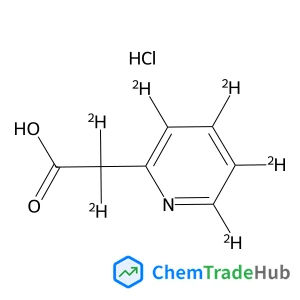
2,2-dideuterio-2-(3,4,5,6-tetradeuterio-2-pyridyl)acetic acid;hydrochloride
CAS Number:
1329799-67-8
Molecular Formula:
C7H2ClD6NO2
Alanazi A. Z., Khalid Alhazzani, Ali M. Alaseem, Abdullah R. Alanzi, Ahmad J. Obaidullah, Mohamed M. El-Wekil
Herein, a molecularly imprinted polymer (MIP) was fabricated for specific sensing of an aminoglycoside e.g. kanamycin (KANA). Carbon paste modified with a MIP specific to Cu2+–KANA was first introduced. Copper (Cu2+) as a metal ion was used as a signal tracer and an amplifier, producing a current response measured by differential pulse voltammetry (DPV). Introducing the aminoglycoside drug into the solution containing Cu2+ did not affect the current response of the NIP/CPE. Under the optimum conditions, the as-fabricated sensor exhibited an increase in the current response in the range of 0.55–550 nM with a good limit of detection (LOD, S/N = 3) of 161 pM. The sensor exhibited many advantages including high sensitivity and selectivity, good stability and reproducibility, and cost-effectiveness. Moreover, it was successfully applied for the determination of KANA in milk and honey samples with RSD % not more than 3.3%, suggesting the reliability of the as-designed sensor.
Nameera F. Baig, Sage J. B. Dunham, Jonathan V. Sweedler, Paul W. Bohn
DOI: 10.1039/C5AN01149C
Feng Chen, Yongxi Zhao
DOI: 10.1039/C2AN36329A
Liang Feng, Hui Li, Yongjun Lv, Yafeng Guan
DOI: 10.1039/C2AN36215E
Ai Gao, Chun-Xia Tang, Xi-Wen He, Xue-Bo Yin
DOI: 10.1039/C2AN36398D
Wayne L. O'Brien, Nicholas D. Boltin, Zhenyu Lu, Brianna M. Cassidy, Raymond G. Belliveau, Emory J. Straub, Stephanie A. DeJong, Stephen L. Morgan, M. L. Myrick
DOI: 10.1039/C5AN01413A
DOI: 10.1039/C5AN00803D
Michael E. Pettit, Brett Harper, Matthew R. Brantley, Touradj Solouki
DOI: 10.1039/C5AN00940E
Neha Batra, Monika Tomar, Vinay Gupta
DOI: 10.1039/C2AN35693G
Sheri Madhu, Santanu Kumar Basu, Sameer Jadhav, Mangalampalli Ravikanth
DOI: 10.1039/C2AN36407G
Michael D. Scott, Rinku Dutta, Manas K. Haldar, Anil Wagh, Thomas R. Gustad, Benedict Law, Daniel L. Friesner, Sanku Mallik
DOI: 10.1039/C2AN35877H
4-Nitrophenyl phosphate disodium salt hexahydrate is primarily used as a substra...
2-(Trifluoromethyl)-1,3-oxazole-4-carboxylic Acid (CAS: 1060816-01-4) is widely ...
2-Fluoro-4-biphenylcarboxylic acid should be stored in a cool, dry place at room...
Prednisolone-21-Carboxylic Acid is primarily used in the pharmaceutical industry...
4-(Hydrazinomethyl)-1,2,3-benzenetriol (CAS: 3614-72-0) should be stored in a co...
4-Amino-1-methyl-1H-pyrazole-5-carboxylic acid hydrochloride (CAS: 92534-70-8) i...
Dehydropachymic acid (CAS: 77012-31-8) is regulated by various agencies. It fall...
The market and research trends for 6-[(2,2-Dimethylpropanoyl)amino]nicotinic aci...
1,10-Phenanthroline-2,9-dicarbaldehyde should be stored in a cool, dry place awa...
5-Carbamoyl-11-oxo-10,11-dihydro-5H-dibenzo[b,f]azepin-10-yl acetate can be synt...

Analyst publishes analytical and bioanalytical research that reports premier fundamental discoveries and inventions, and the applications of those discoveries, unconfined by traditional discipline barriers.



![S-[2,3-Bis(palmitoyloxy)propyl]-N-[(9H-fluoren-9-ylmethoxy)(hydroxy)methylene]cysteine structure](https://static.chemtradehub.com/structs/210/210532-98-2-f6a7.webp "S-[2,3-Bis(palmitoyloxy)propyl]-N-[(9H-fluoren-9-ylmethoxy)(hydroxy)methylene]cysteine structure")






