












![[(1S,2S,3R,4S,7R,9S,10S,12R,15S)-4,12-Diacetyloxy-15-[(2R,3S)-3-benzamido-3-phenyl-2-(2,2,2-trichloroethoxycarbonyloxy)propanoyl]oxy-1,9-dihydroxy-10,14,17,17-tetramethyl-11-oxo-6-oxatetracyclo[11.3.1.03,10.04,7]heptadec-13-en-2-yl] benzoate structure](https://static.chemtradehub.com/structs/100/100431-55-8-7104.webp "[(1S,2S,3R,4S,7R,9S,10S,12R,15S)-4,12-Diacetyloxy-15-[(2R,3S)-3-benzamido-3-phenyl-2-(2,2,2-trichloroethoxycarbonyloxy)propanoyl]oxy-1,9-dihydroxy-10,14,17,17-tetramethyl-11-oxo-6-oxatetracyclo[11.3.1.03,10.04,7]heptadec-13-en-2-yl] benzoate structure")
Contribution of rotational diffusivity towards the transport of antigens in heterogeneous immunosensors
Literature Information
Publication Date
2015-08-06
DOI
10.1039/C5AN00803D
Impact Factor
4.616
Authors
View Original
Abstract
Higher capture efficiency in heterogeneous immunosensors is desirable for the detection of cancer biomarkers at low concentrations. The process of the capture of these antigens is transport limited since the rates of antigen/antibody reactions are faster. In the case of non-flow systems, diffusive transport has contributions from both translational and rotational phenomena. Since the contribution of the rotational diffusivity is comparatively less explored in the literature, we have studied the same for three antigens – bovine serum albumin (BSA), prostate specific antigen (PSA) and C-reactive proteins (CRP). We quantified the rotational diffusivities using the time resolved fluorescence anisotropy method, and further quantified the contribution of the rotational diffusivities to the overall diffusivity of the antigens, and also studied the effect of the process parameters – temperature and pH of the solution. With an increase in temperature, the rotational diffusivity increased showing Arrhenius dependence while with the variation of pH, it showed a non-monotonic behavior having maxima closer to the isoelectric point of the corresponding antigens. This interesting behavior of the pH values could be attributed to lesser electro-viscous effects when the antigen molecule is neutral around its isoelectric point. The optimization of the pH and temperature for the immunosensors could be utilized to design efficient immunosensors.
Related Literature
Rapid construction of the 6/6/5 tricyclic framework via a tandem radical cyclization reaction and its application to the synthesis of 5-epi-7-deoxy-isoabietenin A
Hao Zhang, Shiqiang Ma, Zhimin Xing, Lin Liu, Bowen Fang, Xingang Xie
2017-08-15
Research Article
DOI: 10.1039/C7QO00550D
Photoredox 1,2-dicarbofunctionalization of unactivated alkenes via tandem radical difluoroalkylation and alkynyl migration
Jing Liu, Weipeng Li, Jin Xie
2017-11-06
Research Article
DOI: 10.1039/C7QO00808B
Palladium-catalyzed C–S bond activation and functionalization of 3-sulfenylindoles and related electron-rich heteroarenes
Jianxiao Li, Yanni An, Jiawei Li, Shaorong Yang, Wanqing Wu, Huanfeng Jiang
2017-05-10
Research Article
DOI: 10.1039/C7QO00215G
A one-pot, metal-free approach to bicyclic 2-pyridones
Wannaporn Disadee
2017-07-03
Research Article
DOI: 10.1039/C7QO00406K
Practical synthesis of enantiopure benzylamines by catalytic hydrogenation or transfer hydrogenation reactions in isopropanol using a Ru-pybox catalyst
E. de Julián, E. Menéndez-Pedregal, M. Claros, M. Vaquero, J. Díez, E. Lastra, P. Gamasa, A. Pizzano
2017-12-01
Research Article
DOI: 10.1039/C7QO00908A
Multifunctional odorless isocyano(triphenylphosphoranylidene)-acetates: synthesis and direct one-pot four-component Ugi/Wittig cyclization to multisubstituted oxazoles
Zhi-Lin Ren, Zhi-Rong Guan, Han-Han Kong, Ming-Wu Ding
2017-07-17
Research Article
DOI: 10.1039/C7QO00490G
Construction of a 4H-pyrido[4,3,2-gh]phenanthridin-5(6H)-one skeleton via a catalyst-free radical cascade addition/cyclization using azo compounds as radical sources
Chen Zhang, Junxia Pi, Shu Chen, Ping Liu, Peipei Sun
2017-11-22
Research Article
DOI: 10.1039/C7QO00926G
Sodium nitrite-promoted aerobic oxidative coupling of aryl methyl ketones with ammonium under metal-free conditions: a facile access to polysubstitution imidazoles
Cheng-Kou Liu, Zhao Yang, Yu Zeng, Zheng Fang, Bo Li
2017-05-02
Research Article
DOI: 10.1039/C7QO00247E
Facile synthesis of carbo- and heterocycles via Fe(iii)-catalyzed alkene hydrofunctionalization
Jifeng Qi, Jing Zheng, Sunliang Cui
2017-10-10
Research Article
DOI: 10.1039/C7QO00817A
You might also like
Compound Q&A
What precautions should be taken when handling 4-Methyl-6-(trifluoromethyl)quinoline (CAS: 40716-16-3)?
When handling 4-Methyl-6-(trifluoromethyl)quinoline (CAS: 40716-16-3), safety go...
40716-16-34-Methyl-6-(trifluor...
Compound Q&A
What is 4-(3,5-Difluorophenyl)aniline (CAS: 405058-00-6)?
4-(3,5-Difluorophenyl)aniline is an aromatic organic compound with the CAS numbe...
405058-00-64-(3,5-Difluoropheny...
Compound Q&A
How is 5-{[4-(Trifluoromethyl)phenyl]sulfanyl}-1,2,3-thiadiazole-4-carboxylic acid (CAS: 338982-07-3) typically synthesized?
5-{[4-(Trifluoromethyl)phenyl]sulfanyl}-1,2,3-thiadiazole-4-carboxylic acid can ...
338982-07-35-{[4-(Trifluorometh...
Compound Q&A
What is the market or research trend for 4-Benzylaniline hydrochloride (CAS: 6317-57-3)?
The market for 4-Benzylaniline hydrochloride (CAS: 6317-57-3) is steadily growin...
6317-57-34-Benzylaniline hydr...
Compound Q&A
Is [3-(Diethylsulfamoyl)phenyl]boronic acid (CAS: 871329-58-7) safe?
[3-(Diethylsulfamoyl)phenyl]boronic acid is generally considered safe when handl...
871329-58-7[3-(Diethylsulfamoyl...
Compound Q&A
What are the main uses of 3-Bromo-2,5-dimethoxyaniline (CAS: 115929-62-9)?
3-Bromo-2,5-dimethoxyaniline is mainly used in the pharmaceutical and chemical i...
115929-62-93-Bromo-2,5-dimethox...
Compound Q&A
What regulatory guidelines apply to N-Methyl-1-(5-methyl-1H-indol-3-yl)methanamine (CAS: 915922-67-7)?
N-Methyl-1-(5-methyl-1H-indol-3-yl)methanamine (CAS: 915922-67-7) is subject to ...
915922-67-7N-Methyl-1-(5-methyl...
Compound Q&A
What industries use Carbamic acid, N-[(5S)-5,6-diamino-6-oxohexyl]-, 1,1-dimethylethyl ester (CAS: 24828-96-4)?
This compound is primarily used in the pharmaceutical industry for the synthesis...
24828-96-4Carbamic acid, N-[(5...
Compound Q&A
How should 2-Methyl-2-propanyl [(1S,3R)-3-aminocyclohexyl]carbamate (CAS: 1298101-47-9) be stored?
2-Methyl-2-propanyl [(1S,3R)-3-aminocyclohexyl]carbamate (CAS: 1298101-47-9) sho...
1298101-47-92-Methyl-2-propanyl ...
Compound Q&A
What industries use Ethyl 2-bromo-4,4,4-trifluorobutanoate (CAS: 367-33-9)?
Ethyl 2-bromo-4,4,4-trifluorobutanoate (CAS: 367-33-9) is utilized in the pharma...
367-33-9Ethyl 2-bromo-4,4,4-...
Source Journal
Analyst

CiteScore:
7.8
Self-citation Rate:
5.6%
Articles per Year:
653
Analyst publishes analytical and bioanalytical research that reports premier fundamental discoveries and inventions, and the applications of those discoveries, unconfined by traditional discipline barriers.
Recommended Compounds
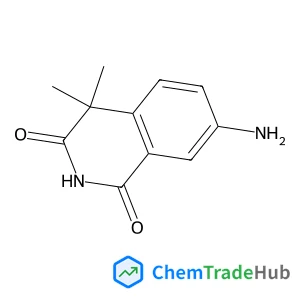
1,3(2H,4H)-Isoquinolinedione, 7-amino-4,4-dimethyl-
CAS Number:
14576-22-8
Molecular Formula:
C11H12N2O2
![(3R,5R)-1-[(Benzyloxy)carbonyl]-5-methyl-3-piperidinecarboxylic acid structure](https://static.chemtradehub.com/structs/126/1269757-29-0-c552.webp "(3R,5R)-1-[(Benzyloxy)carbonyl]-5-methyl-3-piperidinecarboxylic acid structure")
(3R,5R)-1-[(Benzyloxy)carbonyl]-5-methyl-3-piperidinecarboxylic acid
CAS Number:
1269757-29-0
Molecular Formula:
C15H19NO4
Recommended Suppliers





Disclaimer
This page provides academic journal information for reference and research purposes only. We are not affiliated with any journal publishers and do not handle publication submissions. For publication-related inquiries, please contact the respective journal publishers directly.
If you notice any inaccuracies in the information displayed, please contact us at support@chemtradehub.com. We will promptly review and address your concerns.