












A critical evaluation of compressed line-scan Raman imaging
Literature Information
Publication Date
2023-05-08
DOI
10.1039/D3AN00228D
Impact Factor
4.616
Authors
Yajun Yu, Yichuan Dai, Xianli Wang, Kaiqin Chu, Zachary J. Smith
View Original
Abstract
The weak signal strength of Raman imaging leads to long imaging times. To increase the speed of Raman imaging, line scanning and compressed Raman imaging methods have been proposed. Here we combine both line scanning and compressed sensing to further increase the speed. However, the direct combination leads to poor reconstruction results due to the missed coverage of the sample. To avoid this issue, “full-coverage” Compressed Line-scan Raman Imaging (FC-CLRI) is proposed, where line positions are random but constrained to measure each line position of the sample at least once. In proof-of-concept studies of polymer beads and yeast cells, FC-CLRI achieved reasonable image quality while making only 20–40% of the measurements of a fully-sampled line-scan image, achieving 640 μm2 FOV imaging in <2 min with 1.5 mW μm−2 laser power. Furthermore, we critically evaluate the CLRI method through comparison with simple downsampling, and have found that FC-CLRI preserves spatial resolution better while naïve downsampling provides an overall higher image quality for complex samples.
Recommended Journals
Related Literature
Multimodal chemical imaging of molecular messengers in emerging Pseudomonas aeruginosa bacterial communities
Nameera F. Baig, Sage J. B. Dunham, Jonathan V. Sweedler, Paul W. Bohn
2015-08-24
Paper
DOI: 10.1039/C5AN01149C
Real-time impedance analysis of silicananowire toxicity on epithelial breast cancer cells
Frank A. Alexander Jr, Eric G. Huey, Dorielle T. Price, Shekhar Bhansali
2012-10-30
Paper
DOI: 10.1039/C2AN36341K
Confined chemiluminescence detection of nanomolar levels of H2O2 in a paper–plastic disposable microfluidic device using a smartphone
Elise Lebiga, Renny Edwin Fernandez, Ali Beskok
2015-05-27
Communication
DOI: 10.1039/C5AN00720H
Ion-neutral collisional cross sections of carbohydrate isomers as divalent cation adducts and their electron transfer products
Yuting Huang, Eric D. Dodds
2015-07-22
Paper
DOI: 10.1039/C5AN01093D
Electrochemical incorporation of hemin in a ZnO–PPy nanocomposite on a Pt electrode as NOx sensor
Subash Prakash, Seenivasan Rajesh, Sarkkarai Raja Singh, Chandran Karunakaran, Veerapandy Vasu
2012-10-04
Paper
DOI: 10.1039/C2AN36347J
Chemical contrast observed in thermal images of blood-stained fabrics exposed to steam
Wayne L. O'Brien, Nicholas D. Boltin, Zhenyu Lu, Brianna M. Cassidy, Raymond G. Belliveau, Emory J. Straub, Stephanie A. DeJong, Stephen L. Morgan, M. L. Myrick
2015-07-24
Communication
DOI: 10.1039/C5AN01413A
Evaluation of UV radiation-induced toxicity and biophysical changes in various skin cells with photo-shielding molecules
Devasier Bennet
2015-07-30
Paper
DOI: 10.1039/C5AN00979K
Label-free detection of missense mutations and methylation differences in the p53 gene using optically diffracting hydrogels
Kelsey I. MacConaghy, Duncan M. Chadly, Mark P. Stoykovich, Joel L. Kaar
2015-08-06
Paper
DOI: 10.1039/C5AN01191D
Absorption spectroscopy in microfluidic flow cells using a metal clad leaky waveguide device with a porous gel waveguide layer
Bruce Grieve
2012-10-31
Paper
DOI: 10.1039/C2AN35898K
Silver nanostructures in laser desorption/ionization mass spectrometry and mass spectrometry imaging
Justyna Sekuła, Joanna Nizioł, Wojciech Rode, Tomasz Ruman
2015-07-27
Tutorial Review
DOI: 10.1039/C5AN00943J
You might also like
Compound Q&A
What are the main uses of 4-Nitrophenyl phosphate disodium salt hexahydrate (CAS: 333338-18-4)?
4-Nitrophenyl phosphate disodium salt hexahydrate is primarily used as a substra...
333338-18-44-Nitrophenyl phosph...
Compound Q&A
What are the main uses of 2-(Trifluoromethyl)-1,3-oxazole-4-carboxylic Acid (CAS: 1060816-01-4)?
2-(Trifluoromethyl)-1,3-oxazole-4-carboxylic Acid (CAS: 1060816-01-4) is widely ...
1060816-01-42-(Trifluoromethyl)-...
Compound Q&A
How should 2-Fluoro-4-biphenylcarboxylic acid (CAS: 137045-30-8) be stored?
2-Fluoro-4-biphenylcarboxylic acid should be stored in a cool, dry place at room...
137045-30-82-Fluoro-4-biphenylc...
Compound Q&A
What industries use Prednisolone-21-Carboxylic Acid (CAS: 61549-70-0)?
Prednisolone-21-Carboxylic Acid is primarily used in the pharmaceutical industry...
61549-70-0Prednisolone-21-Carb...
Compound Q&A
How should 4-(Hydrazinomethyl)-1,2,3-benzenetriol (CAS: 3614-72-0) be stored?
4-(Hydrazinomethyl)-1,2,3-benzenetriol (CAS: 3614-72-0) should be stored in a co...
3614-72-04-(Hydrazinomethyl)-...
Compound Q&A
What industries use 4-Amino-1-methyl-1H-pyrazole-5-carboxylic acid hydrochloride (CAS: 92534-70-8)?
4-Amino-1-methyl-1H-pyrazole-5-carboxylic acid hydrochloride (CAS: 92534-70-8) i...
92534-70-84-Amino-1-methyl-1H-...
Compound Q&A
What regulatory guidelines apply to dehydropachymic acid (CAS: 77012-31-8)?
Dehydropachymic acid (CAS: 77012-31-8) is regulated by various agencies. It fall...
77012-31-8Dehydropachymic acid
Compound Q&A
What is the market or research trend for 6-[(2,2-Dimethylpropanoyl)amino]nicotinic acid (CAS: 898561-66-5)?
The market and research trends for 6-[(2,2-Dimethylpropanoyl)amino]nicotinic aci...
898561-66-56-[(2,2-Dimethylprop...
Compound Q&A
How should 1,10-Phenanthroline-2,9-dicarbaldehyde (CAS: 57709-62-3) be stored?
1,10-Phenanthroline-2,9-dicarbaldehyde should be stored in a cool, dry place awa...
57709-62-31,10-Phenanthroline-...
Compound Q&A
How is 5-Carbamoyl-11-oxo-10,11-dihydro-5H-dibenzo[b,f]azepin-10-yl acetate (CAS: 113952-21-9) typically synthesized?
5-Carbamoyl-11-oxo-10,11-dihydro-5H-dibenzo[b,f]azepin-10-yl acetate can be synt...
113952-21-95-Carbamoyl-11-oxo-1...
Source Journal
Analyst

CiteScore:
7.8
Self-citation Rate:
5.6%
Articles per Year:
653
Analyst publishes analytical and bioanalytical research that reports premier fundamental discoveries and inventions, and the applications of those discoveries, unconfined by traditional discipline barriers.
Recommended Compounds
![(2E)-3-(3-Chlorophenyl)-N-{2-[4-(methylsulfonyl)-1-piperazinyl]-2-oxoethyl}acrylamide structure](https://static.chemtradehub.com/structs/250/2505001-54-5-c1e9.webp "(2E)-3-(3-Chlorophenyl)-N-{2-[4-(methylsulfonyl)-1-piperazinyl]-2-oxoethyl}acrylamide structure")
(2E)-3-(3-Chlorophenyl)-N-{2-[4-(methylsulfonyl)-1-piperazinyl]-2-oxoethyl}acrylamide
CAS Number:
2505001-54-5
Molecular Formula:
C16H20ClN3O4S
![1-[(4-Methylphenyl)sulfonyl]-3-(4,4,5,5-tetramethyl-1,3,2-dioxaborolan-2-yl)-1H-pyrrolo[2,3-b]pyridine-5-carbonitrile structure](https://static.chemtradehub.com/structs/143/1434747-57-5-fc0d.webp "1-[(4-Methylphenyl)sulfonyl]-3-(4,4,5,5-tetramethyl-1,3,2-dioxaborolan-2-yl)-1H-pyrrolo[2,3-b]pyridine-5-carbonitrile structure")
1-[(4-Methylphenyl)sulfonyl]-3-(4,4,5,5-tetramethyl-1,3,2-dioxaborolan-2-yl)-1H-pyrrolo[2,3-b]pyridine-5-carbonitrile
CAS Number:
1434747-57-5
Molecular Formula:
C21H22BN3O4S

1,3(2H,4H)-Isoquinolinedione, 7-amino-4,4-dimethyl-
CAS Number:
14576-22-8
Molecular Formula:
C11H12N2O2
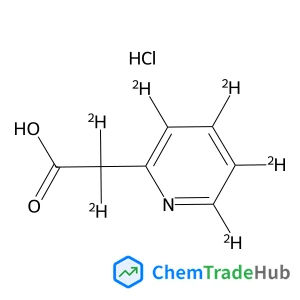
2,2-dideuterio-2-(3,4,5,6-tetradeuterio-2-pyridyl)acetic acid;hydrochloride
CAS Number:
1329799-67-8
Molecular Formula:
C7H2ClD6NO2
Recommended Suppliers






Disclaimer
This page provides academic journal information for reference and research purposes only. We are not affiliated with any journal publishers and do not handle publication submissions. For publication-related inquiries, please contact the respective journal publishers directly.
If you notice any inaccuracies in the information displayed, please contact us at support@chemtradehub.com. We will promptly review and address your concerns.