


Real-time impedance analysis of silicananowire toxicity on epithelial breast cancer cells
Literature Information
Publication Date
2012-10-30
DOI
10.1039/C2AN36341K
Impact Factor
4.616
Authors
Frank A. Alexander Jr, Eric G. Huey, Dorielle T. Price, Shekhar Bhansali
View Original
Abstract
Silica nanowires have great potential for usage in the development of highly sensitive in vivo biosensors used for biomarker monitoring. However, careful analysis of nanowire toxicity is required prior to placing these sensors within the human body. This paper describes a real-time and quantitative analysis of nanowire cytotoxicity using impedance spectroscopy; improving upon studies that have utilized traditional endpoint assays. Silica nanowires were grown using the vapor liquid solid (VLS) method, mixed with Dulbecco's Modified Eagle Medium (DMEM) and exposed to Hs578T epithelial breast cancer cells at concentrations of 0 μg ml−1, 1 μg ml−1, 50 μg ml−1 and 100 μg ml−1. Real-time cellular responses to silica nanowires confirm that while not cytotoxic, silica nanowires at high concentrations (≥50 μg ml−1) are toxic to cells, and also suggest that cell death is due to mechanical disturbances of high numbers of nanowires.
Recommended Journals

Chemistry of Natural Compounds

Anti-Corrosion Methods and Materials

Corrosion Science

Chemistry of Heterocyclic Compounds

Advances in Colloid and Interface Science

AIAA Journal

Cement and Concrete Research

Australian Journal of Chemistry

Bulletin of the Chemical Society of Japan

Chemical & Pharmaceutical Bulletin
Related Literature
Conformation-guided analogue design identifies potential antimalarial compounds through inhibition of mitochondrial respiration
Erik M. Larsen, Chia-Fu Chang, Tomoyo Sakata-Kato, Joseph W. Arico, Vince M. Lombardo, Dyann F. Wirth, Richard E. Taylor
2018-07-11
Communication
DOI: 10.1039/C8OB01257A
Iron promoted C3–H nitration of 2H-indazole: direct access to 3-nitro-2H-indazoles
Arumugavel Murugan, Koteswar Rao Gorantla, Bhabani S. Mallik, Duddu S. Sharada
2018-07-06
Communication
DOI: 10.1039/C8OB00931G
Chemoselective N–H functionalization of indole derivatives via the Reissert-type reaction catalyzed by a chiral phosphoric acid
Yue Cai, Qing Gu
2018-08-03
Paper
DOI: 10.1039/C8OB01863D
Synthesis and biological evaluation of cyclic derivatives of combretastatin A-4 containing group 14 elements
Víctor Blasco, Juan Murga, Eva Falomir, Miguel Carda, Santiago Royo, Ana C. Cuñat, Juan F. Sanz-Cervera, J. Alberto Marco
2018-07-30
Paper
DOI: 10.1039/C8OB01148F
Heteroaryl-linked norbornadiene dimers with redshifted absorptions
Behabitu Ergette Tebikachew, Kasper Moth-Poulsen, Mogens Brøndsted Nielsen
2018-07-19
Paper
DOI: 10.1039/C8OB01470A
Multichromophore arrays of dibenzotetraaza[14]annulene: a promising platform for bioorganic chemistry
Krzysztof M. Zwoliński, Julita Eilmes
2018-07-11
Paper
DOI: 10.1039/C8OB01078A
Transition-metal-free synthesis of polysubstituted pyrrole derivatives via cyclization of methyl isocyanoacetate with aurone analogues
Zhi-Peng Wang, Yun He
2018-07-18
Communication
DOI: 10.1039/C8OB01558A
Zinc–Brønsted acid mediated practical hydrotrifluoromethylation of alkenes with CF3Br
Deqian Peng, Wu Fan, Xueqi Zhao, Wei Chen, Yuan Wen, Li Zhang
2021-09-13
Research Article
DOI: 10.1039/D1QO01073E
A new route to substituted furocoumarins via copper-catalyzed cyclization between 4-hydroxycoumarins and ketoximes
Tuong A. To, Yen H. Vo, Anh T. Nguyen, Anh N. Q. Phan, Thanh Truong, Nam T. S. Phan
2018-07-02
Communication
DOI: 10.1039/C8OB01064A
You might also like
Compound Q&A
What are the main uses of 4-Nitrophenyl phosphate disodium salt hexahydrate (CAS: 333338-18-4)?
4-Nitrophenyl phosphate disodium salt hexahydrate is primarily used as a substra...
333338-18-44-Nitrophenyl phosph...
Compound Q&A
What are the main uses of 2-(Trifluoromethyl)-1,3-oxazole-4-carboxylic Acid (CAS: 1060816-01-4)?
2-(Trifluoromethyl)-1,3-oxazole-4-carboxylic Acid (CAS: 1060816-01-4) is widely ...
1060816-01-42-(Trifluoromethyl)-...
Compound Q&A
How should 2-Fluoro-4-biphenylcarboxylic acid (CAS: 137045-30-8) be stored?
2-Fluoro-4-biphenylcarboxylic acid should be stored in a cool, dry place at room...
137045-30-82-Fluoro-4-biphenylc...
Compound Q&A
What industries use Prednisolone-21-Carboxylic Acid (CAS: 61549-70-0)?
Prednisolone-21-Carboxylic Acid is primarily used in the pharmaceutical industry...
61549-70-0Prednisolone-21-Carb...
Compound Q&A
How should 4-(Hydrazinomethyl)-1,2,3-benzenetriol (CAS: 3614-72-0) be stored?
4-(Hydrazinomethyl)-1,2,3-benzenetriol (CAS: 3614-72-0) should be stored in a co...
3614-72-04-(Hydrazinomethyl)-...
Compound Q&A
What industries use 4-Amino-1-methyl-1H-pyrazole-5-carboxylic acid hydrochloride (CAS: 92534-70-8)?
4-Amino-1-methyl-1H-pyrazole-5-carboxylic acid hydrochloride (CAS: 92534-70-8) i...
92534-70-84-Amino-1-methyl-1H-...
Compound Q&A
What regulatory guidelines apply to dehydropachymic acid (CAS: 77012-31-8)?
Dehydropachymic acid (CAS: 77012-31-8) is regulated by various agencies. It fall...
77012-31-8Dehydropachymic acid
Compound Q&A
What is the market or research trend for 6-[(2,2-Dimethylpropanoyl)amino]nicotinic acid (CAS: 898561-66-5)?
The market and research trends for 6-[(2,2-Dimethylpropanoyl)amino]nicotinic aci...
898561-66-56-[(2,2-Dimethylprop...
Compound Q&A
How should 1,10-Phenanthroline-2,9-dicarbaldehyde (CAS: 57709-62-3) be stored?
1,10-Phenanthroline-2,9-dicarbaldehyde should be stored in a cool, dry place awa...
57709-62-31,10-Phenanthroline-...
Compound Q&A
How is 5-Carbamoyl-11-oxo-10,11-dihydro-5H-dibenzo[b,f]azepin-10-yl acetate (CAS: 113952-21-9) typically synthesized?
5-Carbamoyl-11-oxo-10,11-dihydro-5H-dibenzo[b,f]azepin-10-yl acetate can be synt...
113952-21-95-Carbamoyl-11-oxo-1...
Source Journal
Analyst

CiteScore:
7.8
Self-citation Rate:
5.6%
Articles per Year:
653
Analyst publishes analytical and bioanalytical research that reports premier fundamental discoveries and inventions, and the applications of those discoveries, unconfined by traditional discipline barriers.
Recommended Compounds

cis-3-Amino-1-(trifluoromethyl)cyclobutanol hydrochloride (1:1)
CAS Number:
1408075-16-0
Molecular Formula:
C5H9ClF3NO
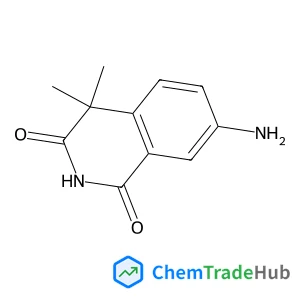
1,3(2H,4H)-Isoquinolinedione, 7-amino-4,4-dimethyl-
CAS Number:
14576-22-8
Molecular Formula:
C11H12N2O2
Recommended Suppliers





Disclaimer
This page provides academic journal information for reference and research purposes only. We are not affiliated with any journal publishers and do not handle publication submissions. For publication-related inquiries, please contact the respective journal publishers directly.
If you notice any inaccuracies in the information displayed, please contact us at support@chemtradehub.com. We will promptly review and address your concerns.