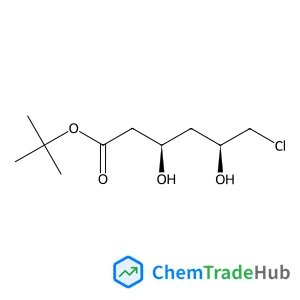
2-Methyl-2-propanyl (3R,5S)-6-chloro-3,5-dihydroxyhexanoate
CAS Number:
154026-93-4
Molecular Formula:
C10H19ClO4
Karla G. Martínez Figueredo, Emanuel M. Virgilio, Darío J. Segobia, Nicolás M. Bertero
The production of pentyl valerate (PV) from γ-valerolactone (GVL) in the liquid phase in the presence of pentanol and H2 over Rh and Pd-based catalysts, using SiO2–Al2O3 (SA) as a support, was studied in this work. Both catalysts had metal loadings lower than 1 wt% and were prepared by incipient wetness impregnation using chlorinated metal precursors. The M0/SA catalysts exhibited a specific surface area and pore volume slightly lower than those of the SA support and the presence of metal nanoparticles with an average size of 5.6 nm for Rh/SA and 3.7 nm for Pd/SA. A total acid site density 10% lower than that of SA was determined for Rh/SA, whereas a value 45% higher was observed for Pd/SA. The relative strength of acid sites followed the pattern: Pd/SA > Rh/SA > SA with mainly Lewis acid sites in all the cases. Pd/SA showed a higher activity, selectivity to PV and carbon balance than Rh/SA. These results indicate that both a relatively high acid site density and smaller metal particles promote the conversion of adsorbed intermediates, reaching a GVL conversion of 81.1% and a PV yield of 70.1% over Pd/SA after 8 h. Therefore, PV productivity values 25% and 120% higher than the best reported value were reached over Rh/SA and Pd/SA, respectively, showing the potential of these catalysts to convert GVL into biofuels for transportation purposes. Finally, with Pd/SA, the apparent activation energy was equal to 25.6 kcal mol−1, the reaction order for H2 was about zero and a unitary reaction order for GVL was determined.
Bojana Katana, Dóra Takács, Felix D. Bobbink, Paul J. Dyson, Nizar B. Alsharif, Matija Tomšič, Istvan Szilagyi
DOI: 10.1039/D0CP02805C
Angélique Marie, Bilel Said, Anne Galarneau, Timo Stettner, Andrea Balducci, Maxime Bayle, Bernard Humbert, Jean Le Bideau
DOI: 10.1039/D0CP03599H
Liu-Cheng Chen, Hui Yang, Ming-An Fu, Jia Cheng, Xiao-Lin Wu, Yun Gao, Zhong-Bing Huang, Xiao-Jia Chen
DOI: 10.1039/C9CP04227J
V. H. Shafeeq, G. Unnikrishnan
DOI: 10.1039/D0CP04275G
Julian M. Schmidt-Engler, Larissa Blankenburg, Rene Zangl, Jan Hoffmann, Nina Morgner, Jens Bredenbeck
DOI: 10.1039/D0CP04307A
QHwan Kim, Joon-Hyuk Ko, Sunghoon Kim, Wonho Jhe
DOI: 10.1039/D0CP03456H
Karol Rytel, Kamil Kędzierski, Bolesław Barszcz, Małgorzata Widelicka, Alicja Stachowiak, Andrzej Biadasz, Łukasz Majchrzycki, Emerson Coy, Danuta Wróbel
DOI: 10.1039/D0CP90227F
A. A. Kurilovich, V. N. Mantsevich, K. J. Stevenson, V. V. Palyulin
DOI: 10.1039/D0CP03744C
Denilson Mendes de Oliveira, Samual R. Zukowski, Vladimir Palivec, Hector Martinez-Seara, Dor Ben-Amotz, Pavel Jungwirth
DOI: 10.1039/D0CP02987D
Sushil Sharma, Zimu Wei, Ferdinand C. Grozema, Sanchita Sengupta
DOI: 10.1039/D0CP04579A
Waste containing 2-Ethyl-4-Methyl-1H-Imidazole-5-Carbaldehyde (CAS: 88634-80-4) ...
Triethoxy(octyl)silane (CAS: 1385031-14-0) is widely used in the pharmaceuticals...
Several alternatives to 3-iodo-7-nitro-1H-indazole (CAS: 864724-64-1) exist in t...
Yes, there are alternatives to Benzene, bis[(trimethoxysilyl)ethyl] (CAS: 266317...
Isothiazole-3-carbonitrile (CAS: 1452-17-1) is generally considered safe when us...
(3-Chlorophenyl)methanol (CAS: 873-63-2) is considered low to moderately toxic. ...
(2S,3S)-2-Hydroxy-3-({[(2-methyl-2-propanyl)oxy]carbonyl}amino)-3-(2-naphthyl)pr...
Proper handling of methyl 2-(bromomethyl)-5-methoxybenzoate requires the use of ...
6,8-Dibromoimidazo[1,2-a]pyridine-2-carboxylic acid (CAS: 904805-36-3) is an aro...
3-Amino-5-bromo-2-pyridinecarbonitrile is considered safe when handled under pro...

Reaction Chemistry & Engineering is an interdisciplinary journal reporting cutting-edge research focused on enhancing the understanding and efficiency of reactions. Reaction engineering leverages the interface where fundamental molecular chemistry meets chemical engineering and technology. Challenges in chemistry can be overcome by the application of new technologies, while engineers may find improved solutions for process development from the latest developments in reaction chemistry. Reaction Chemistry & Engineering is a unique forum for researchers whose interests span the broad areas of chemical engineering and chemical sciences to come together in solving problems of importance to wider society. All papers should be written to be approachable by readers across the engineering and chemical sciences. Papers that consider multiple scales, from the laboratory up to and including plant scale, are particularly encouraged.
![Ethyl 3-((6-(4,5-dihydro-1H-benzo[d]azepin-3(2H)-yl)-2-(pyridin-2-yl)pyrimidin-4-yl)amino)propanoate structure](https://static.chemtradehub.com/structs/137/1373423-53-0-496a.webp "Ethyl 3-((6-(4,5-dihydro-1H-benzo[d]azepin-3(2H)-yl)-2-(pyridin-2-yl)pyrimidin-4-yl)amino)propanoate structure")
![N,N'-1,2-Ethanediylbis[2-(vinylsulfonyl)acetamide] structure](https://static.chemtradehub.com/structs/667/66710-66-5-b556.webp "N,N'-1,2-Ethanediylbis[2-(vinylsulfonyl)acetamide] structure")