












Binding of divalent cations to acetate: molecular simulations guided by Raman spectroscopy
Literature Information
Publication Date
2020-10-10
DOI
10.1039/D0CP02987D
Impact Factor
3.676
Authors
Denilson Mendes de Oliveira, Samual R. Zukowski, Vladimir Palivec, Hector Martinez-Seara, Dor Ben-Amotz, Pavel Jungwirth
View Original
Abstract
In spite of the biological importance of the binding of Zn2+, Ca2+, and Mg2+ to the carboxylate group, cation–acetate binding affinities and binding modes remain actively debated. Here, we report the first use of Raman multivariate curve resolution (Raman-MCR) vibrational spectroscopy to obtain self-consistent free and bound metal acetate spectra and one-to-one binding constants, without the need to invoke any a priori assumptions regarding the shapes of the corresponding vibrational bands. The experimental results, combined with classical molecular dynamics simulations with a force field effectively accounting for electronic polarization via charge scaling and ab initio simulations, indicate that the measured binding constants pertain to direct (as opposed to water separated) ion pairing. The resulting binding constants do not scale with cation size, as the binding constant to Zn2+ is significantly larger than that to either Mg2+ or Ca2+, although Zn2+ and Mg2+ have similar radii that are about 25% smaller than Ca2+. Remaining uncertainties in the metal acetate binding free energies are linked to fundamental ambiguities associated with identifying the range of structures pertaining to non-covalently bound species.
Recommended Journals
Related Literature
Highly porous PProDOT-Et2 film as counter electrode for plastic dye-sensitized solar cells
Kun-Mu Lee, Chih-Yu Hsu, Po-Yen Chen, Masashi Ikegami, Tsutomu Miyasaka, Kuo-Chuan Ho
2009-02-23
Communication
DOI: 10.1039/B823011K
Surface-enhanced IR–visible sum frequency generation vibrational spectroscopy
Qifeng Li, Chiung Wen Kuo, Zheng Yang, Peilin Chen, Keng C. Chou
2009-02-25
Paper
DOI: 10.1039/B821045D
Why Turing mechanism is an obstacle to stationary periodic patterns in bounded reaction-diffusion media with advection
Arik Yochelis, Moshe Sheintuch
2010-03-17
Communication
DOI: 10.1039/B921918H
A theoretical study on the hydrolysis process of two Keppler-type antitumor complexes [TzH][trans-RuCl4(Tz)2] and [2-NH2TzH][trans-RuCl4(2-NH2Tz)2]
Lan-Mei Chen, Si-Yan Liao, Kang-Cheng Zheng, Liang-Nian Ji
2009-02-19
Paper
DOI: 10.1039/B818023G
Astroelectrochemistry: the role of redox reactions in cosmic dust chemistry
Daren J. Caruana, Katherine B. Holt
2010-02-09
Perspective
DOI: 10.1039/B917817A
Growth of solid conical structures during multistage drying of sessile poly(ethylene oxide) droplets‡
David Willmer, Kyle Anthony Baldwin, David John Fairhurst
2010-03-03
Paper
DOI: 10.1039/B922727J
DFT-MD and vibrational anharmonicities of a phosphorylated amino acid. Success and failure
Alvaro Cimas
2010-02-24
Paper
DOI: 10.1039/B924025J
Minimum electrophilicity principle: an analysis based upon the variation of both chemical potential and absolute hardness
Christophe Morell, Vanessa Labet, André Grand, Henry Chermette
2009-02-26
Paper
DOI: 10.1039/B818534D
You might also like
Compound Q&A
How should waste containing 2-Ethyl-4-Methyl-1H-Imidazole-5-Carbaldehyde (CAS: 88634-80-4) be handled?
Waste containing 2-Ethyl-4-Methyl-1H-Imidazole-5-Carbaldehyde (CAS: 88634-80-4) ...
88634-80-42-Ethyl-4-Methyl-1H-...
Compound Q&A
What industries use Triethoxy(octyl)silane (CAS: 1385031-14-0)?
Triethoxy(octyl)silane (CAS: 1385031-14-0) is widely used in the pharmaceuticals...
1385031-14-0Triethoxy(octyl)sila...
Compound Q&A
Are there alternatives to 3-iodo-7-nitro-1H-indazole (CAS: 864724-64-1) in synthesis?
Several alternatives to 3-iodo-7-nitro-1H-indazole (CAS: 864724-64-1) exist in t...
864724-64-13-iodo-7-nitro-1H-in...
Compound Q&A
Are there alternatives to Benzene, bis[(trimethoxysilyl)ethyl] (CAS: 266317-71-9) in synthesis?
Yes, there are alternatives to Benzene, bis[(trimethoxysilyl)ethyl] (CAS: 266317...
266317-71-9Benzene, bis[(trimet...
Compound Q&A
Is Isothiazole-3-carbonitrile (CAS: 1452-17-1) safe?
Isothiazole-3-carbonitrile (CAS: 1452-17-1) is generally considered safe when us...
1452-17-1Isothiazole-3-carbon...
Compound Q&A
Is (3-Chlorophenyl)methanol (CAS: 873-63-2) safe?
(3-Chlorophenyl)methanol (CAS: 873-63-2) is considered low to moderately toxic. ...
873-63-2(3-Chlorophenyl)meth...
Compound Q&A
How is (2S,3S)-2-Hydroxy-3-({[(2-methyl-2-propanyl)oxy]carbonyl}amino)-3-(2-naphthyl)propanoic acid (CAS: 959583-98-3) typically synthesized?
(2S,3S)-2-Hydroxy-3-({[(2-methyl-2-propanyl)oxy]carbonyl}amino)-3-(2-naphthyl)pr...
959583-98-3(2S,3S)-2-Hydroxy-3-...
Compound Q&A
What precautions should be taken when handling Methyl 2-(bromomethyl)-5-methoxybenzoate (CAS: 788081-99-2)?
Proper handling of methyl 2-(bromomethyl)-5-methoxybenzoate requires the use of ...
788081-99-2Methyl 2-(bromomethy...
Compound Q&A
What is 6,8-Dibromoimidazo[1,2-a]pyridine-2-carboxylic acid (CAS: 904805-36-3)?
6,8-Dibromoimidazo[1,2-a]pyridine-2-carboxylic acid (CAS: 904805-36-3) is an aro...
904805-36-36,8-Dibromoimidazo[1...
Compound Q&A
Is 3-Amino-5-bromo-2-pyridinecarbonitrile (CAS: 573675-27-1) safe?
3-Amino-5-bromo-2-pyridinecarbonitrile is considered safe when handled under pro...
573675-27-13-Amino-5-bromo-2-py...
Source Journal
Physical Chemistry Chemical Physics

CiteScore:
5.5
Self-citation Rate:
10.3%
Articles per Year:
3036
Physical Chemistry Chemical Physics (PCCP) is an international journal co-owned by 19 physical chemistry and physics societies from around the world. This journal publishes original, cutting-edge research in physical chemistry, chemical physics and biophysical chemistry. To be suitable for publication in PCCP, articles must include significant innovation and/or insight into physical chemistry; this is the most important criterion that reviewers and Editors will judge against when evaluating submissions. The journal has a broad scope and welcomes contributions spanning experiment, theory, computation and data science. Topical coverage includes spectroscopy, dynamics, kinetics, statistical mechanics, thermodynamics, electrochemistry, catalysis, surface science, quantum mechanics, quantum computing and machine learning. Interdisciplinary research areas such as polymers and soft matter, materials, nanoscience, energy, surfaces/interfaces, and biophysical chemistry are welcomed if they demonstrate significant innovation and/or insight into physical chemistry. Joined experimental/theoretical studies are particularly appreciated when complementary and based on up-to-date approaches.
Recommended Compounds
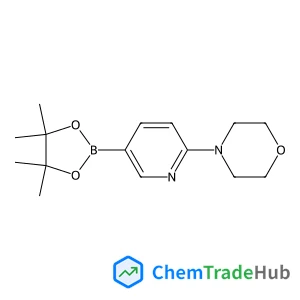
4-(5-(4,4,5,5-tetramethyl-1,3,2-dioxaborolan-2-yl)pyridin-2-yl)morpholine
CAS Number:
485799-04-0
Molecular Formula:
C15H23BN2O3
Recommended Suppliers




Disclaimer
This page provides academic journal information for reference and research purposes only. We are not affiliated with any journal publishers and do not handle publication submissions. For publication-related inquiries, please contact the respective journal publishers directly.
If you notice any inaccuracies in the information displayed, please contact us at support@chemtradehub.com. We will promptly review and address your concerns.